
Stolen trust

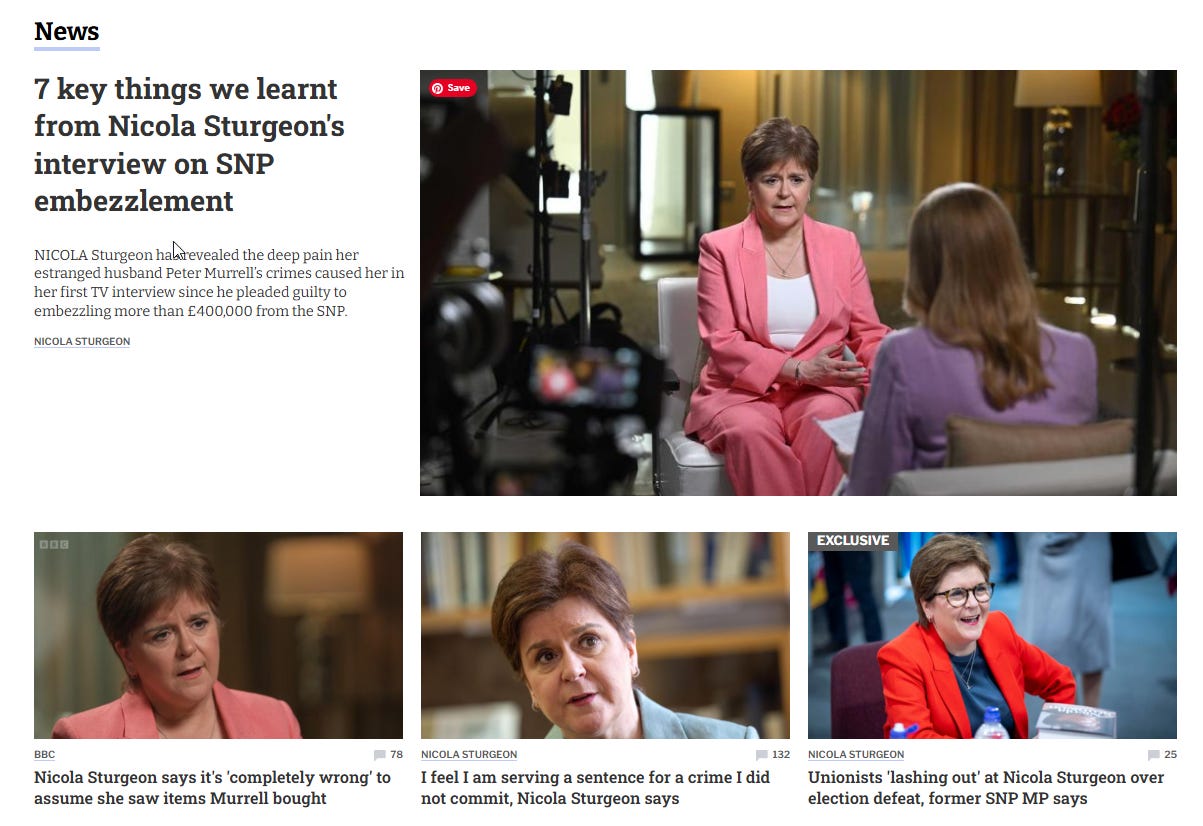
I awoke this morning feeling a bit unwell. Nothing serious, I’m sure. Just a bit of nausea induced by spending rather too much of my Sunday exposed to the waves of pious self-pity emanating from Nicola Sturgeon and the soapy special pleading of the sycophantic apologists who remain inexplicably spellbound by this seriously flawed individual.
Monday looks like being no less blighted by her omnipresence. The National is wall-to-wall Sturgeon, and I expect the rest of the media are much the same as they seek to get as much mileage as possible out of her appearance on the BBC’s Laura Kuenssberg programme. I did not watch it. I have reached the stage where I can’t abide the sound of her voice. And Sturgeon is even worse!
Despite not having watched the performance, I ended the day yesterday feeling as if it had been playing on a loop in my head the entire time. It’s tempting to say I don’t understand why people continue to be so besotted with Nicola Sturgeon, but in fact I understand it quite well, having once been an admirer. I was never in any danger of being embroiled with the personality cult that surrounds Sturgeon. But I know what draws people to her, having fallen partially under her sway back when she was Alex Salmond’s sidekick.
I use the word ‘performance’ advisedly. Because that’s precisely what it is. Sturgeon is widely acknowledged to be a superb communicator. We were left in no doubt of this during the pandemic when, better than any other politician I’m aware of, Sturgeon took the public with her as she introduced what were of necessity some quite Draconian restrictions. Sturgeon’s daily media appearances were a masterclass in techniques of persuasion. She got people to trust her. I hesitate to say she won that trust because with hindsight it now feels more as if she stole it.
Sturgeon’s daily media appearances were a masterclass in techniques of persuasion. She got people to trust her. I hesitate to say she won that trust because with hindsight it now feels more as if she stole it.
There is a fine line between being a very skilled communicator and being an equally proficient manipulator. I don’t recall a moment when my opinion of Sturgeon changed. It certainly wasn’t an overnight thing. I was aware of various missteps on her part, such as campaigning to overturn the EU Leave vote in 2016 rather than leverage the discrepancy between what we voted for and what we got to progress Scotland’s cause. I was inclined to forgive these errors on the grounds that they were outweighed by the potential she had to use her skills to our advantage in other ways. So, I have some understanding of what motivates her apologists now. I’m just baffled that they continue to give her the benefit of a doubt that no longer exists.
At some point it began to dawn on me that Sturgeon was driven more by personal ambition than by aspirations for Scotland. The scales fell from my eyes. It’s a story that will, I’m sure, be familiar to many of those who read this.
The danger when one begins to revise one’s opinion of someone who has disappointed us is that your take on that person can tip too far into the negative. A kind of overcompensation can very easily occur. I witnessed many instances of this over the years as former admirers of Nicola Sturgeon began to exhibit a virulent hatred of her. It’s just one more example of the polarisation that is rife throughout our politics. I know I didn’t fall prey to this tendency. I also know how easily I might have. I have some understanding of the ‘haters’, just as I have of the people who continue to be infatuated with her.
Hatred isn’t necessarily wrong. There are many things in this world that deserve to be hated. But hate isn’t a complete explanation in itself. One of the things I encountered in my sojourn among the denizens of The Sunday National’s comments section was people dismissing criticism of Sturgeon by labelling it ‘hate’. But hate doesn’t materialise in a vacuum. It is occasioned by something. It doesn’t matter whether you think the something to be real or a sufficient cause for hate; there must be something. If you are throwing the hate-word at someone, you must have in mind what might motivate such a powerful emotion. If you don’t, then the term becomes meaningless. A vacuous jibe.
I tried asking some of those who were tossing the word ‘hate’ around what they supposed might have prompted the feeling. None were able or willing to say. Which suggests they were merely using the word in an effort to shut down criticism of Sturgeon.
I can think of numerous fact-based reasons for hating Nicola Sturgeon if that is your inclination. The treatment of Alex Salmond, to cite just one example. I don’t personally feel this way. But I can say what might form a basis for such hatred. None of those I asked were able to suggest anything. They were just using the word to imply that those criticising Sturgeon are being irrational.
Why does any of this matter? It matters, I think, because the adoration of Sturgeon is part of a general malaise in the independence movement. It has become all but impossible to discuss where things have gone wrong and how they might be rectified. Every attempt to have such a discussion quickly descends into a sniping war between the SNP loyalists and the SNP haters.
It matters because I see no possibility of this situation changing. Somebody responded to a comment I posted on Bluesky remarking on Sturgeon’s portrayal of herself as the victim in the Murrell affair, saying that lessons had been learnt and we should just move on. But there is no indication whatever that any lessons have been learnt. It is difficult to move on because there is so much unfinished business. So many unanswered questions. So much unacknowledged culpability.
I wish I could say I felt better for writing this. I don’t. When I say that Sturgeon has been the ruination of the SNP and the bane of the independence movement, I am not doing so from hatred. I am simply acknowledging what I regard as a fact. I regard it as a fact for reasons that I can easily explain by citing other facts.
There is no end in sight because it is not only a few party loyalists on social media who are in blank denial of these facts. The denial goes all the way to the top of the party. Nobody is fixing the things that are wrong because the imperative is not to get these things fixed but to paint over them. Pretty soon, paint is all there is. Everything beneath has rotted away.
Very perceptive and the closest yet to understanding the real sturgeon.
I didn't listen to the BBC interview of Sturgeon either, mainly because I find her head-butting dogmatic style so grating.
The moment I lost trust was at the end of the criminal trial of Alex Salmond when, on the announcement that the latter had been acquitted of all 14 charges, Nicola Sturgeon still managed to cast doubt on the jury's decision by saying that their conclusions didn't mean that the behaviour he was of accused of hadn't happened (or words to that effect).
From there, after some background research and digging, the evidence of her duplicity on numerous matters mounted up.
Her time as SNP leader and FM was all self-obsession, self-righteousness, self-identification and selfies when it should have been focussed on self-determination. On the contrary Nicola Sturgeon and her backers blocked any advance on Scotland's Cause each and every time glaring opportunities presented themselves between 2014 and 2023. (We all know what they were so no need to list them.)
As to the loyalists, they behave like a cult. The moment true believers in a single faith allow the light of reality to shine into their lives is the moment their whole world view falls apart. The have bound themselves so tightly to the Sturgeon bandwagon that they have become etched into the gubbins of the vehicle itself. If the chose try to extricate themselves from it now they would probably leave behind a limb or two. A new philosophy would then be required ... and that is hard for those that have difficulty thinking for themselves.
It would seem there is a lot more to come on the SNP missing money (embezzlement and other fraud) and in other legal matters coming down the pipe.
We can only hope that eventually that the dangers of developing a cult of personality where scrutiny is denied and questions closed down are finally recognised and their associated harsh lessons are learned.