
Powers and power

There is no such thing as writer’s block. So long as you can write that first sentence, the rest will come. It doesn’t even matter what you write in that first sentence. Pretty much anything will do. It doesn’t have to be about anything. It’s just a string of words that gets you tapping those keys again.
This article is not about writer’s block. Nor is it about tips and tricks for overcoming blank page syndrome. It’s about politics. Which means it’s about power. I could link the stuff about writer’s block to the stuff about political power with something about the power of the blank page and the writer’s power to overcome its stranglehold on creativity; but that would be a bit cheesy.
I didn’t listen to Andy Burnham’s speech outlining how he intends to use the power that comes with being prime minister. Of course, he’s not prime minister yet. It would be highly entertaining if somebody else pipped him at the post. Hang on to that entertaining thought. It’s all you’re likely to get out of Burnham’s premiership.
As I’ve said before, I prefer to read transcripts of speeches rather than listen to the speeches themselves. That way, I get the content without the theatrics and body language. It’s the hard content that matters, not the apparent sincerity and emotion with which that content is spoken.
It is useful also to read others’ take on what is supposedly something akin to Burnham’s programme for government. The National has done that thing where they ask columnists to comment on some matter. The headline tells you what to expect. The National columnists react to Andy Burnham’s pitch to the UK.
Lesley Riddoch writes:
Burnham has correctly identified a massive problem with Britain – the remote, top-down nature of power.
She has identified a theme running through the responses of all the columnists involved. All of them talk about power. Excessive power. Unaccountable power. Centralised power. Particularly the last. Whether the centralisation is in London or Edinburgh, the theme is the same. It’s all about power. The power to effect change. The necessary corollary being powerlessness. The powerlessness of ‘ordinary’ people. The powerlessness of communities. The powerlessness of devolved parliaments in the annexed territories of Scotland, Wales, and Northern Ireland.
Assa Samake Roman writes:
But the more important point is that he seemed willing to say that Britain’s crisis is about power: Who controls the essentials, who profits from them, and why ordinary people keep paying the price.
The three pillars of the British state are unaccountable power, unearned privilege and unscrupulous patronage. The above quote put me in mind of Tony Benn’s questions about effective political power.
Where does power reside?
How is power acquired?
How is power legitimised?
What effect does power have?
Whose interests are served by power?
To whom is power accountable?
By what means may power be relocated?
Self-determination is the process by which the people choose how to answer this paraphrasing of Tony Benn’s questions about effective political power. Who among us thinks they are addressing these questions when they participate in a democratic event such as an election or referendum? Hands up, everybody who imagines they are relocating power when they vote? Who supposes they are deciding whose interests will be served?
Andy Burnham is very keen on devolution. He wants more power put in the hands of communities or regions. That necessarily means taking power from somewhere else. Who among us thinks they will have any opportunity to influence what powers are removed, from where they are removed, where they are moved to, or how the power in question is altered in this process?
Over the years, as I’ve listened to people calling for more devolution within Scotland, I have voiced the concern that the British state will intervene – as it has already done with direct funding to councils – in a way that has less to do with improving democracy and more to do with undermining Holyrood. Andy Burham evidently hasn’t given much thought to the annexed territories on England’s periphery, and such thought as he has given appears to regard Scotland as being on a par with England’s regions and cities. That Burnham should think of Scotland in this way should not be surprising given that he was brought up in an England where casual contempt for the non-England parts of the UK has been normalised.
Andy Burham evidently hasn’t given much thought to the annexed territories on England’s periphery, and such thought as he has given appears to regard Scotland as being on a par with England’s regions and cities.
It may well be that Burnham himself is not minded to use a process of extending devolution to undermine Holyrood, but he will be surrounded by people who are. The vagueness with which Burnham speaks of Scotland suggests that his plans for us are nowhere near being fully formed. He is ripe for being pushed in a certain direction by the advisors and civil servants who form the bubble that will envelope him should he become prime minister.
It is not Burnham as prime minister that worries me, or his entourage. My worry is that John Swinney is not the man to defend the Scottish Parliament or our internal affairs. I just can’t envisage Swinney standing up to Burnham any more than he has stood up to Starmer.
I was a little surprised at being impressed by a couple of things Kelly Given had to say.
You would be forgiven for mistaking Burnham’s speech for being a devoted love letter to English devolution rather than an inspiring vision for the rest of us. While his rallying cry to decentralise power may well appeal to voters in Manchester, for those of us in Scotland – it's the answer to a question we're just not asking.
Fair point! Further devolution is hardly the talk of the steamie. If devolution is discussed here in Scotland, it is more likely to be about the powers of the Scottish Parliament, particularly with regard to a new independence referendum. You would be forgiven for thinking Burnham wasn’t even talking to us here in Scotland. I’m unsure whether this is just the standard disregard of an English politician or whether perhaps Andy Burnham is aware that Scotland has a distinct political culture that can’t be addressed in the same terms as England.
Here’s Kelly Given again:
This isn’t renewal, it’s Keir Starmer with better media training and more gall. There is time yet, but from what we have seen so far this is simply more of the same from a Union incapable of serving Scotland’s interests – and it becomes more difficult by the day for them to deny.
She definitely recognises that politics in Scotland is different. But she is very sadly mistaken if Ms Given thinks the British state has any difficulty at all in denying that Scotland is disadvantaged by the Union. The British ruling elites have no interest in denying it anyway. They know that the core purpose of the Union is to ensure that England-as-Britain has an overwhelming and permanent advantage over Scotland.
Ellie Gomersall is equally dismissive of Burnham’s proposed ‘reforms’:
His speech also failed to address the other two issues which have disgusted many of even the staunchest of Labour voters – their demonisation of immigrants, and their complicity in Israel’s genocide in Palestine. All signs show Burnham intends to stick to the disastrous approach taken by Starmer on both these issues and his failure to address them today leaves me with very little optimism that meaningful change is on its way.
Behind this comment lies the abiding truth that regardless of how we shuffle our votes around among political parties, some things are fixed and unchanging. As voters, we have no power to change these things. There are a lot of them. And more than a few are things we would change if our distinctive political culture weren’t suppressed by the Union.
William Thomson, Resilient Economy (formerly Scotonomics) says:
By sticking to the current fiscal rules that limit day-to-day government spending, curtail investment, and can only lead to fiscal austerity, Burnham has hamstrung his government.
There it is again! The likes of Burnham can promise more and better devolution. But the power that is devolved is never taken from the top. It is never the most powerful forces in society that find their power diminished when politicians play the devolution shuffle. For example, he may devolve powers over housing. But control of budgets and procurement regulations doesn’t go with the ‘power’ to create more social housing. Local authorities may be made free to build more social housing. But they can only do so within the context of the centralised powers over those two weighty things, budgets and procurement.
A final quote from Jonathon Shafi:
That’s before we get to attacks on civil liberties, the toxicity around immigration, and ongoing constitutional questions, including Scottish independence and relations with Europe. Or indeed, with the Trump administration. Perspectives on all of these matters must be set out. That’s the difference between being a mayor and being prime minister.
I wonder if Andy Burnham has yet realised that there is a big difference between being a mayor and being (presumptive) prime minister. He’s going to have to make some adjustments.
The common thread that I detect running through all these comments is that we cannot expect much from a change of prime minister. Even one as apparently keen on devolving powers as Andy Burnham. And there you have the nub of the issue. Devolving powers is not the same as devolving power. Devolving powers is just tinkering around the edges. Real power remains at the centre.
This is starkly illustrated by the Section 30 process to which the SNP is steadfastly wedded. The Section 30 process, if followed, devolves powers to hold a referendum on independence. But the real power remains with the British state. The British state decides whether, when, and how powers are devolved. The British state retains the power to veto the outcome of a Section 30 referendum. It retains the power to decide what effect the outcome has, if any.
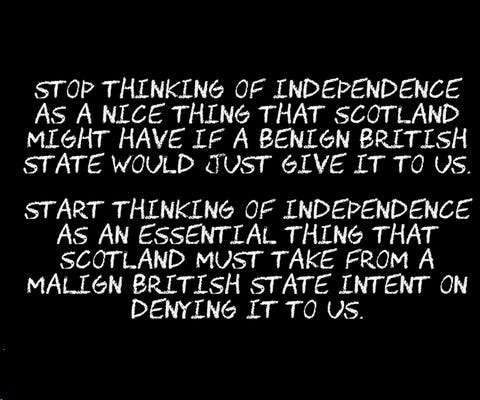
John Swinney thinks in terms of powers. As a Scottish nationalist, I think in terms of power. Real power. Power that will not and cannot be given. Power that can only be taken.
We already have the right of self-determination. We need only take the power to exercise that right.
Brilliantly lucid Peter. POWER not powers. You nailed it.
'You can have pocket money and spend it where you like( almost) but I hold the purse and have the POWER to decide how much you can have...and I might take it away if you don't behave. ' All lies..inuendo..obfuscation...trickery... pish...the hand quicker than the eye.. machinations.......hoax....deceit...swindling...fraudulent...double crossing....all given by a man of straw...or to use his correct title..the NOT PM...spouting... in Scottish parlance.. a dod o' keech ...while the other actual PM..but not for long... saying today we 'should learn to stand on our own two feet'....so he is ordering some drones...but... but ....whit aboot the rusting leaking radioactive nuclear subs in Faslane.....?
Ye couldna mak' it up...a pantomime.... look behind ye Andy..the ugly sisters in this 'pantomime of equals' are not fooled.
We really have to get out of this asylum. I saw a Scottish commentator say that the UK government should just GRANT us a referendum...grant?..grant?.. when did we sign up to the foreign english granting us anything...? A union of equals?.....more chicanery...
I was impressed by the t- shirt .. trendy jacket...surrounded by women ( not sure about that ) ...and he even mentioned Dundee! Wow! This guy has got it sussed...where is Dundee Andy?...Off to light a candle for him..he's gonny need it....an' I ken where I'd stick it..
A very interesting comment by you Peter.
For OUR Scotland and her amused weans.