
Not a rocket


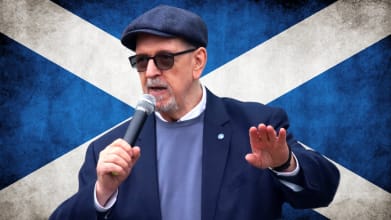
I confess I’m struggling to discern what point Gordon MacIntyre-Kemp is trying to make in his latest column for The National. Much of it is standard independence industry boilerplate about the ‘vision’ thing. It’s the old independence industry orthodoxy that independence ensues from creating the perfect glossy brochure selling independence as a holiday destination and getting that glossy brochure shoved in the faces of enough ‘soft nos’ to make a difference. Gordon clings to his belief in the ‘vision’ thing despite the fact that it has been the independence industry’s preferred strategy since the earliest days of the Yes campaign for the 2014 sham independence referendum and, in all that time, it hasn’t lifted support for independence much above 50%, as Gordon himself acknowledges.
Independence support sits at just over 50%, but we need to understand the question asked in those polls. All the polls are based on an agreed referendum, with recognised processes, an accepted result and willing post-Yes vote negotiations between the Scottish and UK governments.
What he doesn’t acknowledge is that selling independence like a holiday destination hasn’t lifted support for independence at all in the past eleven years. But then, he wouldn’t, would he? After all, the ‘vision’ thing is all he has. That and creating yet another ineffectual talking shop tasked with helping to design the ultimate glossy brochure ‘vision’ of independent Scotland in the hope that this strategy will stop failing
You all know what’s coming next. This is where I draw attention to the fact that Gordon has nothing whatever to say about the travel arrangements. He tells us nothing about how we get to the wonderful place described in the glossy brochure. Some of us regard this as a fatal omission.
This is where I draw attention to the fact that Gordon has nothing whatever to say about the travel arrangements.
Of course, Gordon will doubtless say the ‘vision’ strategy hasn’t had any effect in eleven or twelve years because we’ve not yet perfected the glossy brochure. And some of his supporters, imagining they’re helping, will say there hasn’t been any actual campaigning.
To which my response would be to wonder just how long it’s going to take to perfect the glossy brochure. And to suggest to those supporters of his that they try telling Gordon MacIntyre-Kemp there’s been no campaigning. After all, he’s never done telling us about all the work that’s being done by Believe in Scotland.
Nowadays, the ‘vision’ thing is augmented with the notion of a Celtic alliance.
A co-ordinated demand from the Celtic nations for clear democratic routes places enormous pressure on the claim that the UK is a voluntary union of equals and is not about asking permission.
It’s not about asking permission. It’s about asking the British state to provide “clear democratic routes“ that come with permission attached. Gordon still hasn’t figured out that putting Westminster at the centre of the constitutional issue is a serious mistake and a very large part of the reason the independence industry is unable to explain the ‘how’ of restoring independence. It’s because there is no way to restore independence with Westminster at the centre.
Gordon still hasn’t figured out that putting Westminster at the centre of the constitutional issue is a serious mistake and a very large part of the reason the independence industry is unable to explain the ‘how’ of restoring independence.
Where is the evidence of this “enormous pressure” that is supposedly being brought to bear on the UK government? Granted, the UK government looks flustered and panicky and muddled. But that’s how it always looks. I’ve seen no increase in the levels of fluster, panic, and muddle since the election and the cobbling together of a Celtic Alliance.
For Gordon MacIntyre-Kemp, read John Swinney. For Believe in Scotland, read Scottish National Party. For all the former claims independence from the latter, there is no difference between them in terms of strategy. Both are wedded to the failed ‘vision’ thing and the Section 30 process. Neither has had a new thought since 2013.
The other matter Gordon MacIntyre-Kemp deals with is the idea of a de facto referendum which Angus MacNeil was touting in the pages of The National earlier in the week. My response to that article can be found here.
Some of the things Gordon says about a de facto referendum I can almost agree with.
The thing is, a de facto path could yet be the answer to our constitutional roadblock, but it absolutely should not be seen as the easy shortcut that some are suggesting.
A de facto referendum on independence sure as hell isn’t the “easy shortcut” Angus MacNeil supposes it to be. But neither is it ever going to be “the answer to our constitutional roadblock“. Just like John Swinney, Gordon MacIntyre-Kemp sees Westminster as the roadblock. Or portrays it as such. Westminster makes an easy scapegoat for the independence industry when asked to explain the dearth of progress on the constitutional issue. They blame Westminster and hope nobody notices the pusillanimous procrastination and the total lack of any new ideas.
The reality is that it’s the SNP that is obstructing Scotland’s cause. It is not Westminster that we’re looking to for independence. Westminster isn’t the one promising to restore our independence. It is to the SNP that we have given mandate after mandate. The ‘roadblock’ is the SNP’s refusal to honour those mandates. The rest of the independence industry goes along with the inaction because it’s good for business. The independence industry isn’t in the business of delivering. It is in the business of campaigning. So long as that campaigning is unsuccessful, the independence industry thrives.
It is to the SNP that we have given mandate after mandate. The ‘roadblock’ is the SNP’s refusal to honour those mandates.
I’ve read Gordon MacIntyre-Kemp’s column three times and bits of it a lot more than that. I’m still unclear whether he is for or against a de facto referendum or whether he thinks we could win it or not. Or maybe it’s a good idea at a certain time or under certain conditions. I’m not sure.
What I do know is that even with all his cogitating about a de facto referendum, Gordon can’t get past thinking of it as a referendum on independence. At one point, he makes much of the fact that a de facto referendum would be difficult to win. Which is true. But elsewhere he intimates that he supports the idea.
I previously supported using the last General Election as a de facto referendum, but that was well enough in advance for it to have been practicable – then the SNP became chaotic and it was no longer an option.
However, I would not rule out a de facto referendum though, and Believe in Scotland (BiS) has made it clear that, if Westminster refuses an agreed democratic route by 2028, then the 2029 UK General Election may have to become one.
That he even contemplates using a UK general election as a de facto referendum amply demonstrates how he puts Westminster at the centre of the constitution — no matter if he pays lip service to the principle of popular sovereignty. And, of course, the above quote shows how he – just like John Swinney – continues to believe the Section 30 process to be the ‘gold standard’.
It never occurs to Gordon that a de facto referendum might be about something other than independence but still offer a way of Scotland’s cause making real progress. Nor does it seem to occur to him that making the de facto referendum about something other than independence might make it easier to win by a more impressive margin, thus making a subsequent referendum on independence easier to win by a decisive margin.
Gordon’s thinking never escapes the same wee British box that confines John Swinney’s superficial thinking on the matter. Both are so concerned not to break any rules; they are effectively paralysed.
Gordon MacIntyre-Kemp isn’t talking about making progress. He’s talking about going round and round in the same circles we’ve been going around in for years. Just like Swinney and the SNP and The National, he is caught in Westminster’s gravity well and cannot reach escape velocity. I’m not saying he’s a rocket. Am I?
I shortened your statement Peter to....'SNP is the ROADBLOCK.'......full stop.
I looked up the word 'vision'.......a creation of the imagination or fancy...in a dream or trance.......unreal....given to day daydreaming...... ring a bell?
We have to get rid of the occupying foreign english nation deeply embedded in our country. I can see no other way except rise up in anger....... while we are being betrayed by quislings who earn their living by promoting independence as a career ..and that's as far as they go...mentally colonised....financially rewarded...
... ONLY SCOTS get tae vote for Scotland...it's OUR country...(yer dealing with a Patriot...no quarter given..300 years is a long time.)
Your article is first class but the deluded Scots are no reading it..let alone understanding what is being said...they're great at singing flower o' Scotland...picking up litter after getting kicked oot o' the world cup..everybody loves us...everybody but england....the occupying force.
One of our new politicians laughs.......'Anybody but england.'...So funny ...no it's not ..it's sad... now get aff yer erse MSPs and set in motion the fight to TAKE freedom for your poor country....your land owned and abused by foreigners.(nuclear dumps)....Cairngorms on fire?..nae helicopters..all sent to england and wales...and most important of all the future generations of young Scots tae come whom you are sentencing to live in a country that is occupied by your hostile foreign english neighbours...now ah'm sending YOU home tae think again.
For OUR Scotland and her colonised weans
"Both are so concerned not to break any rules; they are effectively paralysed"
Yes indeed, this is precisely the problem we face, Peter, and similarly Fanon referred to the stasis of the dominant national party elite 'co-opted by colonialism' as a form of 'petrifaction' or 'calcification'.
The national party elite's fear of the oppressor and 'lack of courage at the decisive moment' turns them into what Fanon regarded as the 'legal tendency' of the movement; 'legal' because they then make independence entirely dependent on the laws and ultimately the 'kind generosity' of the oppressor power; which never happens of course as under the oppressor's laws independence is made illegal and/or prevented by other means.
The 'illegal tendency' of the now ruptured movement realise the oppressor's trap and that an alternative path is necessary in line with international law and human rights conventions, including the right to self-determination.
Hence we now see the Liberation Scotland UN initiative which seeks to knock not on the door of number 10 and colonial law, but instead on the door of the United Nations and international law: https://liberation.scot/