
Not so simple

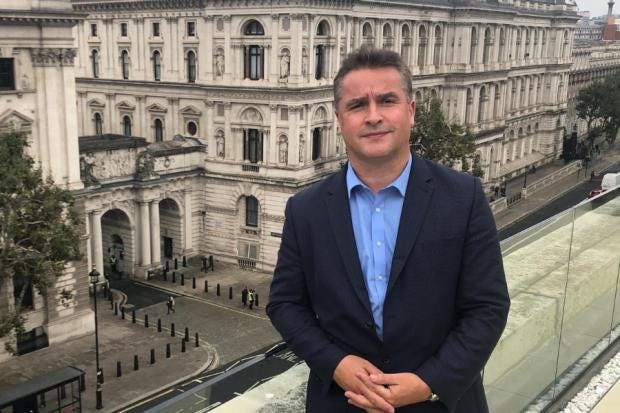
Someone should probably let The National know that Angus MacNeil ceased to be an MP more than two years ago. Maybe then they’ll adjust his byline.
He is still a professional politician, however, and like the vast majority of that ilk, he has one overriding ambition – winning elected office. I’m not one of those who thinks all of Scotland’s MPs and MSPs are only in it for the money. Frankly, the remuneration isn’t that great, considering the hours and the travel and the hassle and, in some cases, the responsibility. Nor am I naive enough to suppose all MPs and MSPs are motivated purely by a sense of civic duty or commitment to a cause. That may be a factor. But I strongly suspect that, whether they would admit to it or not, the strongest motivating factor is the status and the power that attend being an elected representative – or the proximity to power. That goes double for those who, like Angus, have already had a taste of it.
I don’t doubt Angus’s sincerity in the matter of Scotland’s cause. But when attending to what anyone seeking re-election says, we should be ever-mindful of the fact that there is a degree of self-interest involved. That self-interest inevitably influences the thinking of the individual concerned. Whatever else might inform their views on a ‘route to independence’, we can be sure that what they say on the subject will tend to be what will best serve their electoral ambitions. What they say will probably be what they think their target audience wants to hear. It will also tend to be what they reckon the lowest common denominator of that target audience is able to understand when it is explained to them at a length which doesn’t mount too great a challenge to their span of attention.
The idea of a de facto referendum on independence is pleasingly simple (Unionist [sic] will never help us gain independence – we have to stop asking). Especially if you go heavy on the pros and omit as many of the cons as you think safe. For example, it is, as Angus claims, possible for the Scottish Government to precipitate an extraordinary general election.
In November 2022, the Supreme Court concluded that the devolved Parliament at Holyrood could not organise a referendum on Scottish independence. Nevertheless, Section 3 of the same Scotland Act allows Holyrood to call an election at almost any time of its choosing.
Currently, this requires either the support of two-thirds of MSPs or a simple majority to amend Section 3 so that an election can also be called by simple majority. That additional power was devolved through the Scotland Act’s schedules in 2016.
The door is open for John Swinney to look into a camera and say he is calling an election for the noble cause of Scottish independence.
The door is, indeed, open for John Swinney to contrive an extraordinary Scottish general election. But how likely is it that he will go through that door? Angus uses his column in The National to explain the pointlessness of asking the British government to provide a map indicating a route by which Scotland can exit the UK.
Calls from the SNP’s hierarchy for Westminster to explain how Scotland can leave the 1707 Union can be turned back on the SNP leadership, exposing the hollowness and, frankly, the absurdity of that argument.
How much less absurd is it to ask John Swinney to go through that door? How much sense does it make to expect at least 65 MSPs to vote themselves out of a job? A job Angus covets. If Angus tells me he would be prepared to make this sacrifice, who am I to say he’s being disingenuous? But hypothetical sacrifices are a long way from the real thing. I seriously doubt that there are 65 actual MSPs who would be so noble as to lay down their careers, even for the very worthy cause of restoring their nation’s independence.
How much sense does it make to expect at least 65 MSPs to vote themselves out of a job?
Before embarking on the adventure of forcing an extraordinary election, John Swinney would have to be absolutely certain he had the 64 names in the bag – with between three and six additional names to allow for the ones who get cold feet. It is very difficult to see how Swinney could achieve the degree of certainty he’d require.
All of this supposes that John Swinney himself would be motivated to vote himself out of a job. I look at the man, and I look at the plan, and I simply cannot see the two coming together. The plan requires a person that John Swinney isn’t.
What good would it do, anyway? Let’s imagine that Angus’s plan gets off the ground and a date is set for a referendum. That date would, I think, have to be after we’re halfway through the current parliamentary term. Otherwise, it would set off the girning about ‘voter fatigue’. So, no sooner than July 2028. That’s potentially problematic right away. Elections tend to be held in spring or early summer. There are a number of reasons for this, weather being arguably the most important. In spring or early summer the odds favour clement weather and more daylight hours, which is ideal for campaigning. There is also the matter of avoiding clashes with the party conference season and the main holiday season.
There would also be the matter of avoiding a clash with the Westminster election, which could be called at any time between now and the end of June 2029. The considerations for scheduling the Holyrood election would apply also to the Westminster election, meaning it would be more likely to be called no later than April or May 2029. Which is also likely to be the favoured time for the Holyrood election. Although that could be held in spring 2028.
I mention all this because there are always calendaring issues to be taken into account. It’s not as if John Swinney could just call that extraordinary election any time he wanted. There are constraints. Taking those constraints into account, scheduling an extraordinary Scottish general election in the current parliamentary term may be difficult or even impossible. I wonder if Angus MacNeil has taken this into account. I haven’t seen any mention of potential calendaring problems by Angus or any of the people banging the de facto referendum drum. Which suggests they haven’t thought it through.
It’s not as if John Swinney could just call that extraordinary election any time he wanted.
Since we are playing the ‘just suppose’ game, let’s suppose all the problems mentioned so far have been overcome and the date of the extraordinary Scottish election is set in, let’s say, March 2028. How likely is it that the pro-independence side might win?
To answer this question, we can look at opinion polls and previous elections. Do these provide any assurance that the pro-independence side would triumph? Bear in mind that if we are talking about a referendum, then it is vote share that decides the matter and not seats. Is there any reason to believe the pro-independence side might get over 50% of the vote? Has there been any election in the past quarter of a century where the pro-independence side got over 50% of the vote? Have any opinion polls indicated that the pro-independence side would win a clear majority of votes?
Support for independence is only about 50% according to polls. That’s in an actual referendum and not an election pretending to be a referendum. A referendum is binary. An election is not. In a de facto referendum, policy matters would complicate the campaign, putting downward pressure on the pro-independence vote.
A referendum is binary. An election is not.
A lot would depend on how a binary element is introduced to the inherently non-binary election. All the pro-independence parties would have to make exactly the same manifesto commitment. Then the regional ballot could be used as a referendum on that manifesto commitment. This works in theory. But could we be confident of winning? I see no reason to be sure enough of a clear win to make it a risk worth taking. Bear in mind that this de facto referendum will only be recognised as a constitutional referendum if the pro-independence side loses.
Which brings me to my final question. Would a de facto referendum have any legal or constitutional effect? The answer to that has to be in the negative. There is nothing that can ensue from a de facto referendum. It would be a vote on something neither the Scottish Parliament nor Westminster can or will deliver. Holyrood doesn’t possess the legislative competence to end the Union, and Westminster is bound by the doctrine of parliamentary sovereignty. In any case, independence can’t be given. It has to be taken And it has to be taken by the Scottish Parliament because that is Scotland’s legislature.
My main reason for rejecting the idea of a de facto referendum is the fact that I am not persuaded it could be as decisive as it would need to be. The majority for independence must be great enough to leave Unionists no grounds for refusing to accept the outcome. My preference is for a proper constitutional referendum. A confirmatory vote on a detailed proposal for ending the Union and restoring Scotland’s independence contained in an Act of the Scottish Parliament passed subsequent to the Scottish Parliament asserting legislative competence in matters relating to the constitution.
The majority for independence must be great enough to leave Unionists no grounds for refusing to accept the outcome.
The reason no politician has advocated the #ScottishUDI strategy is in large part that this ‘route to independence’ is not as simple as the de facto referendum idea. Politicians tend to think — with some justification — that voters are not able to understand anything that cannot be expressed as a slogan or headline or a soundbite.
Although I can’t claim to know Angus MacNeil well, having met him only a couple of times and once spoken with him on the phone, I have no reason to consider him stupid. I’m certainly not intending to suggest that he is too stupid to comprehend the #ScottishUDI strategy or the new thinking that lies behind it. In fact, there was a time when I thought he might be the first Scottish politician to embrace the idea. Sadly, that now seems unlikely.
Independence has got to feel real and immediate to our people at the moment it does not.... It did in the pre referendum campaign. Procrastination puts the reality of independence further back in voters minds. There are many things the Scottish SNP government could do now. To make independence seem real and immediate. The issue of a Central Bank and currency could be brought forward as an actual bill to be enacted on independence. Similarly plans to nationalize the production of energy could be a bill.
Referendum, de factotherwise is not the way forward. A vote in the Scottish parliament is. If independence is about other States recognizing Scotland as a sovereign state then that is the way to go.
We are being boxed in to a referenfum ... Yet most States in a colonial situation have won the freedom not by referenda . But by aggregating power. Then bringing the colonial power into conflict with the people... That way would ensure s clear support backing independence.
I'm sure it's just a coincidence that all the 'plans' by the various parties and politicians supposedly of Independence - Section 30, Super-Majority, de-facto referendums - are put forward for endorsement in elections where parliamentary representation, and all the associated trappings, for successful candidates is the immediate upshot and reward.