

Counting the days

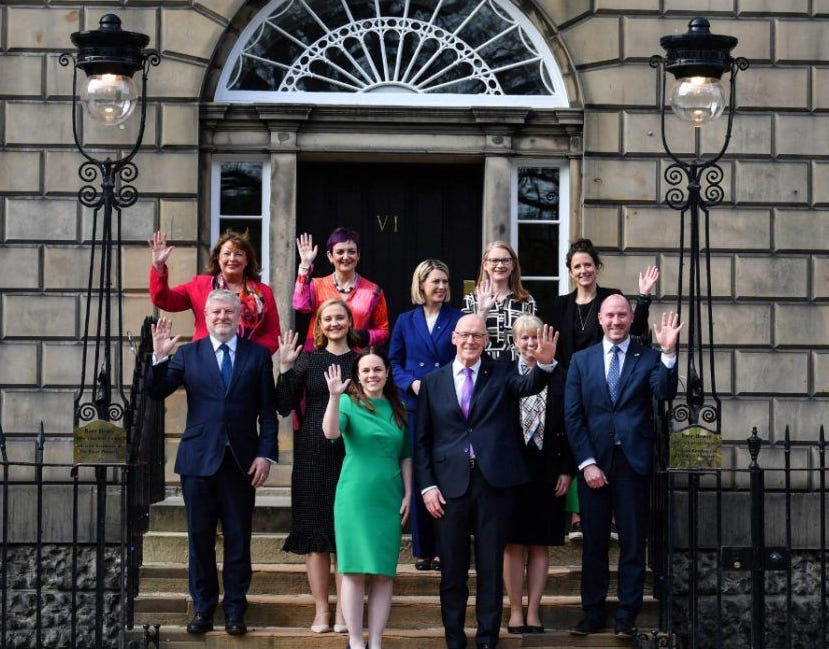
According to the cursory research I thought the matter merited, the practice of attaching special significance to the first 100 days of a new government began with Franklin D. Roosevelt's first term as President of the United States of America in 1933. This is the period during which the new administration is expected to set the tone for the next four or five years by establishing the priorities and setting out the vision. It is also the period in which the new government’s relationship with the public is formed. And, of course, the time when policies are implemented, reforms introduced, and initiatives launched.
Counting from when John Swinney officially assumed office as First Minister on Friday 8 May, the first 100 days takes us to Sunday 16 August 2026, or Monday 28 September 2026 if we exclude weekends and public holidays. Being a generous soul, I’ll use the later date. I realise that others may count differently, and I really don’t care. It’s a very loose 100 days. John Swinney’s 100 days will be up on Monday 28 September of this year.
Ahead of the election, John Swinney declared what he intended to achieve in the first 100 days of his government. If you want to know everything that he promised he’d do before Monday 28 September, you can read a transcript of the speech on the SNP website. As ever, my focus is on the constitutional issue. This is the relevant portion of the speech (emphasis added):
So I can confirm today that on the first sitting day after the appointment of the new government, we will bring forward a vote of the Scottish Parliament to approve the development of a Section 30 to give Scotland the power to hold an independence referendum.
The parliament chosen by the people of Scotland will have the chance to represent the democratic will of the people of Scotland.
Within the first hundred days, we will publish the draft Referendum Bill.
We propose that the question, as in 2014, is: ‘Should Scotland be an independent country? Yes or No.’
On Tuesday 26 May the Scottish Parliament debated a motion submitted in the name of John Swinney and titled Ambitious for Scotland. The motion passed by 72 votes to 55 after the SNP backed an amendment by the Scottish Greens. Below is the full text of the motion as amended. (emphasis added)
That the Parliament welcomes the emphatic democratic mandate for bold and ambitious reform backed by the people of Scotland at the Scottish General Election; further welcomes the Scottish Government’s clear commitment to eradicate child poverty, deliver a stronger NHS and public services, build a more prosperous economy and help people in the cost of living crisis and tackle climate change; recognises that the people of Scotland have returned the largest pro-independence majority ever elected to the Scottish Parliament; believes this majority affirms a clear mandate that decisions about Scotland’s future are best taken in Scotland and that mandate must be respected; calls on the UK Government to make a Section 30 order under the Scotland Act 1998 to devolve the powers to the Scottish Parliament to hold a referendum on Scottish independence; agrees that the Parliament is at its best when it works together in pursuit of a country that can be confident in its future; believes that the most effective way in which to grow public support for Scottish independence and to meet the scale of the challenges currently facing Scotland is through more effective use of existing devolved powers; recognises that meeting the Scottish Government’s stated ambitions will require a significant escalation in action and ambition; notes that no one party holds a majority in the current parliamentary session, but that there is a clear majority for progressive values, and agrees that, if all progressive parties work constructively and collaboratively, Scotland can be a fairer, greener and kinder country where household costs are reduced, where wealth is distributed more equally and where climate and natural environment are protected.
The first thing I noticed about this motion was what seemed to be a discrepancy between it and what was promised in the speech referred to earlier. In that speech, John Swinney said he would bring forward “a vote of the Scottish Parliament to approve the development of a Section 30 [order]”. I was surely not the only person who took this to mean that the Section 30 order was to be drafted by the Scottish Government. The motion passed by the Scottish Parliament, however, “calls on the UK Government to make a Section 30 order under the Scotland Act 1998”.
At first glance, this looked like Swinney rolling back from what he had promised. On reflection, however, I now think that the speech was just clumsily worded. An impression supported by the omission of the word ‘order’. One might be forgiven for thinking of this clumsiness as indicating the level of importance John Swinney attached to this announcement. Time will tell.
The motion was little more than a bit of political theatre. MSPs were asked to vote for something the Scottish Government cannot deliver. Granted, a request for a Section 30 order submitted in the name of the entire Scottish Parliament might carry more weight than a request made by the First Minister alone. But since the latter carries no weight at all, the former needn’t weigh more than a midge’s fart.
Either way, the request was always going to be rebuffed. As if to confirm his contempt for the parliament elected by the people of Scotland, Starmer didn’t bother getting out of bed to respond on behalf of the parliament elected by the people of England. Instead, he delegated the job of contemptuous dismissal to some unnamed Downing Street lackey:
The UK Government does not support independence or another referendum.
People need and want their governments focused on the issues that really matter - economic growth, the cost of living, and public services. Our focus must be on delivery, not division.
What more did Swinney expect? Well, presenting his Ambitious for Scotland motion at Holyrood, Swinney said (emphasis added):
Today is the start of a process that I believe will lead Westminster to a yes to a referendum, and Scotland to a yes to independence.
Today I seek confirmation from this parliament that this is a voluntary union, and the people of Scotland have the right to decide whether we remain in that union. That is a principle that should be accepted by all those in this chamber who support independence but also those who believe in the union, because what is at stake is the democratic wishes of Scotland.
If he was telling the truth, Swinney genuinely expected that the British state would buckle under the weight of a vote in the Scottish Parliament. I’ll wager he is the only person in Scotland who believed this. There are people who believe Elvis is alive and driving a Routemaster bus on the Moon who scoff mightily at the notion of the British Prime Minister agreeing to another referendum.
His 100 days aren’t up yet. Guess what! We’re waiting again! This time we’re waiting for the outcome of face-to-face talks between Swinney and Starmer sometime this month. But it appears the two governments can’t even agree on the subject of the talks. A Scottish Government spokesperson said (emphasis added):
It is particularly welcome that the Prime Minister agreed to meet next month to discuss a referendum on independence,” the Scottish Government spokesperson said.
Given the SNP’s landslide victory and the fact that the people of Scotland have elected more pro-independence MSPs than at any point in the Parliament’s history, the previous refusal of the UK Government to consider Scotland’s right to decide its own future was clearly unsustainable.
Really!? Let’s just check that. Here’s a spokesperson for the UK Government (emphasis added):
The Prime Minister committed to meeting to discuss shared issues, including the cost of living,” the No 10 spokesperson said.
As the Prime Minister told the First Minister, the manifesto this government was elected on was unambiguous that ‘Labour does not support independence or another referendum’.
Our position remains unchanged.
That sounds more like the British state’s customary attitude! There seems to be no reason to think John Swinney will be the one leaving the meeting with a cheesy grin on his face. Time will tell!
By my calculation, Swinney has 82 working days remaining of his first 100 days. He has promised a draft Referendum Bill within this time period. He has also guaranteed that he will deliver a referendum. As The National reported:
Asked by ITV in an interview at Bute House whether he could guarantee a majority will lead to a referendum, Swinney said: “Yes, because that’s what happened in 2011.
I reckon there’s one helluva lot of small print on that guarantee. This has to rank among the most stupid things said by any politician ever. As soon as he heard the word ‘guarantee’, Swinney should have been on his guard. But he just blurted out his answer without thinking. The bit about the 2011 election was tacked on in an attempt to prop up that guarantee. It doesn’t work. It only makes the response look even more stupid.
It is safe to assume that we’ll get to that 100-day mark, and to borrow a phrase from that Downing Street spokesperson, our position remains unchanged. In other words, there is no prospect of any progress for Scotland’s cause in the next five years. Exactly as predicted. Can we expect an apology from John Swinney or any of the people who castigated those who said all we’d get from the election was another five wasted years?
Would it be a resigning matter? Two weeks after the 28 September deadline, delegates gather in Aberdeen for the SNP Annual National Conference. Will we see the membership finally growing spine enough to rebel against the leadership? It has become a tradition to anticipate such a rebellion at every SNP conference. So far, we’ve always been disappointed. What will it take to spark a revolt?
Will this be the last straw for the SNP loyalists and apologists? Time will tell.
" Will we see the membership finally growing spine enough to rebel against the leadership? It has become a tradition to anticipate such a rebellion at every SNP conference. So far, we’ve always been disappointed. What will it take to spark a revolt?"
I don't predict a riot.
No point in SNP asking for a Section 30 as it will either be ignored or, if a referendum is granted, it would be under London rules so designed to fail.