

Cognitive inertia

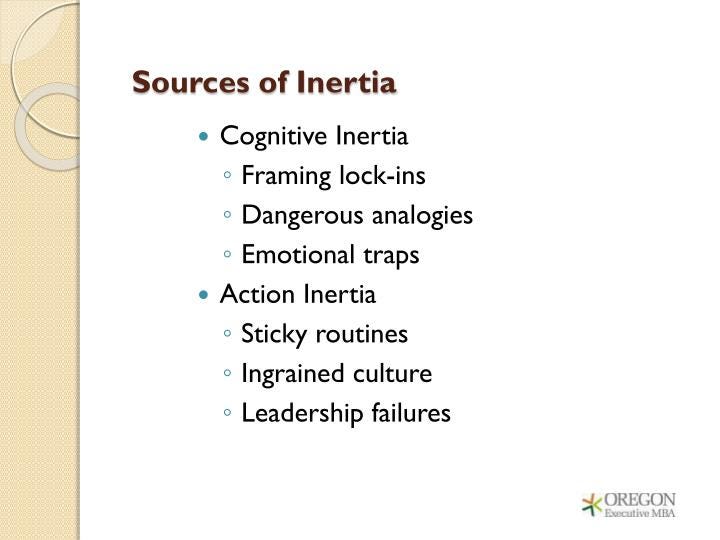
Cognitive inertia is the tendency for a particular orientation in how an individual thinks about an issue, belief, or strategy to resist change. Clinical and neuroscientific literature often defines it as a lack of motivation to generate distinct cognitive processes needed to attend to a problem or issue. The physics term inertia emphasizes the rigidity and resistance to change in the method of cognitive processing that has been used for a significant amount of time. Commonly confused with belief perseverance, cognitive inertia is the perseverance of how one interprets information, not the perseverance of the belief itself. - Wikipedia
The pro-independence parties must get together! The independence movement must unite! Why can’t the parties get around the table and agree on a common strategy?
How often do we hear pleas like the above? I know I see such things daily. Often several times in one day. I find it decidedly irritating because I know that this can never happen other than, perhaps, when there is a single-issue campaign, e.g., the Yes campaign in its early phase. Even then, it was not unity in the sense of amalgamation. The political parties didn’t unite. Members of those parties placed themselves under the Yes umbrella. Even under the anti-independence Better Together banner, the ‘unity’ was informal.
The 2014 referendum was an extraordinary event, but even in those very special circumstances, the kind of ‘unity’ people are pleading for didn’t happen. What chance, then, that such ‘unity’ might be achieved when there is an election in the offing—the time when political parties are most protective of their distinct identities?
The 2014 referendum was an extraordinary event, but even in those very special circumstances, the kind of ‘unity’ people are pleading for didn’t happen.
Just as people can be hesitant about adopting new technology, so they can be averse to new ideas. People have got the ‘work together’ notion into their heads and they just keep on repeating that without questioning it. If everybody is saying ‘work together’ and you are saying ‘there is a better way’, you are saying something different from what everybody else is saying. So, you’re the outlier who can be safely ignored.
Back in August 2023, I published an article titled “The New Thinking”, which was quite well received and has often been referenced by Professor Alf Baird and others. Lately, I have been more concerned about the old thinking, as in the above example, and in the resistance to fresh perspectives and novel ideas, which is the corollary of cognitive inertia.
Another example of cognitive inertia and resistance to new thinking is found in the widespread conviction that the process by which we restore Scotland’s independence must be approved, overseen, and at least partially managed by the British state or its agencies. That a new referendum must be ‘legal and constitutional’ in terms of UK law and the UK’s unwritten constitution was a mantra endlessly repeated by Nicola Sturgeon when she was First Minister. It is the core of what I have termed the Sturgeon doctrine. Though it was a favourite of Sturgeon’s, the phrase had been around before the 2014 referendum. It is part of the old thinking and the customary rationalisation for resistance to new thinking on the constitutional issue.
The SNP leadership in particular became locked in a culture of uncritical conformity that persists to this day, discouraging creativity and individual responsibility.
Here we are in 2026, and the dominant groupthink within the independence movement is that which developed in the four years between the 2011 election and a period of four or five months subsequent to the 2014 referendum. The SNP leadership in particular became locked in a culture of uncritical conformity that persists to this day, discouraging creativity and individual responsibility.
The old thinking is that the nominally pro-independence parties should get together to formulate a strategy and design a campaign. The new thinking is that the strategy and the campaign should be the common connection that the parties ‘unite’ around. It should be a pre-existing plan that they all connect to without necessarily connecting with any rival party. This is unity of purpose. Which, ironically, is actually more like the ‘unity’ of the Yes campaign for the 2014 referendum than the form of ‘unity’ now being insisted upon.
Insisting on something impossible as a condition for progress means there will be no progress. It provides a perfect excuse for those who, for one reason or another, have no desire to make progress.
Insisting on something impossible as a condition for progress means there will be no progress.
Similarly, the old thinking of the Sturgeon doctrine, which pervades Scotland’s nominally pro-independence political elite, effectively shuts out the new thinking which is centred around the sovereign people of Scotland, Scots law, and the Scottish constitutional tradition rather than Westminster and the infinitely manipulable UK constitution.
These are but two examples. The independence movement as a whole—not excluding the nominally pro-independence parties and politicians—is riddled with and addled by outdated precepts and obsolete perspectives. It is powerfully averse to new thinking. Yes! There is a great deal of new thinking on policy matters such as currency and land reform. But on the constitutional issue there is very little, and what new thinking there is struggles to be heard.
If you are seeking an explanation for the lack of progress in Scotland’s cause over the last eleven years or so, the concept of cognitive inertia might be useful.
Spot on...pointing out quite succinctly the sickness at the heart of Holyrood.
I have come to the conclusion that the SNP have been in power for far too long..achieving little in the way of independence..and amazingly expecting the electorate to accept their dreadful inertia while they go on their merry way..gibbering about 'secret plans'..awarding themselves a payrise ( for what ?) and expecting us to fall for the same scam over and over again..
Maybe they are hoping we are too busy trying to survive ..being ripped off in energy scams set up by the foreign english..Scottish households being taxed up to £55 MORE on electricity than Londoners.( Believe in Scotland..today) Whit ye doin' aboot that swiney?
I watch the foreign english government hand our land to an american nutcase so he can attack other nations at will ( and we are not told!) .. that then followed by some squeaks from our pathetic ..'government'.. then being told by a little sh*tty scottish quisling ..alexander... that it's none of the Scottish government's business..The usual scam..'RESERVED'..
Swiney should have SCREAMED out in Holyrood about this attack on our country....and it was an attack...slammed up notices on bill boards...took out adverts in newspapers ...called alexander/stammer to Holyrood to explain themselves...kept the subject to the forefront until stammer had to respond..and a nasty warning to alexander re his treacherous actions against Scotland ..anything...just make those foreign english b*st*rds and their treacherous quisling supporters like alexander......very nervous...and tell the people..loudly what is happening...
Meantime to deflect the great wrong done to Scotland the foreign deceitful english media are yelling about the failings of a hospital blaming ..of course ...the SNP . Great deflection..look over there not here where Scotland is being trashed once again.
We have no other leaders to depend on..sadly lost Alec Salmond too soon. Maybe we deserve to be prisoners of the foreign english...
Once again I look across the Irish Sea and watch our FREE cousins...they did it the hard way..the only way.
For OUR Scotland and her weans... who should be getting mad....
The problem with applying the concept of "Cognitive inertia" is this: "attend to a problem or issue".
The very first step is to establish the importance of any arbitrary problem or issue to an individual. If something is of little or no importance, we may have an opinion off the cuff, but we really don't care either way. If "corrected" (read contradicted) we might answer "Oh, really, how interesting", and either change our view - or not. That issue just doesn't matter to us either way.
For example, I might say "That Victoria Beckham behaved really badly at the wedding"; someone might say "It was the fault of (whoever) egged her on". I'd say "Oh really, I never knew that". Basically because quite frankly my dear, when it comes to Posh and Becks, I really don't give a damn.
On the other hand, on issues we really care about we should indeed be prepared to listen to different points of view, compare and contrast, evaluate, and perhaps change or modify our opinion. Or not!