
Words and deeds

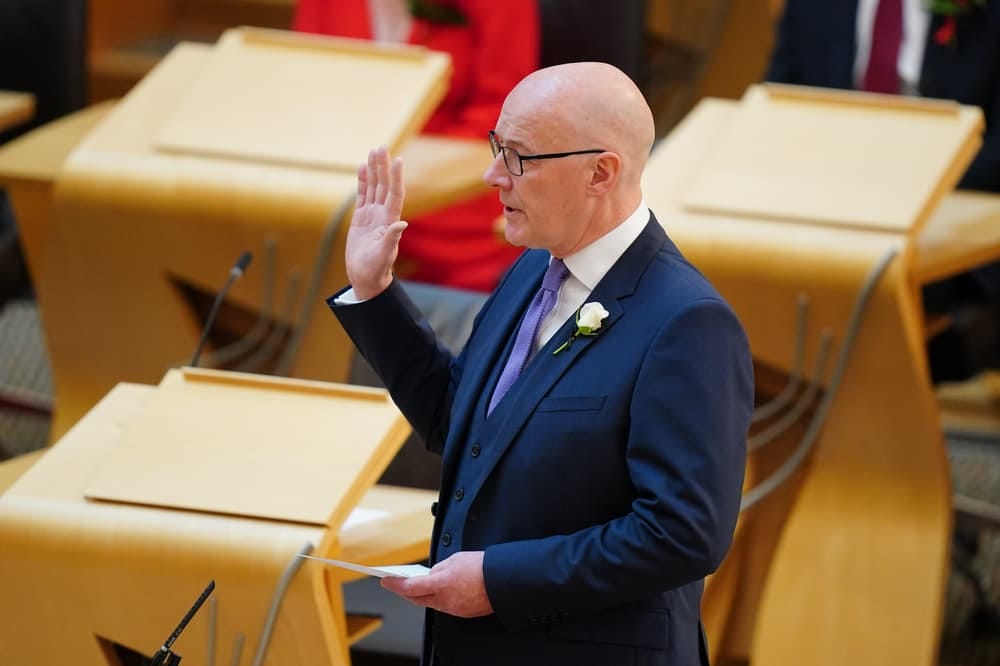
On 14 May 2026, prior to swearing an oath pledging allegiance to England’s King Charles, First Minister John Swinney declared,
Before I take my oath, let me pledge that the primary loyalty of the Scottish National Party is to the people of Scotland, in line with the constitutional principle of the sovereignty of the people.
In The National on 29 June 2026, First Minister John Swinney was quoted as saying,
Scotland is a nation and not a region, and there has now been a pro-independence majority in Holyrood for four elections in a row. This mandate has been ignored by successive Prime Ministers for years.
If Andy Burnham genuinely believes people should have more control over their future, he can recognise that by confirming Scotland’s national right to self-determination.
Fine words! And doubtless uttered with all the rehearsed sincerity a professional politician might muster. I wonder, however, if John Swinney truly understands the meaning of those words.
If John Swinney genuinely believes that Scotland is a nation, not a region, and that the people of Scotland are sovereign, why does he endorse Westminster’s veto over the will of Scotland’s people?
The sovereignty of Scotland's people is both a constitutional fact and an inviolable principle. Sovereignty is not passive. It is not merely a label or a slogan. The sovereignty of Scotland’s people must be constantly affirmed by the way we conduct ourselves. And by the manner in which our politicians conduct themselves when they act on our behalf.
Sovereignty is not passive. It is not merely a label or a slogan. The sovereignty of Scotland’s people must be constantly affirmed by the way we conduct ourselves.
To be sovereign is to be the ultimate authority. The people of Scotland are sovereign. Therefore, there can be no authority above the people of Scotland.
John Swinney claims that “there has now been a pro-independence majority in Holyrood for four elections in a row.” I would insert the word ‘nominally’ before ‘pro-independence’. But we are concerned here with John Swinney’s perspective, not mine. If we take him at his word, he is claiming that the sovereign people of Scotland have voted for independence on four consecutive occasions. Or at the very least, that the sovereign people have voted on four consecutive occasions in favour of holding a referendum on independence.
What is clear is that John Swinney believes the sovereign people of Scotland have spoken. That we have made our will known through the democratic process. As Swinney sees things, the will of the sovereign people of Scotland is either that Scotland’s independence be restored or that there should be a constitutional referendum to resolve the question of Scotland’s constitutional status.
Readers will note that Scotland’s independence has not been restored. Nor have we had a referendum. Neither is there any prospect of a referendum. The people have spoken, and nothing has happened that must happen if the people are sovereign.
John Swinney blames “successive [British] Prime Ministers“, who he says have ignored this mandate for years. But the mandate wasn’t given to successive Prime Ministers of the UK. The mandate was given to successive First Ministers of Scotland, including John Swinney. If the mandate has been ignored, it has been ignored by successive SNP Scottish Governments.
Swinney asserts that the people of Scotland spoke in four Scottish general elections, saying they want independence restored or they want a constitutional referendum. These were elections to the Scottish Parliament. When the sovereign people of Scotland spoke, they spoke to the candidates and parties standing in the Scottish general election. The message was addressed to John Swinney and the Scottish National Party (SNP). If the message was ignored, it was ignored by John Swinney and the SNP.
When the sovereign people of Scotland spoke, they spoke to the candidates and parties standing in the Scottish general election.
If the results of those four elections were an instruction from the electorate, that instruction was issued to John Swinney and the SNP. If that instruction has not been obeyed, it is John Swinney and the SNP who have not obeyed. They have declined or failed to act on an instruction issued by the ultimate authority—the sovereign people of Scotland.
What is their excuse? How does John Swinney justify disregarding a clear and unequivocal instruction from the people of Scotland? His excuse is that the British state would not let him. He excuses his failure to obey an instruction from the people of Scotland by claiming that this instruction was countermanded by the British Prime Minister. Or more precisely, by some lackey in the office of the British Prime Minister.
How does John Swinney justify disregarding a clear and unequivocal instruction from the people of Scotland?
How can an instruction from the ultimate authority be countermanded by an edict issued on behalf of the British Prime Minister? That is for John Swinney to explain. There cannot be two ultimate authorities. Either the people of Scotland are sovereign or the parliament of England-as-Britain is sovereign. By his words, John Swinney holds the people of Scotland to be sovereign. By his actions, he accedes to the sovereignty of Westminster.
By requesting a Section 30 order, John Swinney validates the British state’s veto over the democratically expressed will of Scotland’s people. By making that request, he compromises the principle that the people of Scotland are sovereign.
John Swinney talks as if Scotland were a nation in which the people are sovereign, but he acts as if Scotland were merely a region of England-as-Britain where Westminster is sovereign.
You will know them by their fruits. Do men gather grapes from thornbushes or figs from thistles? - Matthew 7:16
Historically England has consolidated its power over Scotland, from the act of union through to most recently with the formation of the UK supreme court. There is a case reported this week of that court operating with criminal cases in Scotland, and up until the 90s the Scottish criminal system had no appeal to House of Lords as the system was then. Point is it seems to have been changed; that is how Scottish sovereignty has been eroded gradually over the years and is now effectively gone. Therefore the system is stacked against the Scottish people sovereignty argument. The SNP accede to this as you point out; they are now effectively a devolution party.
Excellent argument Peter.
"If Andy Burnham genuinely believes people should have more control over their future, he can recognise that by confirming Scotland’s national right to self-determination."
Somebody should tell John Swinney that there is no requirement to solicit the opinion of a recently elected English MP on an entitlement that is already guaranteed by the UN Charter.
Swinney and his team of phony freedom fighters are the immediate blockage to restoring Scotland's full self-government and independent statehood.