

The never-ending dance

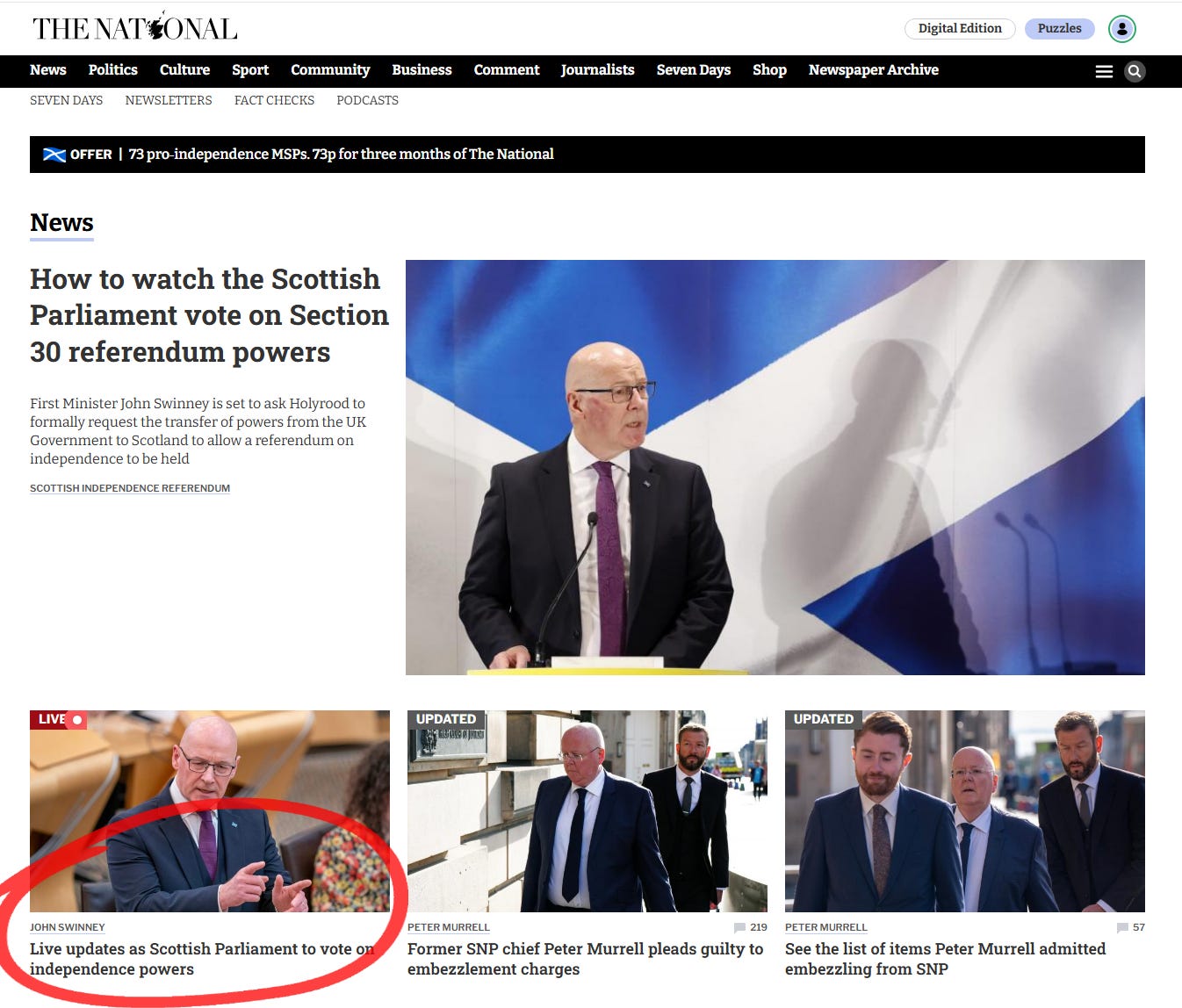
In a response to one of my comments on social media about the Section 30 process (I can’t find it now), somebody remarked that they reckon most people know that a Section 30 referendum is not “legally binding”. In reply, I wondered why, if so many people are aware that a Section 30 referendum is a sham, they persist in voting for the SNP. I’m not sure most people are aware of the true nature of a referendum legislated for with transferred powers. I suspect a great many people see headlines that include the word ‘independence’ and imagine that the vote in the Scottish Parliament today (Tuesday 26 May) is about independence. It really isn’t.
As if to confirm my suspicions regarding the misunderstanding of today’s ‘debate’, the next thing I saw was a letter to The National the first sentence of which is:
Like many, I am delighted to hear that John Swinney is to bring a motion on Scottish independence to Holyrood on Tuesday.
No, he isn’t!
What is happening in the Scottish Parliament today is mere political theatre. Let me remind you of the text of John Swinney’s motion.
That the Parliament welcomes the emphatic democratic mandate for bold and ambitious reform backed by the people of Scotland at the Scottish General Election; further welcomes the Scottish Government’s clear commitment to eradicate child poverty, deliver a stronger NHS and public services, build a more prosperous economy and help people in the cost of living crisis and tackle climate change; recognises that the people of Scotland have returned the largest pro-independence majority ever elected to the Scottish Parliament; believes this majority affirms a clear mandate that decisions about Scotland’s future are best taken in Scotland and that mandate must be respected; calls on the UK Government to make a Section 30 order under the Scotland Act 1998 to devolve the powers to the Scottish Parliament to hold a referendum on Scottish independence, and agrees that the Parliament is at its best when it works together in pursuit of a country that can be confident in its future.
The motion will pass. Of that, I am certain. With 72 nominally pro-independence MSPs in the chamber, it would be a bit embarrassing for John Swinney if his motion failed. That’s putting it mildly. It won’t fail. But that needn’t prevent us from speculating as to the implications of hypothetical failure. It would be potentially catastrophic. John Swinney could be forced to resign. Scotland’s cause would suffer a serious setback. It would be a mess.
That’s what failure means. What about success? What is achieved when the motion is endorsed by a majority of MSPs? The cost of failure is exorbitant. You might therefore expect that the benefit of success would be correspondingly noteworthy. But you’d be wrong. The motion passing achieves nothing. It changes nothing. It has no effect whatever.
The cost of failure is exorbitant. You might therefore expect that the benefit of success would be correspondingly noteworthy.
Actually, that’s not quite true. There is no benefit to Scotland’s cause pursuant to the passing of the motion. What benefit there is goes to John Swinney and the SNP. For all the hype surrounding it, the motion merely asks the parliament to approve Swinney’s request for a Section 30 order. He can do that anyway. He doesn’t require parliament’s approval. He could simply have gone ahead with writing to the British Prime Minister, beseeching him to have his parliament consent to a temporary and conditional transfer to Holyrood of competence to legislate for a deliberative and non-self-executing referendum on the question of whether Scotland should be an independent country. In reality, just a glorified opinion poll.
The benefit for Swinney is that bringing this motion to the Scottish Parliament makes it look like he is doing something positive and constructive for Scotland’s cause. A perception enhanced by a slew of headlines containing the word ‘independence’. Many and perhaps most people who take any interest at all will probably think it is a “motion on Scottish independence”, just like the letter writer mentioned above. They will think it important, if they think of it at all. It isn’t.
Almost as certain as the endorsement of Swinney’s motion is that Starmer will reject the request for a Section 30 order on whatever grounds take his fancy. Most likely it will be something along the lines of ‘Now is not the time’, implying that there might be an appropriate time; this just isn’t it. Starmer can’t say that there will never be another referendum, because that would constitute a denial of our right of self-determination and put the UK on the wrong side of international law. Saying that now is not the time suggests that there is something about present circumstances that makes it an inappropriate time to have a referendum. But there is nothing about present circumstances that makes them exceptional. The way things are is pretty much the way things always are. So, saying that now is not the time is a convenient way of saying never without actually saying never.
Saying that now is not the time suggests that there is something about present circumstances that makes it an inappropriate time to have a referendum.
What next? That’s always the question. What happens next? What happens when John Swinney’s request for a Section 30 order is dismissed? What are his options?
Does he have any options? Is there anything Swinney can actually do when his begging letter is brushed aside with a stroke of the British Prime Minister’s pen? Anything, that is, except bleat about how unfair it all is. SNP loyalists claim Swinney has a ‘Big Secret Plan’. They really believe this. But what would such a plan look like?
Obviously, it would have to be something other than a Section 30 referendum. That has been ruled out. So, it would of necessity be a way forward which didn’t require Westminster’s consent. But if there is a way forward that doesn’t require consent which isn’t going to be forthcoming anyway, why did Swinney not do that in the first place? Why go through all the bother of asking knowing the answer will be no when there is a way that doesn’t involve getting permission?
I can only think of one thing that Swinney might do when his supplication proves fruitless. The ‘Big Secret Plan’ is probably nothing more mysterious than trying to make the UK general election a de facto referendum on the question of once again asking for a Section 30 order. It’s a dance that never ends.
Soon I will go back into my straight jacket Peter..don't know how you stay sane...
A motion on Scottish Independence.
What is a motion I hear you ask..
1. Legal term ..a lot of noise signifying nothing (reminds me of Holyrood)
2. A turd...you'll find them in potties.
2. A dance term..leap..spin or ...just run aboot like a chicken wi its heid cut aff...( reminds me of SNP activists)
Tak' yer pick...Ah ken the one I would go for that encapsulates our quest for freedom....
The quickness of the hand deceives the eye..pick a card ..any card....whit's it say...Independence!..er naw no' that card..pick another card..whit ! noo is no the time.?...
And while this jibber jabber goes on the foreign english media are celebrating ... ...embezzlement..so well timed ...
Pick a card..any card..whit's it say?..Independence..er naw no that card...
Pick a card... any card..whit! noos no the time...?
And so we go on the roundabout.....round and round...and round..and...
For OUR Scotland and her deceived weans...
It's a case of all risk and no reward ... for Scotland's Cause.