

The blank page

The title of this article does not, as some might suppose, refer to the condition that afflicts every writer from time to time. Those occasions when you sit down with the intention of writing a masterpiece of prose and find yourself instead staring at a blank page (or screen) for two or three hours while your mind strives to emulate the blankness of that page.
What the title refers to is the appeal of a fresh start. The idea of wiping the slate clean and starting from scratch is, I suppose, something that everybody entertains from time to time. Especially when things are particularly shitty, we all enjoy the notion of flushing it all away and going back to a pristine condition. We all like to imagine we can erase all the mistakes we’ve made, do it over, and do it right this time.
The idea of wiping the slate clean and starting from scratch is, I suppose, something that everybody entertains from time to time.
Marketers exploit this tendency all the time, whether they are selling a product or an idea. Political activists are really just marketers. A political campaign is a marketing exercise. Wannabe politicians are sold to the public using the same techniques as are used to sell washing powder. To a greater or lesser degree, they are all sold on the basis of a promise to cast off the old and introduce the new. Or just as likely, to cast off the new and return to some imagined golden age.
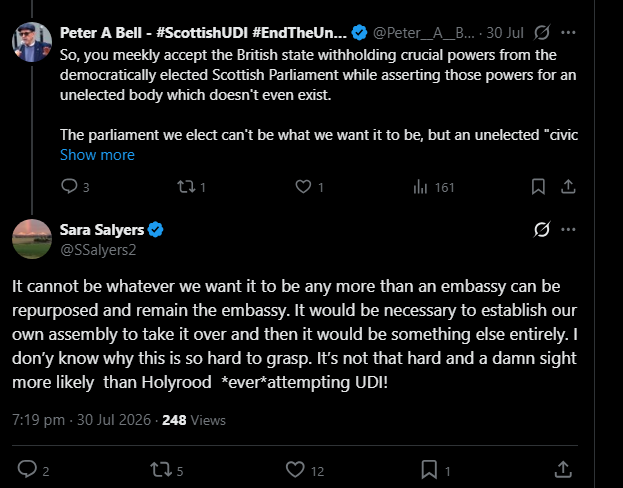
I had a mild case of the first type of blank page syndrome earlier this morning. It was a mild case because I hadn’t yet looked at the news or my social media feeds, which are my usual source of inspiration. Unusually, I went to my social media feeds first today. I usually turn to the news first. On 𝕏 I was involved in an exchange with Sara Salyers. For all that we agree on a great many points, I have never accepted that the Scottish Parliament cannot be whatever we want it to be and that it would have to be abandoned in favour of some kind of “civic commission”.
I have never accepted that the Scottish Parliament
cannot be whatever we want it to be …
As regular readers will know, I advocate making use of the parliament we have by electing people who are committed to making it the parliament that we want or need. Sara and I ‘debate’ this point every once in a while. Neither of us has so far managed to influence the other. But the discussion is far from arid. In fact, it can be quite fruitful. So, I thought I would bring the discussion here to see what commenters make of the arguments.
The following is my most recent response on the topic and covers the gist of my argument against throwing away what we have in favour of something that remains unknown. The appeal of the blank page can, if we are not cautious, lead us to unnecessarily destroy things that are valuable.
I grasp the idea. Of course, an embassy would stop being an embassy if you repurposed it as something other than an embassy – a brothel, for example. But that is not what I'm suggesting we do with the Scottish Parliament.
The parliament is the people sitting in it. If the Scottish Parliament were packed with Unionists, it would be a different parliament from a parliament packed with nationalists.
You seem to be saying that if we elected a majority of MSPs committed to the #ScottishUDI process, it still wouldn't be able to restore Scotland's independence. You seem to be saying that we, the people, can own everything in Scotland except the parliament that we elect.
This is what I can't make sense of. If I am grasping your point correctly, you are saying that there is nothing we can do to make the Scottish Parliament the parliament of an independent Scotland – not even if we elect a huge majority of genuine nationalists. Not even if every single MSP was signed up to the #ScottishUDI process. Not even if every single one of them voted to assert legislative competence and then unanimously passed legislation for a proper constitutional referendum
Moreover, you seem to be saying that all the things which can't be done by the parliament we vote for can be done by some unelected "civic commission". I'm having a hard time getting my head around that.
I'm trying very hard to envisage the legislature we have sitting idly by while some cobbled-together committee enacts legislation. I don't think that makes me stupid. I reckon it just makes me someone who adheres to the principle that the people of Scotland are sovereign and that the parliament the sovereign people elect is whatever the sovereign people want it to be.
I can understand the appeal of a 'fresh start'. Raze and rebuild! Tear down everything to restore Scotland to some pristine state, then build anew all that you've just torn down using the same materials! What other materials are there?
Presumably, this would apply to every part of our existing governance infrastructure – the civil service, for example. If not, it needs to be explained why the Scottish Parliament is an exception. So, I have to ask, who will implement the decisions made over the heads of our elected parliament by an unelected committee?
Presumably, there would have to be a parallel civil service. If you discount the democratically elected parliament, you would surely have to also discount all the administrators who derive their authority from the discounted parliament.
Here's another thing! This "civic commission" could only come into existence after the electorate has elected a parliament that is sympathetic to the idea of a parallel (rival?) body doing things that only the parliament is empowered to do, because that's the only way we have of measuring the mood of the voters. So, why bother? Why go to the trouble of setting up this unelected parallel administration when you have a democratically legitimised administration with the same objective?
I understand the idea. It is because I understand it that I have so many questions.

I agree with the warning against the blank page. Scotland should not throw away institutional capacity it already possesses. But Holyrood is not simply whatever its members declare it to be. Its democratic legitimacy comes from the Scottish people, while its present legal competence remains bounded by the Scotland Act. A civic commission could not legislate in its place either. The task is to build capacity and legitimacy through Holyrood, supported by wider civic institutions, without confusing an inherited platform for sovereignty with sovereignty itself.
"Fanon synthesised Freud, Marxism, and anti-colonialism by arguing that colonial rule simultaneously exploits people economically, dominates them politically, and wounds them psychologically, so genuine liberation must transform both social structures and human consciousness." (Fearghal Mac Bhloscaidh)
So the main thing that a liberated people must do is: 1. totally transform our (colonial) institutions, and: 2. get rid of our colonial mindset.