

So what?

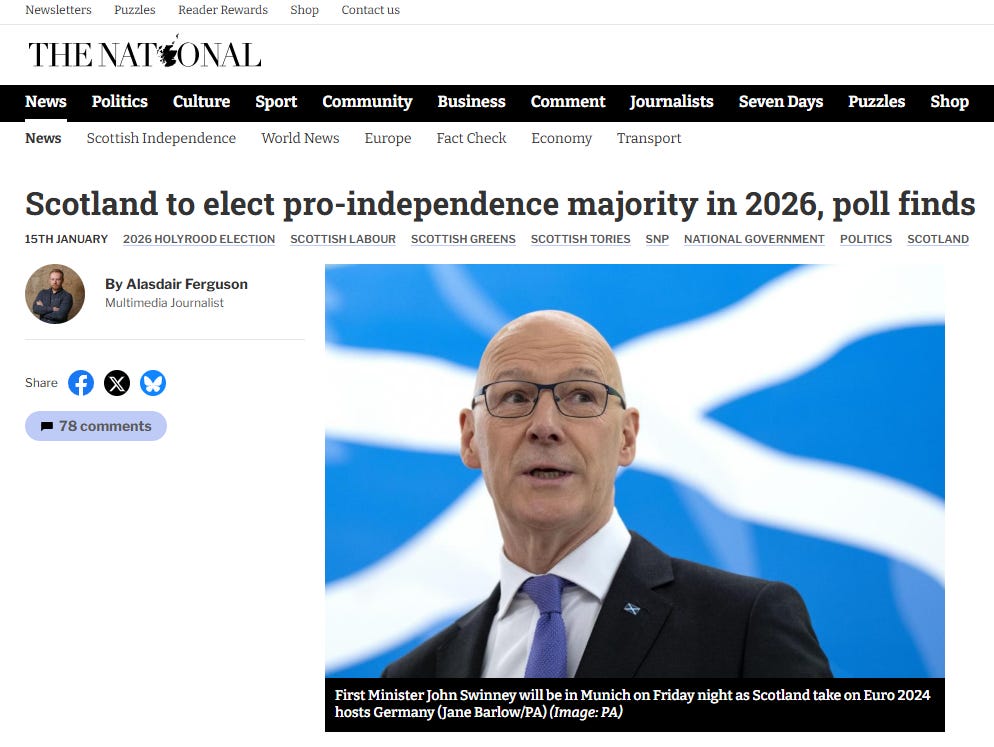
When I see a headline in The National breathlessly declaring Scotland to elect pro-independence majority in 2026, poll finds, my first reaction is to check the date lest I have somehow lighted upon the same or similar story from last week, or the week before. My second reaction is to inwardly shrug and ask, “So what?”. The three previous elections also produced nominally pro-independence majorities. The last five have resulted in nominally pro-independence governments. Yet here we remain, still annexed territory of England-as-Britain! Clearly, what The National refers to as a “pro-independence majority” is not sufficient to rid us of the Union.
The 2007 election gave us the first pro-independence Scottish Government. But it was a minority administration and so could not realistically have been expected to make any substantive move towards restoring our independence. The 2011 election famously gave us the only single-party (SNP) majority there has ever been. It did so, totally unexpectedly, as the electoral system is designed to powerfully militate against such an outcome. It was a total fluke. A freak event.
John Swinney imagines he can engineer a repeat of this freak event. Or at least that is what the rhetoric would have us believe. My suspicion is that he doesn’t need the polls to tell him this is not going to happen. 2011 proved that a single-party could happen. It did not indicate it could be made to happen.
2011 proved that a single-party could happen. It did not indicate it could be made to happen.
That 2011 result took everyone by surprise. Not least Alex Salmond. The then leader of the SNP and First Minister found himself in the awkward position of being obliged to deliver a referendum within the term of the parliament. He had to take whatever he could get. I like to think that, Salmond being the great political strategist he undoubtedly was, he knew that what he got was far from ideal. Under the circumstances, he got the best deal possible. But I reckon there was a part of him that knew a Yes win in a Section 30 referendum would not be the end of the matter. It would be but the start of a battle that the British would make as protracted as they possibly could.
As it transpired, there was no Yes win. Although much that was positive came out of the Yes campaign, it ultimately failed. Salmond resigned. And although we didn’t know it at the time, the independence movement’s troubles began.
Nicola Sturgeon became SNP leader and First Minister amid another surprising outcome. Instead of leaving the independence movement defeated and depressed, the aftermath of the 2014 vote saw a huge surge in support for both the SNP and independence. At this point, Sturgeon made the first of what was to be a catalogue of catastrophic choices. Rather than use the momentum spurred by the 2014 referendum to carry forward the struggle to restore Scotland’s independence, she opted instead to try and make it serve partisan advantage and personal ambition. For Scotland’s cause, it has been all downhill from that point.
No Scottish Government since that time has prioritised the constitutional issue. In the 2015 Westminster election, independence was used by Sturgeon as an electioneering tool. The tactic paid off, with the SNP taking 56 seats. Since then, the SNP and other nominally pro-independence parties have never treated independence as anything other than an electioneering device. The success of the SNP’s 2015 UK election campaign ensured that politicians and parties hungry for the rewards of elected office would forevermore see the constitutional issue as first and foremost the key to that prize.
The 2026 election is set to be no different. While the entire world has changed dramatically since 2015, the ‘old guard’ of the independence industry remains firmly stuck in the past. The only fresh idea they’ve come up with in all that time is the notion of a plebiscite election as a way of circumventing the UK Government’s effective veto on another referendum. This tells us only that it hasn’t occurred to them to challenge that veto. Or if it has occurred to them, they have shied away from the prospect of confronting the British state.
While the entire world has changed dramatically since 2015, the ‘old guard’ of the independence industry remains firmly stuck in the past.
The SNP briefly latched onto the idea of a de facto referendum. But they dropped it. Possibly because they saw how pitifully little it was doing for Alba Party, who have made a plebiscite election on independence the central plank of their offering on the constitutional issue. They’ve been banging that drum for five years and it has signally failed to inspire voters. It has been suggested—by myself, if no one else—that Alba Party might want to reconsider a strategy which patently isn’t working. But the party leadership is disinclined to listen. Much like the leadership of the SNP.
Going by the polls, we can discount Alba Party. With Reform UK now competing on the regional ballot, the notional threshold for winning a seat has risen. Alba Party would need to treble its polling numbers to be in with a chance. There is nothing to suggest this is possible. They would have to come up with something big to lure that many voters. It seems that despite five years of failure, they continue to imagine their plebiscite election idea will work a miracle.
As far as Scotland’s cause is concerned, Reform UK’s entry into the electoral fray changes nothing. The divide is between pro- and anti-independence camps. Reform UK has simply shifted some of the numbers on the latter side.
The poll being trumpeted by The National is best described as uninteresting. From the perspective of a Scottish nationalist, it is depressing. What it indicates is that the 2026 election will change nothing of any significance to Scotland’s cause. It’ll give us another nominally pro-independence parliament and another SNP government. So what?
The poll being trumpeted by The National is best described as uninteresting. From the perspective of a Scottish nationalist, it is depressing.
One difference from previous elections will be that whereas they resulted in Scottish Governments which justifiably claimed a mandate for a new independence referendum, the 2026 election will give us an SNP government which cannot claim to have that mandate. John Swinney has contrived to make it so by pinning the mandate firmly to the SNP winning a majority, as in 2011. The best information we have indicates that this simply isn’t going to happen. Among all the other dreadful things it will do, Swinney’s ‘strategy’ will put the mandate in the shredder.
The truly disturbing thing, however, is not misplaced glee of The National’s report of a very dull poll, but the comments on the article. Disturbing because this may be the best indication of the condition of the independence movement. If so, it’s a decrepit beast, to be sure.
The entire comment section is basically one long squabble about which party or parties should be included in the projected pro-independence majority and what voting strategy will achieve the biggest pro-independence majority. This despite the fact that none of these parties has a plan for restoring independence and it wouldn’t matter if they did because they will have no mandate to carry out that plan. And the fact that the size of the majority is of no consequence whatever.
This critique cuts deep. The cycling through nominally pro-independence majorities with zero strategic movement is the exact trap movements get stuck in when electoral success becomes the end instead of the means. I've seen similar patterns in other governance debates where parties grab mandates but never actualy use them to change the underlying power structure. The point about Swinney tying the mandate to a majority that won't happen is particularly brutal becuase it preloads the excuse for inaction.
You paint a gloomy picture, Peter, unfortunately you're 100% correct. But how many people in the independence movement actually buy and read The National? A very small proportion, I would guess.