I sympathise with a sentiment expressed by Lesley Riddoch in her column in today’s National. She writes, “…when you’re fed up making a point repeatedly, others may only have just started to really listen“. I am certainly fed up making the point that it is not the UK government we need to send a message to but the Scottish Government. As I have stated countless times, Westminster has no role in the exercise of the right of self-determination by the people of Scotland. It is an internal matter for the people of Scotland alone.
The opinion polls show a 50/50 split. I think when it’s a clear sustained majority there will be another referendum. Arguably the smart move for the British state would be to have one now - losing a second time would take independence off the table for 30 years
The polls have flatlined since 2015. Yet the SNP and the rest of the independence industry refuse to even consider changing their approach to the constitutional issue. What will prompt a rise in polling for Yes is action, not glossy brochures and flashy photo-ops. What is lacking is belief that it can happen. People may want independence but decline to actively support the idea because they are not convinced it can actually happen. They need to see a plan.
Neither the SNP nor any of the other nominally pro-independence parties is showing us a plan. It's all bold rhetoric and snappy slogans and worthy sentiments, but with no substance.
You're right about offering Swinney a Section 30 referendum being a smart move on Starmer's part. One of my fears for this election was that Starmer would shoot Swinney's fox by offering a Section 30 transfer of powers. Swinney would seize this with alacrity. Only then would Starmer start to list the conditions and caveats. Swinney would be trapped.
The British state will never sanction a referendum which might put the Union in jeopardy. If they are giving us a referendum, then the fact that they are giving it proves that it will not lead to independence.
The Scottish Parliament in 1707 in no way at all dissolved itself - it adjourned on the 25th March with, as far as anyone can tell, every intention of reconvening BEFORE the Union started on 1st May.
Going back to the treaty of Union, there were English troops sent up to the border (can't find exactly which camp yet) and in Edenburg itself, by the infamous traitor Queensberry who was well rewarded. In addition units of the Royal Navy were from memory, off the Firth of Forth. Hostage taking was common - wives and children living down in London without a train in sight! That was the many sticks - the carrot was "nobles" debts paid off and houses in wonderful lively London and places at court. This all continued in different ways during the Scottish Parliament "debates" about the Act of Union with England. Vote Aye or else.
I don't know whether I'll vote or for whom. My wife likes the Labour guy but can't stand Sarwar so thinks she'll vote for the Independent candidate called William Wallace on the list. I might do the same!
There is one interesting thing in the manifesto but. It's the populist and mostly stupid supermarket price cap. Which would bring ScotGov into a "public health" conflict with the Infernal Market Act which ScotGov might win and thereby dingy the Union. Strong possibility of that I think on past court records.
Swinney has very little time, hours only, to make a very public Independence impression. My postal vote arrived today, earlier than I expected. Others might dingy the SNP on the basis the manifesto is inadequate for Indy.
"Normally if the British state pointed to the Section 30 process and claimed this offered a val
The Scottish Government can no more reject validating the Section 30 process than it can deny Westminster's authority in Scotland. It is the creature of the Westminster government, given life by the Scotland Act. Anything else would be ultra vires; it would immediately trigger a Supreme Court challenge and censure or worse for the Scottish government.
In the scenario you describe, whereby the UN recognises (the demonstrable truth of) Scotland as an annexed territory under a fraudulent treaty and bogus 'voluntary partnership', the UN would pay no more heed to an arm of the body politic endorsing the conditions of its attachment than it would to the body politic declaring the rectitude of the arrangement. It would treat them as one and the same body.
The fact is that the Scottish Government has no standing whatsoever in the matter of Scotland's constitutional future (in truth it already has none) once the UN determines Scotland's status as no voluntary partner of England but an annexed territory under English Crown sovereignty - a 'dependency' as the 1954 Royal Commission put it, in a choice of two and only two mutually exclusive constitutional states.
Who or what therefore does have standing? The Scottish people, in a representative body. Let's call it a Convention of the Estates, since an institution by that name was the body that consistently dealt with the constitutional affairs of the (annexed yet extant in all essential regards) Scottish state.
That said, John Swinney has given no incentive to Scots to come out and celebrate should his party continue in power. A recognition of the truth of Scots sovereignty (entrenched even in the UK's constitution) and the Scottish Government's dilemma as an arm of the UK government would have been the least if things. An election fought on a common independence maximising ticket, and a statement that a Convention of the Estates would be assembled immediately after an election win, would have been electrifying; he could have flooded the streets of the capital.
This sounds very like the Sara Salyers argument. I've never understood the notion that the people of Scotland own everything in, on, under, and around Scotland, except the parliament that we elect.
The Convention of the Estates thing has a certain immediate emotional appeal to what our opponents would doubtless call 'Braveheart nationalism'. But try thinking it through, and it falls apart like a ginger nut biscuit dropped in a cup of tea. It compares very badly with the alternative.
The Convention of the Estates doesn't exist. The Scottish Parliament does. It would be possible to put together an organisation calling itself the Convention of the Estates. But whence its democratic legitimacy? The only way it could have democratic legitimacy would be if it borrowed it from the Scottish Parliament. The Convention of the Estates could only have legal and constitutional standing if it were established by an Act of the Scottish Parliament. Aside from the fact that the Scottish Parliament is hardly likely to create a body that would compete with it, this runs into the ubiquitous problem of legislative competence.
In other words, the Convention of the Estates idea only becomes a possibility AFTER #ScottishUDI.
The Scottish Parliament is legally and constitutionally the primary legislature for Scotland. The fact that it is a creature of Westminster is irrelevant compared to the parliament's legal and constitutional standing in Scotland. The proposed Convention of the Estates would have no legislative competence at all. The Scottish Parliament has almost complete legislative competence. All that is required for the Scottish Parliament to become the national parliament of an independent nation is that it repossess the competencies that are being withheld by the British state.
Politically, the Convention of the Estates idea is never going to fly. One of the benefits of devolution is that it shifted the locus of Scotland's politics from London to Edinburgh. People identify with Holyrood. They think of it as their parliament. Selling the idea of a Convention of the Estates to the public would be very difficult.
Why bother? Legally, constitutionally, and politically, it is far easier to simply take back our parliament. It makes for a simpler yet vastly stronger campaign message if we portray the Scottish Parliament as the ancient parliament of Scotland taken from us in 1707 and reconvened – as Winnie Ewing stated – in 1999. Our parliament was returned to us in 1999, but it was returned bound in the chains of devolution. All that is required is for the parliament to strike off those chains. That is one of the things the #ScottishUDI strategy does.
Then there is the matter of time. There is wide agreement that the constitutional issue needs to be resolved as a matter of urgency. Given this, it seems foolish to take time out to get a new body up and running and, crucially, accepted by the people. You'd be starting from scratch with something few people understand and working against reluctance, if not outright opposition, from every quarter.
It is better to do what nature does. Evolution doesn't 'invent' new things. It builds on what already exists. It adapts what is already there. The #ScottishUDI process works like evolution.
I was reading back through your recent blogs and comments Peter and when I got to this bit. it made me think.
"The Convention of the Estates doesn't exist. The Scottish Parliament does. It would be possible to put together an organisation calling itself the Convention of the Estates. But whence its democratic legitimacy?
vvvv
The only way it could have democratic legitimacy would be if it borrowed it from the Scottish Parliament.
The Convention of the Estates could only have legal and constitutional standing if it were established by an Act of the Scottish Parliament.
^^^^
Aside from the fact that the Scottish Parliament is hardly likely to create a body that would compete with it, this runs into the ubiquitous problem of legislative competence.
In other words, the Convention of the Estates idea only becomes a possibility AFTER #ScottishUDI."
For the avoidance of doubt I am not about to argue against any of the points that you made.
It occurs to me however that an alternative possibility might be viable (as a thought experiment).
A modest proposal follows. ;-)
In the M4I the democratic legitimacy comes initially from the Scottish People voting for the M4I proposals that were formally presented to them as part of the party political election manifesto process.
The election is now past and that did not happen.
However a near equivalent may still be theoretically possible.
A close simulcrum of the M4I process could perhaps be initiated without the occasion of an election by the Scottish Parliament first passing a bill to hold a referendum which would give the sovereign Scottish people the chance to express their will.
Perhaps something along the lines of "vote YES or NO to: Should the Sovereign Scottish people give their consent to their establishment of a Constitutional Convention which will ... [do the specified things that we need it to do ] ."
This then would have been organised by the SP but validated by the people.
Obviously the passage of the initial question Bill would be subject to the familiar difficulties (and thus opportunities) as have been previously discussed at length here.
Indeed I would argue that the attempted administrative blocking of such a bill could be the nucleus of a campaign in the SP that could cause a further bill to subsequently be brought forward
along the lines of the M4I empowerment question.
"vote YES or NO to: Should the Sovereign Scottish people give their consent that their Scottish Parliament should henceforth be responsible for all laws and regulations that are to be passed by this parliament"
A sort of recursive process of upping the ante and asking the sovereign people to approve more each time that the previous more modest proposal is blocked.
If the first Bill passed, then the possibility exists to establish a SS / Graeme McCormick style extra-parliamentary body claiming genuine legitimacy from our popular sovereignty.
If the 2nd bill was blocked, then the sequence can continue e.g.
"vote YES or NO to: Should the Sovereign Scottish people give their consent that their Scottish Parliament should henceforth no longer allow the administrative blockage of democraticaly and procedurally regularly passed bills from being blocked by the English Crown?"
Imaginative eh? Now this is a thought experiment, and obviously it would be difficult to envisage the current timid SNP following such a bold plan.
Have a think about the underlying premises.
Obviously the exact details of implementation could be adjusted as necessary.
I apologise for the tardiness of this reply. I somehow missed your comment.
As I understand it, what you are suggesting is a formal referendum legislated for by the Scottish Parliament establishing a body – perhaps called a Constitutional Convention. I'm not clear, however, on what would be the purpose of this newly created body. If it were to have the power to do something, it could only have that power if it were given by the Scottish Parliament. But the Scottish Parliament couldn't give this new body powers if the Scottish Parliament didn't itself have the powers in question.
The point is in the process not the initial proposal.
As I said for the initial proposal, whatever suitable text is to be put there can be thrashed out as appropriate.
The fundamentally important outcome is that it is the Sovereign Scottish people who are giving their permission, not the Scottish Parliament (who as we well know cannot 'legally' currently expand their powers as constrained by the Scotland Act.
It is a though experiment about how to jump over the traces of UK law by applying Scottish constitutional Sovereignty.
Other permutations may be available if we have the wits to imagine them.
I'm still not seeing how a body established by the Scottish Parliament could do anything that couldn't already be done by the Scottish Parliament. I get that the text defining the purpose and powers of this new body remains to be "thrashed out". But that doesn't mean they could be anything at all. It's not open-ended.
It seems like the idea is to get around the problem of the parliament being unable to do something by having the parliament establish a body that it empowers to do those things.
I understand that it's a thought experiment. But I just can't seem to think it through to any useful conclusion. When I try, I keep coming back to the question: why didn't the Scottish Parliament just do whatever it is that it has set up this body to do?
The important thing that the Scottish Parliament can't do is legislate for a proper constitutional referendum. For the same reasons, the Scottish Parliament cannot legislate to set up a body that would legislate for a proper constitutional referendum. It seems like an attempt to do something that requires breaking the rules while acting within the rules. That's illogical.
The problem that this ideal seeks to resolve – again, as I understand it – is getting an electoral mandate to do something that breaks the rules. It seems obvious to me that you can't have the parliament legislate for a referendum that provides a mandate to break the rules unless the parliament itself has the capacity to break the rules; if only it had an electoral mandate to do so.
I feel an infinite regression headache coming on!
This is where a de facto referendum comes in. Because it is logically impossible to acquire a mandate to break the rules by way of a process that is constrained by the rules that are to be broken, it is necessary to use an informal process which can function outside the boundaries set by those rules. That's what a de facto referendum does. So, you use a cleverly contrived de facto referendum to acquire the mandate to break the rules. Specifically, a mandate to assert legislative competence in matters relating to the constitution.
This works only if nobody reads the above explanation. I think!
To be clear that first part is entirely political in nature.
It is a campaign to create awareness and drum up support.
Since the situation as it stands at the moment I do not foresee any such bill ever being 'allowed' to pass by the English Crown.
However their still remains the possibility in the future to refer to these 1,2 or 3 bills which were passed by the parliament and struck down by the English Crown.
either at a subsequent M4I style election or indeed as justification for drawing the situation to a creshendo and proposing the denoument of 'an Independence Election'. ;-)
".. if we portray the Scottish Parliament as the ancient parliament of Scotland taken from us in 1707 and reconvened – as Winnie Ewing stated – in 1999. Our parliament was returned to us in 1999 ..."
There is the rub Peter - that 'portrayal'. Because that's all it ever was and all it ever can be. Winnie Ewing's ' Scottish parliament reconvened' was no more than symbolism - wishful thinking, nostalgia for an auld sang.
Sadly it was and remains misleading. No parliament was returned to us; indeed nothing was returned to us. Instead, a brand new strangling tentacle of English government, established by ordinary statute, mark you, was extended into Scotland, complete with a phalanx of English functionaries to administer it (that no-one thought to replace - that tells you something).
Moreover, as Sara Salyers says, the Treaty of Union was actually subordinated to the Scotland Act. Can you credit that? The creation reaches back in time and changes its creator. They simply make it up as they please, as England's imperial prerogative has forever down the ages, and most especially since 1707, operated.
The perceived complexity of the Convention of the Estates you're expressing here is overstated. We agree that Scotland is a state frozen in time, immobilised, yet constitutionally and institutionally preserved, like a bee in amber. We are creating no new state, but restoring the ancient sovereign nation state of Scotland. Think Poland, the Baltic States, Armenia and certain Central Asian republics. Think Austria.
Scotland comes as a package - its constitution is in large part expressed by the Claim of Right; its unique Crown - the Community of the Realm - no king, but the people themselves; that Crown's territory and institutions of state. Those include the Convention of the Estates and Parliament.
An arm of English government, whether it has a degree of legitimacy through an elective process or not, can not sever itself in international eyes from the body. But, as Kosovo shows, it does not need to. Indeed, it shoots itself in the foot internationally by attempting to do so. All that is required is that those representatives who have obtained legitimacy via an election - the essential ingredient in all of this - declare first the formation of the Convention of the Estates into which they carry their legitimacy and which itself carried immense constitutional legitimacy, and then declare UDI under the auspices of that institution. Or, rather, declare the restitution of the ancient nation state of Scotland and an end to annexation. With the required mandate achieved via the English government's elective process, nothing could be simpler; nothing more constitutionally coherent.
You're just adding a totally superfluous step to the process. Instead of the Scottish Parliament simply passing an Act of Dissolution, you've got it changing its name to Convention of the Estates first. Why? Why take the legitimacy to another body before using it? You say yourself that it's the same legitimacy.
You're the one harking back to the past. You want to bring back the ancient Convention of the Estates for what can only be reasons of nostalgia, because there is no other reason for it when we already have a fully functioning modern parliament. All that is required is for that parliament to reform itself. The Scottish Parliament stops being an arm of Westminster when the Scottish Parliament says so. I suppose it could change its name to Convention of the Estates as part of the process. But I can't think why it would want to.
I've tried to explain why such a step is far from superfluous, using the Kosovo ruling as a very recent and very live example. What I can't understand is why you express concern for what the UN might think about the Scottish administration asking Westminster for a Section 30 order (nothing, in my view - it is one branch of Westminster asking another), yet have no concern for how it might apply international law should an arm of the UK government declare UDI.
You're not getting it. If you are talking about the Scottish Parliament being an arm of the UK government, then you have either not bothered to read about #ScottishUDI or you simply haven't understood it. Following the #ScottishUDI process, the Scottish Parliament would cease to be an arm of the UK government.
Your failure to comprehend is not limited to the #ScottishUDI strategy. I did not "express concern for what the UN might think about the Scottish administration asking Westminster for a Section 30 order". My concern is that the UK government would be able to claim that there was an existing democratic route to independence that was validated by First Minister John Swinney and that there was, therefore, no call for any UN intervention.
The Section 30 process must be repudiated. The application to have Scotland added to the list of non-self-governing territories (NSGT) is undermined if there is a democratic route out of the Union for Scotland agreed upon and accepted by both sides.
Keeping the section 30 process on the table destroys the principal justification for the Scottish Parliament asserting its legislative competence in relation to constitutional matters. The #ScottishUDI process works by making the constitutional issue a human rights issue. It works because it doesn't prematurely seek to restore independence but to secure the means and opportunity whereby the people of Scotland fully and freely exercise our inalienable right of self-determination. The argument is that the Scottish Parliament must unilaterally repossess legislative competence in constitutional matters, as this is the ONLY way there can be a proper constitutional referendum. If John Swinney validates the section 30 process, that justification is lost.
This should concern you, as your imagined Convention of the Estates would be relying on the same arguments after it somehow acquires the democratic legitimacy and legislative powers of the Scottish Parliament.
I just don't see the point of setting up a new body to do what the Scottish Parliament can already do. When the Scottish Parliament asserts its legislative competence as described, it becomes the thing that you want your Convention to be without the hassle of setting up a separate body. A separate body which would in any case have to be established by the Scottish Parliament in order to have any legal standing or democratic legitimacy. And the Scottish Parliament could only establish the Convention AFTER it had taken back that legislative competence and so made itself the thing that the Convention purports to be.
Only a lawyer could think up something so pointlessly complicated.
I do not know how we resolve the question of how we achieve a body of Scots recognised as legitimate by London and by the people of Scotland and by the International Community.
However, I can state categorically that I could never accept an SNP government or a Parliament, elected under the current British decreed basis, as having the responsibility for negotiating our leaving the British Union or for setting up an Independent Scotland with a new Consitution and all the machinery of government.
I totally agree. Which is why I say we must take back our government and then take back our parliament so we can take back our nation. Far too few people seem capable of imagining the Scottish Parliament as anything other than what the British have made it. The breakthrough comes when a significant number of people realise that the parliament can be whatever we want to make it.
London, the international community and the people of Scotland already recognise the Scottish Parliament as Scotland's legislature. It's just that this legislature is shackled by the chains of devolution. A foreign parliament asserts its supremacy over the parliament that is elected by the people of Scotland. and our politicians meekly accept this state of affairs.
Which tells us what? It tells us that we need better politicians. They won't get better of their own accord. They won't serve Scotland's cause better than they have these last eleven years unless we, the people, force them to do so.
If we are to do this, we must organise. The idea occurred to me yesterday that there are actually two independence movements. There is what I have called the 'independence industry', the SNP, Believe in Scotland, etc. It is well organised and funded, at least compared to what I would call the liberation movement.
The independence industry is old and sluggish and set in its ways. The liberation movement is young and agile and wide open to new ideas and fresh perspectives. What the liberation movement lacks is organisation. The ability to speak and act as one. The ability to convert its strength to effective power.
I think that is what the Alliance to Liberate Scotland wanted to do. A pity they did not get more support, but the media ignored them and the Unionists were against them, as was the ‘we control the Independence narrative’ SNP.
Alliance to Liberate Scotland failed because there was no credible plan. Ask them how they intended to restore Scotland, and all you got was, 'We'll just do it!'. It was amateurish! They were obviously clueless about how the Scottish Parliament works. The last thing I saw from them was a demand that the First Minister call a snap election. Which the First Minister cannot do!
Maybe you should read what Humza Yousaf said. Because it totally contradicts what you are saying. He recognises that independence will only be restored by an Act of the Scottish Parliament. The question is how do we get to the point where "we can pass an act of the Scottish parliament to repeal the Treaty of Union". The #ScottishUDI process answers that question.
The people of Scotland are sovereign. The Scottish Parliament is whatever the people of Scotland say it is. All this waffle about citizenship and legal systems is irrelevant.
The Scottish Parliament exists. It sits in Edinburgh. I've seen it with my own eyes. And I don't mean the parliament building. I mean the parliament. Which is the 129 people elected by the people of Scotland to serve as Members of the Scottish Parliament.
The Scottish Parliament is an executive arm of Westminster because that is what Westminster says it is. Unlike you, I do not accept that Westminster has the last word on this or any other matter relating to Scotland. If you allow that Westminster has the last word, you deny the sovereignty of the Scottish people. I will not deny the principle of popular sovereignty. To do so is tantamount to denying that Scotland is a nation.
De-colonise your mind! Exclude Westminster completely from your thinking on the constitutional issue. Westminster has no legitimate role in the matter of deciding Scotland's constitutional status. It is an internal matter for the people of Scotland alone.
The Kingdom's were united first through the AOU,then came Great Britain,Peter.
The British are created through the text of the AOU on May 1st 1707. Meaning the UK predated the British. That is why the British are not in the AOU.
In the Treaty of Waitangi that created New Zealand,the Maori were given British citizenship. They are not in the AOU,Peter.
the Maori cannot repeal the AOU?
From AI on the web:
"The Acts of Union refer to two acts of Parliament, one by the Parliament of Scotland in March 1707, followed shortly thereafter by an equivalent act of the Parliament of England. They put into effect the international Treaty of Union agreed on 22 July 1706, which politically joined the Kingdom of England and Kingdom of Scotland into a single "political state" named Great Britain, with Queen Anne as its sovereign. The English and Scottish acts of ratification took effect on 1 May 1707, creating the new kingdom, with its parliament based in the Palace of Westminster."
A Section 30, though an Order in Council and usually subject to little debate in either Parliament, nevertheless requires consent from both UK houses, commons and lords, AND the Scottish Parliament. Not a lot of people know this but it's in the detail.
I think it is obvious that we have more in common with Scandinavian countries than with England, particularly on the grounds of levels of equality and the care for using natural resources for the good of the country and the people who live there.
It makes sense to point this out as the contrasts are stark.
Agree with all the above, #UDI is the only option .
It is the declaration from Scotland of independence and ending the union.
When are the folks going to get it into their brains , the unionist branch office employees are English puppets bought and paid for , absolute traitors , so many of the SNP are as well, with ermine waiting for them.
Their names will never be in Scottish history book's.
I agree,with UDI being an option and (disagreeing with Peter about the UN approach bring useless) consider it helpful as, if successful, designation as a non-self-governing territory denies Englsnd (aka Britain) the right to interfere in the process of Scotland becoming free. Decaring UDI in those circumstances would be legal snd supported by other states.
I also disagree with the notion the UN would not be that bothered or consider Scotland important. Au contraire, the UN could see the break up of the,UK as a welcome opportunity to change the outdated UN Security Council to something more in keeping with the position of countries around the world now.
A United Kingdom of Great Britain and Northern Ireland shown to be a colonising power under a false name, having lied about the status of Scotland, when asked in the 50s, and with its hold on Wales and N Ireland looking very skaky, could well be denied continuing status to the club and the resulting shakeup could be of advantage to many countries and establish a new world order to replace the current obsolete version.
I didn't say the UN initiative was useless. I said that ON ITS OWN it would change nothing. It is also misleading to say the success of the UN initiative would make UDI legal. According to the ICJ, UDI does not breach international law.
The key to the whole thing is the issue of legislative competence. Like many others, you are coming at the issue, asking, 'How do we restore Scotland's independence?". That is the wrong question. The question that must be asked and answered first is "How do we secure the means and opportunity to fully and freely exercise our right of self-determination?"
The answer to that question is that we must first restore the power of the Scottish Parliament to legislate in constitutional matters. Because only then can we have a proper constitutional referendum. The only way to restore this legislative competence is for the Scottish Parliament to TAKE IT BACK from the British state, which usurped that power in 1707.
How do we 'take back' our Parliament from under the British state, particularly when it is largely made up of the SNP, a party which consistently shows it us not willing to do so?
The situation may change after the May election, but I don't expect one that will be willing to do this will emerge!
What must be done and what can be done are two separate issues. The fact that independence can only be restored by a particular process exists quite separately from the fact that the dominant force in Scottish politics refuses to commit to this process. The first fact cannot be changed. The second can be changed.
In the run-up to the 2026 Scottish general election, the independence movement's energy was almost entirely devoted to various efforts to change the first fact, all of which were necessarily futile.
Only a handful of pro-independence activists, including myself and Mike Wallace, were working to change the second fact. Needless to say, that work was in vain. It came to nothing due to lack of support.
This is why I say that we must first take back our government. By which I mean we must exert some control or significant influence over the party or parties which will form the Scottish Government after the election. That was always going to be the SNP. The SNP was always going to remain the dominant force in Scottish politics after the election because there was no party posing a meaningful challenge.
We failed to take back our government. Therefore, we have no possibility of taking back our parliament in the next five years and obviously no possibility of restoring independence.
It is important to note that this was a choice made by the independence movement. People will be quick to blame the SNP and/or Alba Party or other supposed 'alternatives'. But it was always the case that the only way Scotland's cause could be progressed was by bringing a hammer down on the SNP and other nominally pro-independence parties. Only the independence movement in combination could be a big enough hammer to do the job. The independence movement chose to be a thousand ineffectual wee toffee hammers instead of the one sledgehammer that was required.
The situation will remain the same after the election. Except that the independence movement will no longer have any potential leverage over the SNP and the rest. The leverage afforded by the election will have been squandered.
What will change the situation is John Swinney submitting a Section 30 request. Merely submitting such a request undermines Scotland's cause regardless of whether the Section 30 order is granted or refused. But that is outwith the scope of this response.
My analysis of the now inevitable situation after the election is that a new party of liberation must emerge. This is in keeping with post-colonial theory. With hindsight, I can see that this new party should have been contesting this election. But I was persuaded that the independence movement could be induced to combine for the purpose of taking back our government and parliament. I was wrong. By far the larger part of the independence movement was fragmented into a plethora of incompatible self-contained projects, none of which had a big enough gun to hold to the heads of Scotland's political elite.
The 2026 opportunity has been squandered in almost exactly the same way that the 2021 opportunity was squandered. No lessons were learned. The sliver of hope that remains is that the independence movement will be shaken out of its tribal idiocy when the SNP again fails to deliver any progress for Scotland's cause. There is the merest glimmer of hope that we might retrieve the situation between now and 2031.
New Scotland Party was set up to be the party of national liberation that turns things around. It should really be relaunched right after the election. But I have neither the money nor the energy to do this. It is likely that other parties will arise looking to cash in on the SNP's betrayal of Scotland's cause. My expectation is that they will all go the same way as Alba Party.
At this time of global energy uncertainty, Westminster needs Scotland's energy resources more than ever to just remain afloat. No chance of that situation changing sometime soon.
I think Scotland would be prepared to do a deal abd sell energy to England,at tge market price. We could also suggest that taking away the nuclear waste we did not ask to be dumped on us be removed, as condition of that.
There are two Scotland's since May 1st 1707ad in Scottish law.
1)Sovereign Kingdom of Scoltand.
This is the country under Scottish sovereign law and Crown.
Treaty of Arbroath 1320
Union of Crowns 1603
Claim of Right 1689
Act of Settlement 1701
Act of Union 1707
These are all under 'sovereign' Scotland. Nobody can ever repeal these other than the sovereignty of the Scottish law and Crown. And 'crucially' Scottish(not British) citizens.
2)Scotland that is part of the Great Britain land area,British citizens under the Parliament for British citizens. Scotland is not sovereign here,the Great Britain parliament is.
If Lesley gets over a 100,000 that would hold some strength to the argument for a English controlled S30 referendum. But the fear is she will be lucky to get a few hundred doing more harm than good This would feed the unionism stance that there is no appetite for a referendum or independence. You don't hold a march, protest or demonstration unless you know you can get the numbers. Political posturing just doesn't do it.
This is just silly. The Treaty was written and passed by the Scottish parliament Jan 1707. Without them doing that the British literally cannot legally exist on May 1st 1707.
As i have pointed out before,in this act of the Scottish parliament(Act of Union),Scottish law was kept sovereign. In other words the treaty has never left Scotland. And can never do so.
The British have no say in the Treaty of Union.
They couldn't even be mentioned on the voting paper 2014.
This is why even the British concede the Union is voluntary. The Union is between the Kingdom's. Great Britain (the British) are a separate legal entity for the land area of Great Britain. But GB cannot exist if the Kingdom's are not united.
That is why on a British passport they are two separate entities. But the United Kingdom comes first.
How is the UN going to repeal an act of the Scottish parliament 1707,when only Scotland uses Scottish law,and it ends at the Scottish border under the Scottish crown?
England,Wales,Northern Ireland and the Republic all use the English system of law.
Scotland uses the continental system of law.
The British are Great Britain,the land area and citizenship for the people in that land area. 'Great' Britain just means largest Island.
This is why we can do a plebiscite.
But we cannot use a British institution(Holyrood)to put the vote into effect. As all British citizens and institutions are (legally)linked to Great Britian and are under the Great Britain parliament.
Interesting arguments here and elsewhere. But firstly, the Treaty of Union was NOT the Scottish Parliament, it was a load of commissioners appointed by Queen Anne - acting as Queen of both England and Scots. If you want dubious legality look no further. Same as the so-called "official" dissolution of the Scottish Parliament on 28th April 1707 to make way just in time for the start of the implementation of the Acts of Union which could not take place without the Scottish Parliament dissolving itself first - it didn't as it didn't reconvene in 1707 to dissolve - repeal - or listen to Salvo.
Second it wasn't just one Act of Union it was two. One with England by the Scottish Parliament and the other by the English one.
Third this citizenship is a mishmash, and a red herring. It's a function of Government, and we could be citizens of Cornwall if "Government" so decided. Which "Government" I'll leave as an exercise in confusion.
Ultimately Sovereignty even in England, is with the people - whatever any Parliament tries to pretend. Unless elections are abolished. we sack the lot at our will - both Scottish and UK.
Oh, and "British" is another red herring - it can be geographical or political. Hence for instance "Danish".
Lesley Riddoch just can't see past the SNP since Herr Sturgeon took over (she was a HUGE fan of the sleek it lying one) and now a huge fan of the not so honest John.. The only leader & FM who TRIED and was prepared to try again if the voters elected him and his ALBA party, (albeit he got things wrong and was prepared to use the same franchise again) but at least he kept his promise when asking for that mandate he got in 2011, & it cost him his job, a job his successor has seldom ever turned up to do, yet she has been getting paid mighty well for her absence, and Riddoch is ok with that.. She makes films about all the small nordic countries that gained their Independence, yet she just can't see past the SNP, the party that is NO longer a party of Independence, & is happy to settle down and keep building their bank balances.. You would think after all the knowledge she gathered from those small now Independent countries, she would have seen the SNP for what it is.. & It will always be PARTY before COUNTRY with them..
Until Voters stop voting SNP NOTHING will ever change...
Lesley Riddoch makes a good point when she says “…when you’re fed up making a point repeatedly, others may only have just started to really listen“.
She then ruins it somewhat by going on to encourage people to gather outside the Scottish Parliament the day after the election in an effort to make a point which can only be described as ... pointless.
Clearly Lesley Riddoch has not read this blog or listened to a Proud Malcontent podcast as she might have noticed the continuous battering of the Scottish Government's and SNP's fraudulent approach to the constitutional question over the decade and the clear alternative and realistic process of #ScottishUDI laid down since around 2021.
Lesley Riddoch is not alone among The National's supposedly pro-Independence contributors in this matter nor among other surviving SNP sycophantic bloggers.
But I guess, like them, Lesley Riddoch has a column to file.
Did they not listen to foreign fat englishman sweating....'you are not having a referendum....you already had one..it will cause chaos......you are destroying 'our 'country...( he means foreign england)
Now if those statements are not enough to shake sense into the Scots who think by voting SNP and then a pathetic section 30... they will somehow 'get ' independence....I give up.
Scots are dumb and that's why the sh*tty foreign english are able to HOODWINK them..over and over and over and over and over again.
Alf Baird calls it distressing..I call it tragic...
If I said what I think we as a nation should do Police Scotland headed by a foreign englishwoman would be knocking at my door.( we're helping to pay for her second home)..they have Scotland by the balls....any country that lets another foreign country use their land to attack other foreign nations...AND NOT KNOW ABOUT IT ...deserve all they bl**dy well get.
Well done for trying Peter..but even you must see that Scotland's freedom is a lost cause.....unless we find our courage .....lost after Bannockburn.
Aye Peter, distressing indeed that Swinney, Riddoch and the 'independence industry' appear not to understand what independence really means.
As the UN and history tell us, national independence of 'a people' requires their decolonisation and liberation from an oppressive power and culture.
Only once people realise what independence means will they become nationalists.
Brian Cox gets it, with his "Make Scotland FFS Free!" appeal. But few others on the Calton Hill stage beside him really understand our colonial condition, or the only remedy, liberation:
I wish I could insert a picture because this week I found a picture of our elected first minister (elected by default, I know), bowing in deference as he shakes the hand of the King of England.
It sums up very graphically what Swinney thinks of the notion of the people of Scotland being sovereign.


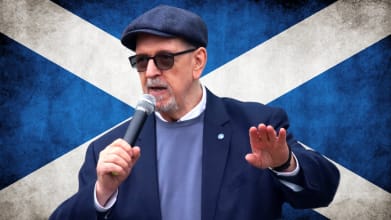
The opinion polls show a 50/50 split. I think when it’s a clear sustained majority there will be another referendum. Arguably the smart move for the British state would be to have one now - losing a second time would take independence off the table for 30 years
The polls have flatlined since 2015. Yet the SNP and the rest of the independence industry refuse to even consider changing their approach to the constitutional issue. What will prompt a rise in polling for Yes is action, not glossy brochures and flashy photo-ops. What is lacking is belief that it can happen. People may want independence but decline to actively support the idea because they are not convinced it can actually happen. They need to see a plan.
Neither the SNP nor any of the other nominally pro-independence parties is showing us a plan. It's all bold rhetoric and snappy slogans and worthy sentiments, but with no substance.
You're right about offering Swinney a Section 30 referendum being a smart move on Starmer's part. One of my fears for this election was that Starmer would shoot Swinney's fox by offering a Section 30 transfer of powers. Swinney would seize this with alacrity. Only then would Starmer start to list the conditions and caveats. Swinney would be trapped.
The British state will never sanction a referendum which might put the Union in jeopardy. If they are giving us a referendum, then the fact that they are giving it proves that it will not lead to independence.
There is only #ScottishUDI.
The Scottish Parliament in 1707 in no way at all dissolved itself - it adjourned on the 25th March with, as far as anyone can tell, every intention of reconvening BEFORE the Union started on 1st May.
Going back to the treaty of Union, there were English troops sent up to the border (can't find exactly which camp yet) and in Edenburg itself, by the infamous traitor Queensberry who was well rewarded. In addition units of the Royal Navy were from memory, off the Firth of Forth. Hostage taking was common - wives and children living down in London without a train in sight! That was the many sticks - the carrot was "nobles" debts paid off and houses in wonderful lively London and places at court. This all continued in different ways during the Scottish Parliament "debates" about the Act of Union with England. Vote Aye or else.
Voluntary my arse. Scottish crown ilkawise.
Interesting links:
https://www.scottisharchivesforschools.org/union1707/chapter5.asp#:~:text=Troops%20were%20brought%20into%20Edinburgh%20to%20maintain,English%20border%20in%20case%20of%20further%20unrest.
and in its way
https://www.sqa.org.uk/pastpapers/papers/instructions/2022/mi_NH_History_Scottish-History_2022.pdf
I don't know whether I'll vote or for whom. My wife likes the Labour guy but can't stand Sarwar so thinks she'll vote for the Independent candidate called William Wallace on the list. I might do the same!
There is one interesting thing in the manifesto but. It's the populist and mostly stupid supermarket price cap. Which would bring ScotGov into a "public health" conflict with the Infernal Market Act which ScotGov might win and thereby dingy the Union. Strong possibility of that I think on past court records.
Swinney has very little time, hours only, to make a very public Independence impression. My postal vote arrived today, earlier than I expected. Others might dingy the SNP on the basis the manifesto is inadequate for Indy.
"Normally if the British state pointed to the Section 30 process and claimed this offered a val
The Scottish Government can no more reject validating the Section 30 process than it can deny Westminster's authority in Scotland. It is the creature of the Westminster government, given life by the Scotland Act. Anything else would be ultra vires; it would immediately trigger a Supreme Court challenge and censure or worse for the Scottish government.
In the scenario you describe, whereby the UN recognises (the demonstrable truth of) Scotland as an annexed territory under a fraudulent treaty and bogus 'voluntary partnership', the UN would pay no more heed to an arm of the body politic endorsing the conditions of its attachment than it would to the body politic declaring the rectitude of the arrangement. It would treat them as one and the same body.
The fact is that the Scottish Government has no standing whatsoever in the matter of Scotland's constitutional future (in truth it already has none) once the UN determines Scotland's status as no voluntary partner of England but an annexed territory under English Crown sovereignty - a 'dependency' as the 1954 Royal Commission put it, in a choice of two and only two mutually exclusive constitutional states.
Who or what therefore does have standing? The Scottish people, in a representative body. Let's call it a Convention of the Estates, since an institution by that name was the body that consistently dealt with the constitutional affairs of the (annexed yet extant in all essential regards) Scottish state.
That said, John Swinney has given no incentive to Scots to come out and celebrate should his party continue in power. A recognition of the truth of Scots sovereignty (entrenched even in the UK's constitution) and the Scottish Government's dilemma as an arm of the UK government would have been the least if things. An election fought on a common independence maximising ticket, and a statement that a Convention of the Estates would be assembled immediately after an election win, would have been electrifying; he could have flooded the streets of the capital.
This sounds very like the Sara Salyers argument. I've never understood the notion that the people of Scotland own everything in, on, under, and around Scotland, except the parliament that we elect.
The Convention of the Estates thing has a certain immediate emotional appeal to what our opponents would doubtless call 'Braveheart nationalism'. But try thinking it through, and it falls apart like a ginger nut biscuit dropped in a cup of tea. It compares very badly with the alternative.
The Convention of the Estates doesn't exist. The Scottish Parliament does. It would be possible to put together an organisation calling itself the Convention of the Estates. But whence its democratic legitimacy? The only way it could have democratic legitimacy would be if it borrowed it from the Scottish Parliament. The Convention of the Estates could only have legal and constitutional standing if it were established by an Act of the Scottish Parliament. Aside from the fact that the Scottish Parliament is hardly likely to create a body that would compete with it, this runs into the ubiquitous problem of legislative competence.
In other words, the Convention of the Estates idea only becomes a possibility AFTER #ScottishUDI.
The Scottish Parliament is legally and constitutionally the primary legislature for Scotland. The fact that it is a creature of Westminster is irrelevant compared to the parliament's legal and constitutional standing in Scotland. The proposed Convention of the Estates would have no legislative competence at all. The Scottish Parliament has almost complete legislative competence. All that is required for the Scottish Parliament to become the national parliament of an independent nation is that it repossess the competencies that are being withheld by the British state.
Politically, the Convention of the Estates idea is never going to fly. One of the benefits of devolution is that it shifted the locus of Scotland's politics from London to Edinburgh. People identify with Holyrood. They think of it as their parliament. Selling the idea of a Convention of the Estates to the public would be very difficult.
Why bother? Legally, constitutionally, and politically, it is far easier to simply take back our parliament. It makes for a simpler yet vastly stronger campaign message if we portray the Scottish Parliament as the ancient parliament of Scotland taken from us in 1707 and reconvened – as Winnie Ewing stated – in 1999. Our parliament was returned to us in 1999, but it was returned bound in the chains of devolution. All that is required is for the parliament to strike off those chains. That is one of the things the #ScottishUDI strategy does.
Then there is the matter of time. There is wide agreement that the constitutional issue needs to be resolved as a matter of urgency. Given this, it seems foolish to take time out to get a new body up and running and, crucially, accepted by the people. You'd be starting from scratch with something few people understand and working against reluctance, if not outright opposition, from every quarter.
It is better to do what nature does. Evolution doesn't 'invent' new things. It builds on what already exists. It adapts what is already there. The #ScottishUDI process works like evolution.
I was reading back through your recent blogs and comments Peter and when I got to this bit. it made me think.
"The Convention of the Estates doesn't exist. The Scottish Parliament does. It would be possible to put together an organisation calling itself the Convention of the Estates. But whence its democratic legitimacy?
vvvv
The only way it could have democratic legitimacy would be if it borrowed it from the Scottish Parliament.
The Convention of the Estates could only have legal and constitutional standing if it were established by an Act of the Scottish Parliament.
^^^^
Aside from the fact that the Scottish Parliament is hardly likely to create a body that would compete with it, this runs into the ubiquitous problem of legislative competence.
In other words, the Convention of the Estates idea only becomes a possibility AFTER #ScottishUDI."
For the avoidance of doubt I am not about to argue against any of the points that you made.
It occurs to me however that an alternative possibility might be viable (as a thought experiment).
A modest proposal follows. ;-)
In the M4I the democratic legitimacy comes initially from the Scottish People voting for the M4I proposals that were formally presented to them as part of the party political election manifesto process.
The election is now past and that did not happen.
However a near equivalent may still be theoretically possible.
A close simulcrum of the M4I process could perhaps be initiated without the occasion of an election by the Scottish Parliament first passing a bill to hold a referendum which would give the sovereign Scottish people the chance to express their will.
Perhaps something along the lines of "vote YES or NO to: Should the Sovereign Scottish people give their consent to their establishment of a Constitutional Convention which will ... [do the specified things that we need it to do ] ."
This then would have been organised by the SP but validated by the people.
Obviously the passage of the initial question Bill would be subject to the familiar difficulties (and thus opportunities) as have been previously discussed at length here.
Indeed I would argue that the attempted administrative blocking of such a bill could be the nucleus of a campaign in the SP that could cause a further bill to subsequently be brought forward
along the lines of the M4I empowerment question.
"vote YES or NO to: Should the Sovereign Scottish people give their consent that their Scottish Parliament should henceforth be responsible for all laws and regulations that are to be passed by this parliament"
A sort of recursive process of upping the ante and asking the sovereign people to approve more each time that the previous more modest proposal is blocked.
If the first Bill passed, then the possibility exists to establish a SS / Graeme McCormick style extra-parliamentary body claiming genuine legitimacy from our popular sovereignty.
If the 2nd bill was blocked, then the sequence can continue e.g.
"vote YES or NO to: Should the Sovereign Scottish people give their consent that their Scottish Parliament should henceforth no longer allow the administrative blockage of democraticaly and procedurally regularly passed bills from being blocked by the English Crown?"
Imaginative eh? Now this is a thought experiment, and obviously it would be difficult to envisage the current timid SNP following such a bold plan.
Have a think about the underlying premises.
Obviously the exact details of implementation could be adjusted as necessary.
;-)
I apologise for the tardiness of this reply. I somehow missed your comment.
As I understand it, what you are suggesting is a formal referendum legislated for by the Scottish Parliament establishing a body – perhaps called a Constitutional Convention. I'm not clear, however, on what would be the purpose of this newly created body. If it were to have the power to do something, it could only have that power if it were given by the Scottish Parliament. But the Scottish Parliament couldn't give this new body powers if the Scottish Parliament didn't itself have the powers in question.
I'm not seeing where this goes.
Think bigger Peter!
The point is in the process not the initial proposal.
As I said for the initial proposal, whatever suitable text is to be put there can be thrashed out as appropriate.
The fundamentally important outcome is that it is the Sovereign Scottish people who are giving their permission, not the Scottish Parliament (who as we well know cannot 'legally' currently expand their powers as constrained by the Scotland Act.
It is a though experiment about how to jump over the traces of UK law by applying Scottish constitutional Sovereignty.
Other permutations may be available if we have the wits to imagine them.
I'm still not seeing how a body established by the Scottish Parliament could do anything that couldn't already be done by the Scottish Parliament. I get that the text defining the purpose and powers of this new body remains to be "thrashed out". But that doesn't mean they could be anything at all. It's not open-ended.
It seems like the idea is to get around the problem of the parliament being unable to do something by having the parliament establish a body that it empowers to do those things.
I understand that it's a thought experiment. But I just can't seem to think it through to any useful conclusion. When I try, I keep coming back to the question: why didn't the Scottish Parliament just do whatever it is that it has set up this body to do?
The important thing that the Scottish Parliament can't do is legislate for a proper constitutional referendum. For the same reasons, the Scottish Parliament cannot legislate to set up a body that would legislate for a proper constitutional referendum. It seems like an attempt to do something that requires breaking the rules while acting within the rules. That's illogical.
The problem that this ideal seeks to resolve – again, as I understand it – is getting an electoral mandate to do something that breaks the rules. It seems obvious to me that you can't have the parliament legislate for a referendum that provides a mandate to break the rules unless the parliament itself has the capacity to break the rules; if only it had an electoral mandate to do so.
I feel an infinite regression headache coming on!
This is where a de facto referendum comes in. Because it is logically impossible to acquire a mandate to break the rules by way of a process that is constrained by the rules that are to be broken, it is necessary to use an informal process which can function outside the boundaries set by those rules. That's what a de facto referendum does. So, you use a cleverly contrived de facto referendum to acquire the mandate to break the rules. Specifically, a mandate to assert legislative competence in matters relating to the constitution.
This works only if nobody reads the above explanation. I think!
Aye, so at least you have thought it through.
But don't over think it! ;-)
my initial reaction would be to recoil from this bit:
"it is logically impossible to acquire a mandate to break the rules by way of a process that is constrained by the rules that are to be broken"
by retorting that if you start with your conclusion then you are going to end up at that conclusion, but that is not helpful! ;-)
I will think on this some more. I have to go away from my computer now.
To be clear that first part is entirely political in nature.
It is a campaign to create awareness and drum up support.
Since the situation as it stands at the moment I do not foresee any such bill ever being 'allowed' to pass by the English Crown.
However their still remains the possibility in the future to refer to these 1,2 or 3 bills which were passed by the parliament and struck down by the English Crown.
either at a subsequent M4I style election or indeed as justification for drawing the situation to a creshendo and proposing the denoument of 'an Independence Election'. ;-)
".. if we portray the Scottish Parliament as the ancient parliament of Scotland taken from us in 1707 and reconvened – as Winnie Ewing stated – in 1999. Our parliament was returned to us in 1999 ..."
There is the rub Peter - that 'portrayal'. Because that's all it ever was and all it ever can be. Winnie Ewing's ' Scottish parliament reconvened' was no more than symbolism - wishful thinking, nostalgia for an auld sang.
Sadly it was and remains misleading. No parliament was returned to us; indeed nothing was returned to us. Instead, a brand new strangling tentacle of English government, established by ordinary statute, mark you, was extended into Scotland, complete with a phalanx of English functionaries to administer it (that no-one thought to replace - that tells you something).
Moreover, as Sara Salyers says, the Treaty of Union was actually subordinated to the Scotland Act. Can you credit that? The creation reaches back in time and changes its creator. They simply make it up as they please, as England's imperial prerogative has forever down the ages, and most especially since 1707, operated.
The perceived complexity of the Convention of the Estates you're expressing here is overstated. We agree that Scotland is a state frozen in time, immobilised, yet constitutionally and institutionally preserved, like a bee in amber. We are creating no new state, but restoring the ancient sovereign nation state of Scotland. Think Poland, the Baltic States, Armenia and certain Central Asian republics. Think Austria.
Scotland comes as a package - its constitution is in large part expressed by the Claim of Right; its unique Crown - the Community of the Realm - no king, but the people themselves; that Crown's territory and institutions of state. Those include the Convention of the Estates and Parliament.
An arm of English government, whether it has a degree of legitimacy through an elective process or not, can not sever itself in international eyes from the body. But, as Kosovo shows, it does not need to. Indeed, it shoots itself in the foot internationally by attempting to do so. All that is required is that those representatives who have obtained legitimacy via an election - the essential ingredient in all of this - declare first the formation of the Convention of the Estates into which they carry their legitimacy and which itself carried immense constitutional legitimacy, and then declare UDI under the auspices of that institution. Or, rather, declare the restitution of the ancient nation state of Scotland and an end to annexation. With the required mandate achieved via the English government's elective process, nothing could be simpler; nothing more constitutionally coherent.
You're just adding a totally superfluous step to the process. Instead of the Scottish Parliament simply passing an Act of Dissolution, you've got it changing its name to Convention of the Estates first. Why? Why take the legitimacy to another body before using it? You say yourself that it's the same legitimacy.
You're the one harking back to the past. You want to bring back the ancient Convention of the Estates for what can only be reasons of nostalgia, because there is no other reason for it when we already have a fully functioning modern parliament. All that is required is for that parliament to reform itself. The Scottish Parliament stops being an arm of Westminster when the Scottish Parliament says so. I suppose it could change its name to Convention of the Estates as part of the process. But I can't think why it would want to.
I've tried to explain why such a step is far from superfluous, using the Kosovo ruling as a very recent and very live example. What I can't understand is why you express concern for what the UN might think about the Scottish administration asking Westminster for a Section 30 order (nothing, in my view - it is one branch of Westminster asking another), yet have no concern for how it might apply international law should an arm of the UK government declare UDI.
You're not getting it. If you are talking about the Scottish Parliament being an arm of the UK government, then you have either not bothered to read about #ScottishUDI or you simply haven't understood it. Following the #ScottishUDI process, the Scottish Parliament would cease to be an arm of the UK government.
Your failure to comprehend is not limited to the #ScottishUDI strategy. I did not "express concern for what the UN might think about the Scottish administration asking Westminster for a Section 30 order". My concern is that the UK government would be able to claim that there was an existing democratic route to independence that was validated by First Minister John Swinney and that there was, therefore, no call for any UN intervention.
The Section 30 process must be repudiated. The application to have Scotland added to the list of non-self-governing territories (NSGT) is undermined if there is a democratic route out of the Union for Scotland agreed upon and accepted by both sides.
Keeping the section 30 process on the table destroys the principal justification for the Scottish Parliament asserting its legislative competence in relation to constitutional matters. The #ScottishUDI process works by making the constitutional issue a human rights issue. It works because it doesn't prematurely seek to restore independence but to secure the means and opportunity whereby the people of Scotland fully and freely exercise our inalienable right of self-determination. The argument is that the Scottish Parliament must unilaterally repossess legislative competence in constitutional matters, as this is the ONLY way there can be a proper constitutional referendum. If John Swinney validates the section 30 process, that justification is lost.
This should concern you, as your imagined Convention of the Estates would be relying on the same arguments after it somehow acquires the democratic legitimacy and legislative powers of the Scottish Parliament.
I just don't see the point of setting up a new body to do what the Scottish Parliament can already do. When the Scottish Parliament asserts its legislative competence as described, it becomes the thing that you want your Convention to be without the hassle of setting up a separate body. A separate body which would in any case have to be established by the Scottish Parliament in order to have any legal standing or democratic legitimacy. And the Scottish Parliament could only establish the Convention AFTER it had taken back that legislative competence and so made itself the thing that the Convention purports to be.
Only a lawyer could think up something so pointlessly complicated.
Because Scottish law is sovereign(forever in the text of the Treaty of Union),Scotland can do a UDI (theoretically).
The problem is what democratic institution could you use? HR is out.
It would have to be in Scotland,it has to be under Scottish law like the Treaty of Union.
All British citizens and institutions are under the Great Britain parliament for British citizens,under English law.
That is why NS as a lawyer never went to the Scottish courts,despite that being where the AOU is.
I worded that wrong. All British citizens and 'POLITICAL' institutions are under the Great Britain parliament for British citizens,under English law.
And now everything that is devolved under devolution is under Scottish law.
The British(WM) have no legal way to give powers to HR to end the union,that is Scottish sovereignty,that ends at the Scottish border.
Scottish judiciary is sovereign
Scottish political legislation is not,since May 1 1707.
But WM could scrap the devolution act anyway. No Parliament can bind another under English law.
No,Peter.
The 'real' Scottish parliament dissolved itself after passing the Treaty of Union.
It can only come back under the Scottish crown,it was dissolved under the Scottish crown.
Scottish Mps dissolved the Scottish parliament before British citizenship replaced Scottish.
It doesn't actually exist in Scottish law anymore,for 319yrs.
As i have said,Scottish law ends at the Scottish border. WM is under English law,so is the devolution act.
I will prove it. Humza Yousaf as SNP leader: "I look forward to the day we can pass an act of the Scottish parliament to repeal the Treaty of Union."
He said this while FM in coalition with the Greens with a majority?
The SNP know that HR can never act as a bona fides Scottish parliament.
I do not know how we resolve the question of how we achieve a body of Scots recognised as legitimate by London and by the people of Scotland and by the International Community.
However, I can state categorically that I could never accept an SNP government or a Parliament, elected under the current British decreed basis, as having the responsibility for negotiating our leaving the British Union or for setting up an Independent Scotland with a new Consitution and all the machinery of government.
I totally agree. Which is why I say we must take back our government and then take back our parliament so we can take back our nation. Far too few people seem capable of imagining the Scottish Parliament as anything other than what the British have made it. The breakthrough comes when a significant number of people realise that the parliament can be whatever we want to make it.
London, the international community and the people of Scotland already recognise the Scottish Parliament as Scotland's legislature. It's just that this legislature is shackled by the chains of devolution. A foreign parliament asserts its supremacy over the parliament that is elected by the people of Scotland. and our politicians meekly accept this state of affairs.
Which tells us what? It tells us that we need better politicians. They won't get better of their own accord. They won't serve Scotland's cause better than they have these last eleven years unless we, the people, force them to do so.
If we are to do this, we must organise. The idea occurred to me yesterday that there are actually two independence movements. There is what I have called the 'independence industry', the SNP, Believe in Scotland, etc. It is well organised and funded, at least compared to what I would call the liberation movement.
The independence industry is old and sluggish and set in its ways. The liberation movement is young and agile and wide open to new ideas and fresh perspectives. What the liberation movement lacks is organisation. The ability to speak and act as one. The ability to convert its strength to effective power.
I think that is what the Alliance to Liberate Scotland wanted to do. A pity they did not get more support, but the media ignored them and the Unionists were against them, as was the ‘we control the Independence narrative’ SNP.
Alliance to Liberate Scotland failed because there was no credible plan. Ask them how they intended to restore Scotland, and all you got was, 'We'll just do it!'. It was amateurish! They were obviously clueless about how the Scottish Parliament works. The last thing I saw from them was a demand that the First Minister call a snap election. Which the First Minister cannot do!
Maybe you should read what Humza Yousaf said. Because it totally contradicts what you are saying. He recognises that independence will only be restored by an Act of the Scottish Parliament. The question is how do we get to the point where "we can pass an act of the Scottish parliament to repeal the Treaty of Union". The #ScottishUDI process answers that question.
The people of Scotland are sovereign. The Scottish Parliament is whatever the people of Scotland say it is. All this waffle about citizenship and legal systems is irrelevant.
The Scottish Parliament exists. It sits in Edinburgh. I've seen it with my own eyes. And I don't mean the parliament building. I mean the parliament. Which is the 129 people elected by the people of Scotland to serve as Members of the Scottish Parliament.
The Scottish Parliament is an executive arm of Westminster because that is what Westminster says it is. Unlike you, I do not accept that Westminster has the last word on this or any other matter relating to Scotland. If you allow that Westminster has the last word, you deny the sovereignty of the Scottish people. I will not deny the principle of popular sovereignty. To do so is tantamount to denying that Scotland is a nation.
De-colonise your mind! Exclude Westminster completely from your thinking on the constitutional issue. Westminster has no legitimate role in the matter of deciding Scotland's constitutional status. It is an internal matter for the people of Scotland alone.
Then go to the sovereign Scottish courts and make your case. That is where the AOU is!
Nobody is stopping you,Peter.
It isn't in the GB Parliament,it is in Scotland.
Did you see the word 'British' on the ballot paper in 2014?
You can lead a horse to water, but you can't make it drink!
I can make no sense of this.
The GB parliament is sovereign over all British citizens only.
However,the Kingdom's are the sovereign part that created the British.
The British have no say in the AOU,they would have to 'legally' overrule the sovereignty of the Kingdom's that created them(legally not possible)
That is why it is the 'UK' flag,not the 'British' flag.
The British have no sovereignty at national state level, that is reserved for the Kingdom's.
British sovereignty is Parliament and citizenship,that is all they are allowed in the AOU.
The Scottish Crown is sovereign
The Scottish Judiciary is sovereign
The Scottish legislature is British.
Do you think the AOU is British?
The AOU is the Kingdom's of Scotland and England.
The Kingdom's were united first through the AOU,then came Great Britain,Peter.
The British are created through the text of the AOU on May 1st 1707. Meaning the UK predated the British. That is why the British are not in the AOU.
In the Treaty of Waitangi that created New Zealand,the Maori were given British citizenship. They are not in the AOU,Peter.
the Maori cannot repeal the AOU?
From AI on the web:
"The Acts of Union refer to two acts of Parliament, one by the Parliament of Scotland in March 1707, followed shortly thereafter by an equivalent act of the Parliament of England. They put into effect the international Treaty of Union agreed on 22 July 1706, which politically joined the Kingdom of England and Kingdom of Scotland into a single "political state" named Great Britain, with Queen Anne as its sovereign. The English and Scottish acts of ratification took effect on 1 May 1707, creating the new kingdom, with its parliament based in the Palace of Westminster."
A Section 30, though an Order in Council and usually subject to little debate in either Parliament, nevertheless requires consent from both UK houses, commons and lords, AND the Scottish Parliament. Not a lot of people know this but it's in the detail.
Briefly, a Section 30 is subordinate / secondary legislation, and in its case is subject to a Type A procedure - which from the next page is:
"Type A: No recommendation to make the legislation is to be made to Her Majesty in Council unless a draft of the instrument —
(a) has been laid before, and approved by resolution of, each House of Parliament, and
(b) has been laid before, and approved by resolution of, the Parliament."
https://www.legislation.gov.uk/ukpga/1998/46/schedule/7/crossheading/general-provision
So any of these has the legal right to refuse approval of the draft. No need to go to court - and no point either.
Lesley riddoch needs to make a real documentary on Scotland past and present.
She stuck mainly with Scandinavian countries instead , yes I get it , with comparisons and lifestyles and oil wealth.
The corruption of our people is blatant , and typical of perfidious Albion , where they create division amongst us .
Better to have home grown politics, our very own democracy and ideologies.
Onwards and upwards🐼🐼🏴🏴❤️
I've never been very comfortable with the 'Scotland should be more like xxx' argument. What's wrong with being ourselves?
I think it is obvious that we have more in common with Scandinavian countries than with England, particularly on the grounds of levels of equality and the care for using natural resources for the good of the country and the people who live there.
It makes sense to point this out as the contrasts are stark.
Scotland's a good laugh. Having lived and worked in Sweden for a few months, it ain't.
Agree with all the above, #UDI is the only option .
It is the declaration from Scotland of independence and ending the union.
When are the folks going to get it into their brains , the unionist branch office employees are English puppets bought and paid for , absolute traitors , so many of the SNP are as well, with ermine waiting for them.
Their names will never be in Scottish history book's.
Just a traitorous footnote.
Onwards and upwards🐼🐼🏴🏴❤️
I agree,with UDI being an option and (disagreeing with Peter about the UN approach bring useless) consider it helpful as, if successful, designation as a non-self-governing territory denies Englsnd (aka Britain) the right to interfere in the process of Scotland becoming free. Decaring UDI in those circumstances would be legal snd supported by other states.
I also disagree with the notion the UN would not be that bothered or consider Scotland important. Au contraire, the UN could see the break up of the,UK as a welcome opportunity to change the outdated UN Security Council to something more in keeping with the position of countries around the world now.
A United Kingdom of Great Britain and Northern Ireland shown to be a colonising power under a false name, having lied about the status of Scotland, when asked in the 50s, and with its hold on Wales and N Ireland looking very skaky, could well be denied continuing status to the club and the resulting shakeup could be of advantage to many countries and establish a new world order to replace the current obsolete version.
I didn't say the UN initiative was useless. I said that ON ITS OWN it would change nothing. It is also misleading to say the success of the UN initiative would make UDI legal. According to the ICJ, UDI does not breach international law.
The key to the whole thing is the issue of legislative competence. Like many others, you are coming at the issue, asking, 'How do we restore Scotland's independence?". That is the wrong question. The question that must be asked and answered first is "How do we secure the means and opportunity to fully and freely exercise our right of self-determination?"
The answer to that question is that we must first restore the power of the Scottish Parliament to legislate in constitutional matters. Because only then can we have a proper constitutional referendum. The only way to restore this legislative competence is for the Scottish Parliament to TAKE IT BACK from the British state, which usurped that power in 1707.
How do we 'take back' our Parliament from under the British state, particularly when it is largely made up of the SNP, a party which consistently shows it us not willing to do so?
The situation may change after the May election, but I don't expect one that will be willing to do this will emerge!
What must be done and what can be done are two separate issues. The fact that independence can only be restored by a particular process exists quite separately from the fact that the dominant force in Scottish politics refuses to commit to this process. The first fact cannot be changed. The second can be changed.
In the run-up to the 2026 Scottish general election, the independence movement's energy was almost entirely devoted to various efforts to change the first fact, all of which were necessarily futile.
Only a handful of pro-independence activists, including myself and Mike Wallace, were working to change the second fact. Needless to say, that work was in vain. It came to nothing due to lack of support.
This is why I say that we must first take back our government. By which I mean we must exert some control or significant influence over the party or parties which will form the Scottish Government after the election. That was always going to be the SNP. The SNP was always going to remain the dominant force in Scottish politics after the election because there was no party posing a meaningful challenge.
We failed to take back our government. Therefore, we have no possibility of taking back our parliament in the next five years and obviously no possibility of restoring independence.
It is important to note that this was a choice made by the independence movement. People will be quick to blame the SNP and/or Alba Party or other supposed 'alternatives'. But it was always the case that the only way Scotland's cause could be progressed was by bringing a hammer down on the SNP and other nominally pro-independence parties. Only the independence movement in combination could be a big enough hammer to do the job. The independence movement chose to be a thousand ineffectual wee toffee hammers instead of the one sledgehammer that was required.
The situation will remain the same after the election. Except that the independence movement will no longer have any potential leverage over the SNP and the rest. The leverage afforded by the election will have been squandered.
What will change the situation is John Swinney submitting a Section 30 request. Merely submitting such a request undermines Scotland's cause regardless of whether the Section 30 order is granted or refused. But that is outwith the scope of this response.
My analysis of the now inevitable situation after the election is that a new party of liberation must emerge. This is in keeping with post-colonial theory. With hindsight, I can see that this new party should have been contesting this election. But I was persuaded that the independence movement could be induced to combine for the purpose of taking back our government and parliament. I was wrong. By far the larger part of the independence movement was fragmented into a plethora of incompatible self-contained projects, none of which had a big enough gun to hold to the heads of Scotland's political elite.
The 2026 opportunity has been squandered in almost exactly the same way that the 2021 opportunity was squandered. No lessons were learned. The sliver of hope that remains is that the independence movement will be shaken out of its tribal idiocy when the SNP again fails to deliver any progress for Scotland's cause. There is the merest glimmer of hope that we might retrieve the situation between now and 2031.
New Scotland Party was set up to be the party of national liberation that turns things around. It should really be relaunched right after the election. But I have neither the money nor the energy to do this. It is likely that other parties will arise looking to cash in on the SNP's betrayal of Scotland's cause. My expectation is that they will all go the same way as Alba Party.
Any SNP figure taking ermine would surely finish the party.
At this time of global energy uncertainty, Westminster needs Scotland's energy resources more than ever to just remain afloat. No chance of that situation changing sometime soon.
I think Scotland would be prepared to do a deal abd sell energy to England,at tge market price. We could also suggest that taking away the nuclear waste we did not ask to be dumped on us be removed, as condition of that.
There are two Scotland's since May 1st 1707ad in Scottish law.
1)Sovereign Kingdom of Scoltand.
This is the country under Scottish sovereign law and Crown.
Treaty of Arbroath 1320
Union of Crowns 1603
Claim of Right 1689
Act of Settlement 1701
Act of Union 1707
These are all under 'sovereign' Scotland. Nobody can ever repeal these other than the sovereignty of the Scottish law and Crown. And 'crucially' Scottish(not British) citizens.
2)Scotland that is part of the Great Britain land area,British citizens under the Parliament for British citizens. Scotland is not sovereign here,the Great Britain parliament is.
If Lesley gets over a 100,000 that would hold some strength to the argument for a English controlled S30 referendum. But the fear is she will be lucky to get a few hundred doing more harm than good This would feed the unionism stance that there is no appetite for a referendum or independence. You don't hold a march, protest or demonstration unless you know you can get the numbers. Political posturing just doesn't do it.
Liberation Scotland/Salvo UN initiative
This is just silly. The Treaty was written and passed by the Scottish parliament Jan 1707. Without them doing that the British literally cannot legally exist on May 1st 1707.
As i have pointed out before,in this act of the Scottish parliament(Act of Union),Scottish law was kept sovereign. In other words the treaty has never left Scotland. And can never do so.
The British have no say in the Treaty of Union.
They couldn't even be mentioned on the voting paper 2014.
This is why even the British concede the Union is voluntary. The Union is between the Kingdom's. Great Britain (the British) are a separate legal entity for the land area of Great Britain. But GB cannot exist if the Kingdom's are not united.
That is why on a British passport they are two separate entities. But the United Kingdom comes first.
How is the UN going to repeal an act of the Scottish parliament 1707,when only Scotland uses Scottish law,and it ends at the Scottish border under the Scottish crown?
England,Wales,Northern Ireland and the Republic all use the English system of law.
Scotland uses the continental system of law.
The British are Great Britain,the land area and citizenship for the people in that land area. 'Great' Britain just means largest Island.
This is why we can do a plebiscite.
But we cannot use a British institution(Holyrood)to put the vote into effect. As all British citizens and institutions are (legally)linked to Great Britian and are under the Great Britain parliament.
Interesting arguments here and elsewhere. But firstly, the Treaty of Union was NOT the Scottish Parliament, it was a load of commissioners appointed by Queen Anne - acting as Queen of both England and Scots. If you want dubious legality look no further. Same as the so-called "official" dissolution of the Scottish Parliament on 28th April 1707 to make way just in time for the start of the implementation of the Acts of Union which could not take place without the Scottish Parliament dissolving itself first - it didn't as it didn't reconvene in 1707 to dissolve - repeal - or listen to Salvo.
Second it wasn't just one Act of Union it was two. One with England by the Scottish Parliament and the other by the English one.
Third this citizenship is a mishmash, and a red herring. It's a function of Government, and we could be citizens of Cornwall if "Government" so decided. Which "Government" I'll leave as an exercise in confusion.
Ultimately Sovereignty even in England, is with the people - whatever any Parliament tries to pretend. Unless elections are abolished. we sack the lot at our will - both Scottish and UK.
Oh, and "British" is another red herring - it can be geographical or political. Hence for instance "Danish".
Lesley Riddoch just can't see past the SNP since Herr Sturgeon took over (she was a HUGE fan of the sleek it lying one) and now a huge fan of the not so honest John.. The only leader & FM who TRIED and was prepared to try again if the voters elected him and his ALBA party, (albeit he got things wrong and was prepared to use the same franchise again) but at least he kept his promise when asking for that mandate he got in 2011, & it cost him his job, a job his successor has seldom ever turned up to do, yet she has been getting paid mighty well for her absence, and Riddoch is ok with that.. She makes films about all the small nordic countries that gained their Independence, yet she just can't see past the SNP, the party that is NO longer a party of Independence, & is happy to settle down and keep building their bank balances.. You would think after all the knowledge she gathered from those small now Independent countries, she would have seen the SNP for what it is.. & It will always be PARTY before COUNTRY with them..
Until Voters stop voting SNP NOTHING will ever change...
Lesley Riddoch makes a good point when she says “…when you’re fed up making a point repeatedly, others may only have just started to really listen“.
She then ruins it somewhat by going on to encourage people to gather outside the Scottish Parliament the day after the election in an effort to make a point which can only be described as ... pointless.
Clearly Lesley Riddoch has not read this blog or listened to a Proud Malcontent podcast as she might have noticed the continuous battering of the Scottish Government's and SNP's fraudulent approach to the constitutional question over the decade and the clear alternative and realistic process of #ScottishUDI laid down since around 2021.
Lesley Riddoch is not alone among The National's supposedly pro-Independence contributors in this matter nor among other surviving SNP sycophantic bloggers.
But I guess, like them, Lesley Riddoch has a column to file.
Did they not listen to foreign fat englishman sweating....'you are not having a referendum....you already had one..it will cause chaos......you are destroying 'our 'country...( he means foreign england)
Now if those statements are not enough to shake sense into the Scots who think by voting SNP and then a pathetic section 30... they will somehow 'get ' independence....I give up.
Scots are dumb and that's why the sh*tty foreign english are able to HOODWINK them..over and over and over and over and over again.
Alf Baird calls it distressing..I call it tragic...
If I said what I think we as a nation should do Police Scotland headed by a foreign englishwoman would be knocking at my door.( we're helping to pay for her second home)..they have Scotland by the balls....any country that lets another foreign country use their land to attack other foreign nations...AND NOT KNOW ABOUT IT ...deserve all they bl**dy well get.
Well done for trying Peter..but even you must see that Scotland's freedom is a lost cause.....unless we find our courage .....lost after Bannockburn.
For OUR Scotland and her colonial weans....
Aye Peter, distressing indeed that Swinney, Riddoch and the 'independence industry' appear not to understand what independence really means.
As the UN and history tell us, national independence of 'a people' requires their decolonisation and liberation from an oppressive power and culture.
Only once people realise what independence means will they become nationalists.
Brian Cox gets it, with his "Make Scotland FFS Free!" appeal. But few others on the Calton Hill stage beside him really understand our colonial condition, or the only remedy, liberation:
https://www.youtube.com/watch?v=JGvDqM7PXe0
I wish I could insert a picture because this week I found a picture of our elected first minister (elected by default, I know), bowing in deference as he shakes the hand of the King of England.
It sums up very graphically what Swinney thinks of the notion of the people of Scotland being sovereign.