
Racing to a red light

Firstly, an apology. I’ve been absent for much of the last few days, as I’ve been working on preparations for the relaunch of New Scotland Party (NSP). Also, the laptop I am using for party business lost its hard drive. It just disappeared, taking everything with it. So, I’ve been multitasking, which I freely admit is not my forte. Yesterday, I spent the whole day installing a new SSD while writing an Introduction to New Scotland Party. The former is done. But I fear the article may wander a bit. It may need a bit of editing.
In the meantime, there’s this. A newsletter from Believe in Scotland (BiS) caught my attention. You may recall a recent article in which I likened John Swinney’s “strategy for the SNP securing a second independence referendum” to him driving straight at a row of traffic bollards. Today, I’m making the same point in relation to BiS so as to highlight the fact that the problem of the colonised mind isn’t exclusive to the SNP but affects the whole independence industry.
Put the SNP and BiS together, and you have by far the larger part of the independence industry. Read the newsletter authored by Gordon MacIntyre-Kemp as well as Swinney’s ‘strategy’ statement, and you’ll see what I mean by the term ‘independence industry’. Both John Swinney and Gordon MacIntyre-Kemp are using the constitutional issue to maintain their personal status and the status of their respective organisations.
It is a fact frequently remarked upon that absent effective leadership, organisations tend over time to come to serve themselves rather than the purpose for which they were established. The SNP was established to restore Scotland’s independence. It is clear, however, that its focus has shifted from that goal to its own continuity. Likewise with BiS, all the activity seems directed to empire-building. At least, that’s the impression I get. It seems to me that a great deal of thought has been devoted to planning events or initiatives and very little to the ultimate goal.
The SNP was established to restore Scotland’s independence. It is clear, however, that its focus has shifted from that goal to its own continuity.
The thing about both these guys is that they are managers. I don’t mean that as an insult. Managers do important work. I have no doubt that both John Swinney and Gordon MacIntyre-Kemp are very good managers. But what is it they are managing? Are they managing a project that has independence as its goal? Or are they managing the development of their respective organisations? To me, they both look as if they’d be quite happy to spend the rest of their days managing.
Look at all the things littering Gordon’s year-planner:
Scotland’s Right to Choose campaign
Scottish Independence Congress
Civic Constitutional Convention
Scottish Citizens’ Convention
i-GERS
End the Scottish Energy Bill Rip-Off campaign
Indy Campaign Days
National Days of Action
Believe in Scotland Independence March
Busy! Busy! Busy! But what is there to show for this activity? Support for independence hasn’t increased markedly or consistently. Each initiative seems to breed more initiatives. But it’s all running on the spot. Lots of managing. No achieving.
Neither of these individuals seems to have moved on from the 2014 referendum, having learnt from the experience. John Swinney was quite explicit about his ‘strategy’ being a rerun of the period between the 2011 Scottish general election and the vote in September 2014. Gordon MacIntyre-Kemp’s thinking seems likewise fixed in the past:
The independence movement has to push now and it has to push harder than ever – to push like it is 2013 again and we have a date to aim for…
Perhaps I’m being slightly unfair to Gordon. There is one respect in which he looks to have begun the process of decolonising his mind. He seems to have realised that there are two battles to be fought. Before the battle for independence, there is the fight to secure the means and opportunity to exercise our right of self-determination.
We must launch a massive and engaging Scotland’s Right to Choose campaign – not just asking for a Section 30 but calling for the powers to hold a referendum to be transferred and agreeing what conditions trigger future referendums.
Unfortunately, it’s a case of one step forward and two steps back. Yet again we see the independence industry putting Westminster at the centre of the constitutional issue. In one breath, Gordon asserts our right to choose. Next, he asserts Westminster’s right to dictate if, when, and how we exercise this right to choose. He hasn’t thought the thing through far enough to recognise that Westminster cannot transfer powers which supersede its own. The doctrine of parliamentary sovereignty forbids it.
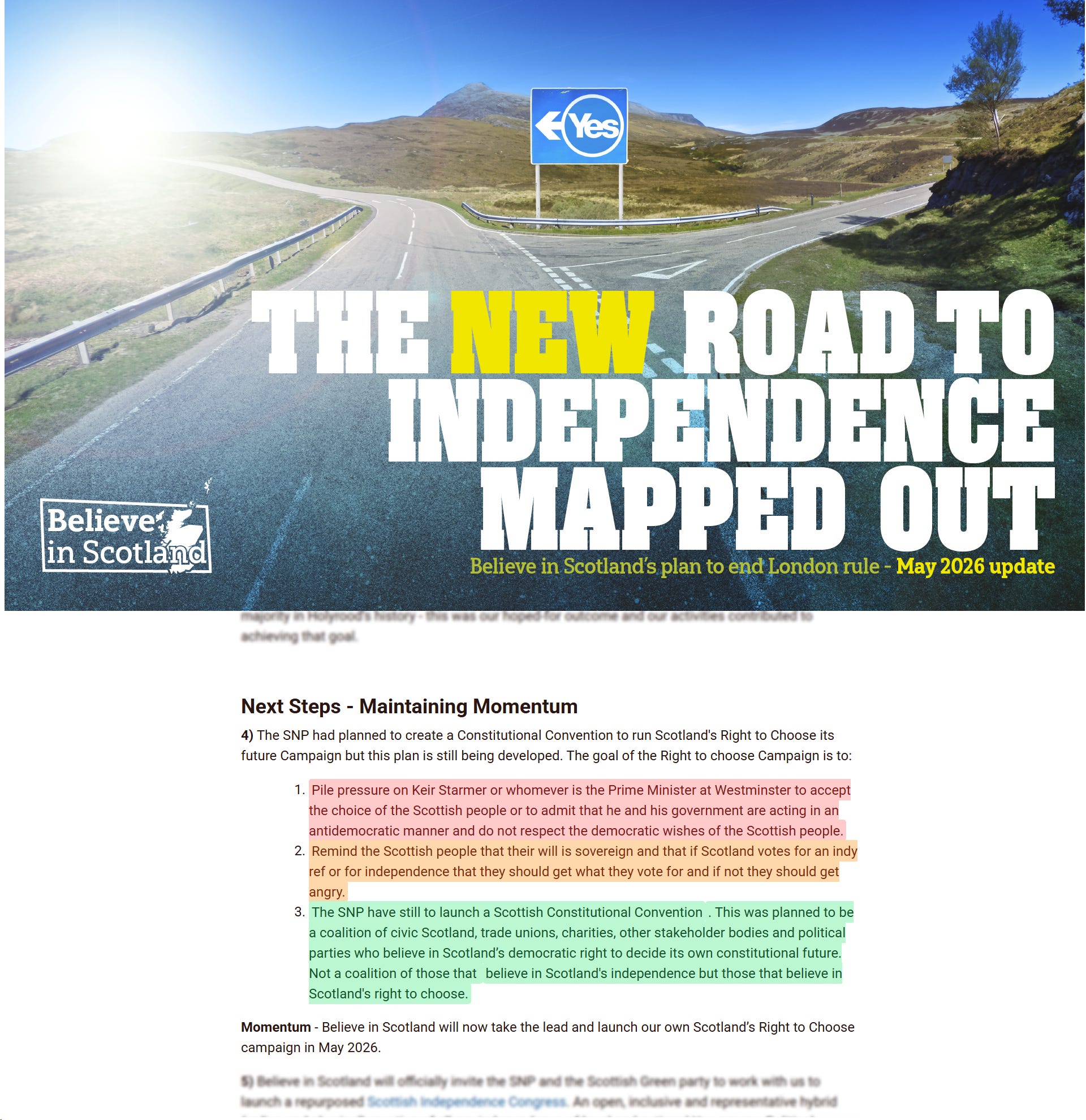
Another part of the BiS newsletter illustrates how the thinking starts well but quickly degenerates. (see image above)
Gordon sets out three steps aimed at “maintaining momentum”. We can gloss over for the moment the fact that momentum implies movement, which is non-existent. I’ll take these three steps in reverse order.
The SNP have still to launch a Scottish Constitutional Convention. This was planned to be a coalition of civic Scotland, trade unions, charities, other stakeholder bodies and political parties who believe in Scotland’s democratic right to decide its own constitutional future. Not a coalition of those that believe in Scotland’s independence but those that believe in Scotland’s right to choose.
There’s that “right to choose”.
Remind the Scottish people that their will is sovereign and that if Scotland votes for an indy ref or for independence that they should get what they vote for and if not they should get angry.
There’s affirmation of the principle that the people of Scotland are sovereign.
Pile pressure on Keir Starmer or whomever is the Prime Minister at Westminster to accept the choice of the Scottish people or to admit that he and his government are acting in an antidemocratic manner and do not respect the democratic wishes of the Scottish people.
There’s the red light. Having motored along nicely, Gordon skids to a standstill at the point where he puts Westminster in the way, preventing further progress. He seems unaware of the contradiction in saying the people of Scotland are sovereign and that the choice of the Scottish people must be referred to Westminster.
Can it be that Gordon MacIntyre-Kemp doesn’t understand what sovereignty means? We’ve already noted that he hasn’t grasped the idea of parliamentary sovereignty or its implications for any notion of transferred powers facilitating a proper constitutional referendum. How can it be that someone so prominent in the independence movement is so clueless about such things?
What hope is there for a satisfactory resolution of the constitutional issue if we rely on the independence industry?
The first question that should be put to anybody (such as BiS representatives / Gordon Macintyre-Kemp and SNP representatives / John Swinney) claiming to have a plan or process or methodology or scheme to enable the exercise of Scotland's right of self-determination and/or restore Scotland's full self-government is:
Who holds sovereignty in Scotland?
a) Westminster Parliament
b) Scottish People
If the answer given is not b) then you know that the respondent(s) either i) don't understand the concept or ii) are charlatans.
I have seen through MacIntyre-Kemp for a long time. Business for Scotland, Believe in Scotland are both the same. They don't even hide it now. In my mind they are both SNP Quangos, they have denied it to me trying to put me down, so I replied with wrong word then tell me the right one. End of conversation.