
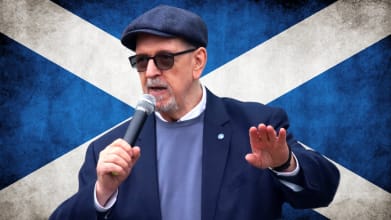
No way out


If you are a supporter of Scotland’s cause and prone to bouts of depression, then you would be well-advised to steer well clear of Robin McAlpine’s column in the Sunday National. Because if his reading of the situation is correct, there is no possibility of Scotland’s independence being restored. At the risk of ruining this and all your subsequent Sundays, I shall quote the relevant parts of Robin’s doom-laden message.
Scotland cannot begin to consider being stuck in the Kosovo situation because our economy is too advanced. There is no half-independence for us, no bluffing it, no work-around. Which leaves one major question – how do we get other nation states to recognise us?
In asking this question, it is important to put away naïve sentiment: it doesn’t matter how much everyone “loves” Scotland, they will all want to see certain conditions met before they embrace us, and by far the biggest of those is that we are entering the world in a state of agreement with the nation state from which we are departing.
Drawing parallels between Scotland and Kosovo strikes me as rather foolish, for the same reason as I deprecate comparisons with Catalunya — the constitutional circumstances are far too unalike for such comparisons to be valid.
But let’s suppose Robin only mentions Kosovo to make his point about the importance of international recognition. There is no denying that Scotland would want more international recognition than Kosovo has so far achieved. But there is no way to guarantee that recognition would be forthcoming. Action that moves us towards independence cannot be conditional on international recognition for the very obvious reason that recognition comes after independence.
Kosovo declared independence knowing that it would not get full recognition. If we are taking Kosovo as an example, then what it tells us is that independence can be more important than full recognition.
All we can do is ensure that the process by which we restore our independence is impeccably democratic. We can never be certain of enough recognition to get UN membership. The best we can do is make sure that the way we restore our independence leaves no grounds for withholding recognition. Even then, we cannot be sure one or more nations won’t withhold recognition despite there being no procedural grounds for doing so. There may be political reasons. Which is the polite way of saying some nations might withhold recognition out of spite. Or out of a need to stay on good terms with one or more of the nations acting out of spite.
Robin takes the view that general recognition will be critically dependent on Scotland being “in a state of agreement“ with the UK. Essentially, what he is saying is that we cannot restore our independence absent the consent of the UK. Or to put it another way, we can only restore our independence on terms which the UK finds acceptable, no matter how much those terms restrict our ability to act as an independent nation.
If the UK’s agreement is as essential as Robin says, we can be sure that this agreement will come at a very high cost. The purpose of the Union was to give England-as-Britain a decisive advantage over Scotland in all matters and for all time. The Union is what allows England-as-Britain to exploit Scotland’s resources for its own benefit and at any cost to Scotland. We can be quite certain that the British state would seek to retain as much of this advantage as can be squeezed from Scotland as the price of its agreement.
If Robin is right, Scotland can never have a status that would resemble what other nations consider to be independence. If he is right, we can only have as much independence as England-as-Britain is prepared to allow. Need I remind readers that this is the England-as-Britain which is barely able to accept the highly restrictive devolution we have? Need I point out the various ways—such as the Internal Market Act—in which England-as-Britain is endeavouring to circumvent or roll back devolution?
The strange thing is that Robin McAlpine appears to genuinely believe that Scotland’s independence can be restored despite this England-as-Britain having the final say on what independence means.
More from Robin:
Democracy isn’t a science but a collective agreement – it works because (almost) everyone agrees to the rules of how it works in advance. If different parties start to play by different rules, it starts to break down.
For example, a referendum is an agreement signed by both sides which states they will abide by the result. It’s [sic] strength is this agreement, this binding commitment. Take that away and it is just an opinion poll. You cannot make another party agree to recognise the outcome of something against their will.
I don’t know what referendum Robin has in mind here, but it can’t be the one we had in 2014 because England-as-Britain did not undertake to “abide by the result” of that sham referendum. Scour the Edinburgh Agreement as you may, and you will find nothing which commits the British state to abide by the result. It was “just an opinion poll”. No process in which England-as-Britain has a significant role can ever lead to the full restoration of Scotland’s independence. And Robin McAlpine opines that England-as-Britain must have a role which is not merely significant but decisive.
I promise this is the last excerpt from Robin’s spirit-sapping column.
If you want to be independent, the people have to support it. If a strong majority of Scotland wants to be independent and London continues to block it, then and only then does the political pressure rise high enough that it starts to force their hand.
At that point we can start talking about de facto referendums or unilateral declarations or delegations to the UN or mass protest as negotiating tactics from a position of strength – but as means of skipping the process of building strength? Forget it.
This is a common argument. Robin is far from being alone in maintaining that we must have won majority support for independence before we engage with the process by which independence will be restored. None of those who advance this argument seem able to grasp that engaging with the process might be the thing which wins that majority support. What is certain is that declining to engage with a credible process will leave Scotland’s cause abandoned up a blind alley, as it has been for the last twelve years.
According to Robin, we will win because we “build a position of strength”. And we will do this by building a “solid, defensible case and an enthused and engaged public”. But building that case is what the independence industry claims it has been doing for all of the twelve years that support for independence has flatlined. Support for independence has flatlined despite whatever it is that the independence industry has been doing and despite the UK government supposedly ‘driving people to Yes’ throughout that period.
It is clear that the SNP Scottish Government’s strategy of making progress for Scotland’s cause conditional on the consent and cooperation of the administering power has comprehensively failed. Yet this is what Robin McAlpine maintains is the only strategy that can work. It sure as hell isn’t a strategy which enthuses and engages the public. Inaction breeds only indifference. People are not enthused and engaged because there is nothing to be enthusiastic about and nothing to engage them.
If support for independence is to increase, people not only need to want it, they have to be persuaded that it can happen. They have to see it happening. But if Robin McAlpine and John Swinney are both correct and nothing can happen without the consent and cooperation of those most strenuously opposed to restoring Scotland’s independence, Scotland’s cause is stillborn. If they are right, we have no way out.
Robin McAlpine has written a lot over a period of time being highly critical of the lack of action on the part of the SNP and stagnation in support for the return of Scotland's independent statehood .
I, therefore, find it surprising that he advocates the very thing that the SNP advocates (as a cop-out from confronting Westminster), which can be characterised as 'building support'.
He must surely be aware that it was the Scottish Independence Referendum campaign is the only mechanism that has caused a genuine and sustained surge in support for restoring Scotland's full self-government. That is, the period when pro-YES support rose from 33% on average in 2012 opinion polls to 45% in the actual vote in September 2014 and onwards/upwards to 50% in surveys by the end of the latter year.
The Scottish Devolution Referendum of 1997 didn't alter underlying support for nation-state status. Neither did the election of the first SNP (minority) government of 2007. Even the SNP parliamentary majority that was returned at the 2011 Scottish election had little effect on sentiment in favour of Scotland's Cause.
The experience of 2012-14 showed that the most effective way to "build a position of strength" and to demonstrate that "independence is the settled will" is to run a time-bound campaign with a specific endpoint at which people indicate their preferred form of government.
Not only do I have great respect and high regard for Robin, despite never having met him I like him as a person - as opposed to ' political commentator '. I perceive him to be someone of deep moral, intellectual and psychological quality. Nonetheless, he does get on my tits on occasion. This is one of those occasions. It's as if his long status/employment as a " political insider ", which no doubt contributes to his well-informed analyses, also makes him over-cautious and just as prone to " ye cannae dae thatery " as too many in the Pro-Independence demographic
You have superbly highlighted the flaws and contradictions in that article - and his position on Independence in general, so I have nothing to add to that really.
Of course none of us can predict with 100% certainty how, eg the Brit State will act in the future, or what the state-of-play will be re the Constitutional Question within Scotland, but I just can't see under what circumstances the Brits will change their hard recalcitrance voluntarily, ergo, how Independence will be restored without some kind of confrontation with them.
Granted Robin does kind of allude to that, obliquely, but only, in his opinion, after there is demonstrably high support for Independence; such increased support surely contingent on unequivocally strong and concerted action by those charged with achieving that goal - as you correctly state. We're in ' chicken or egg ' territory here.
I'd put the inevitability of confrontation with the Brit State at the core of ( probable ) future scenarios and work from that premise to create the conditions in which that scenario can be fought - and, crucially, won. Otherwise what Robin is stating as an absolute necessity before such confrontation is just another bogus sine-qua-non to add to the already fairly long list of such things; eg a 60/70/80% lead in the polls; in some quarters, the removing/replacing of the SNP as the " main vehicle of/to Independence " and - from the more abstract/ obsessive realm - the total elimination of " Woke " Culture from Scotland; good luck with that given it's international entrenchment and reach: would we really want some kind of Trumpian " Woke " Extermination Gov? That would almost certainly be a ' cure worse than the disease " situation.