
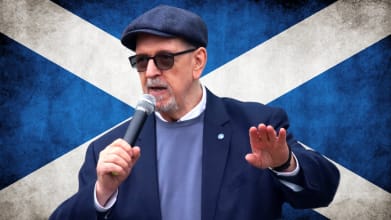
My regret

When you get to my age (75), the last thing you need in your life is another regret. Most men—and this is probably true for women too—have accumulated enough regrets by the age of 25 to keep them haunted through their decrepitude. I certainly did. But it seems I haven’t done collecting regretables quite yet.
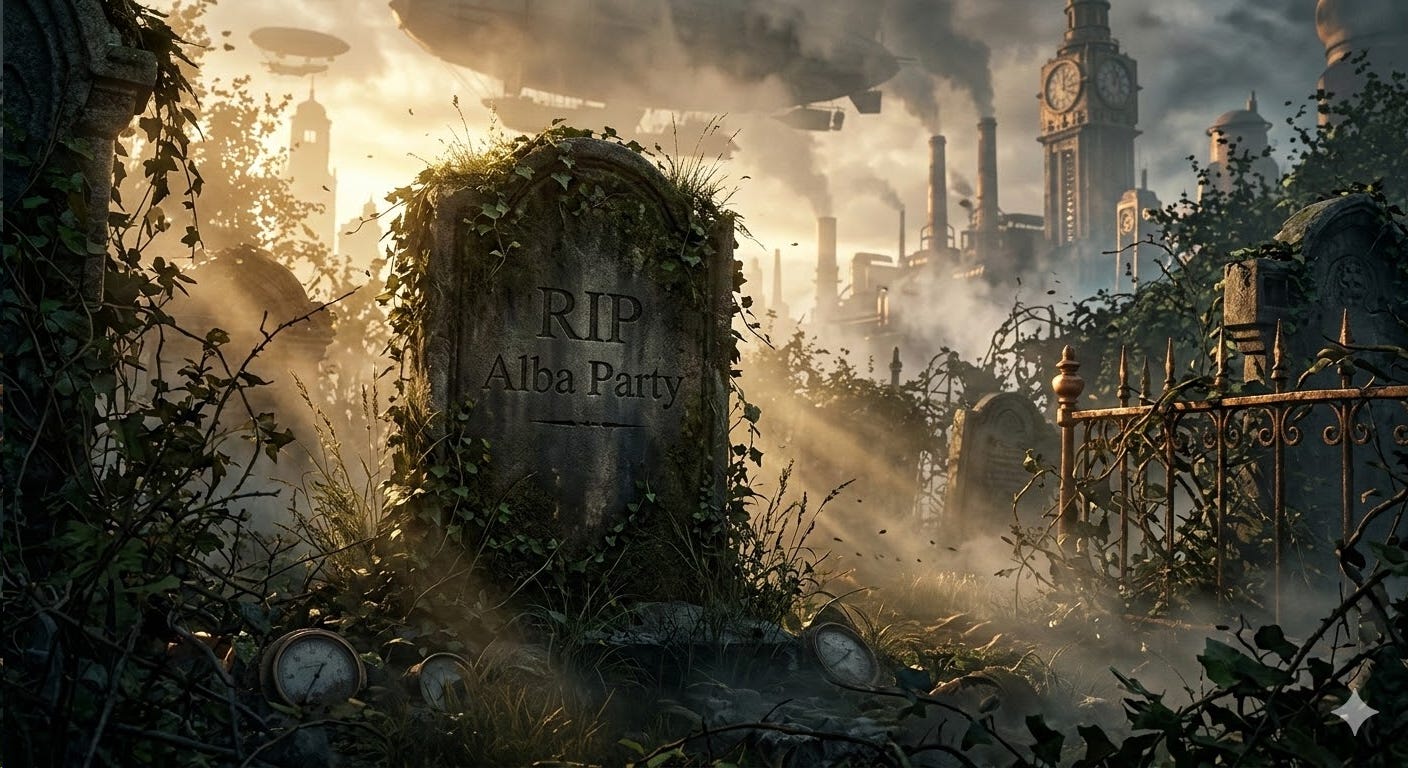
As I read about the demise of Alba Party, I can’t help but regret my choice not to persist with setting up New Scotland Party. It seemed a sensible decision at the time. The Manifesto for Independence Petition looked to be our best bet for using the 2026 Scottish general election as a trigger for a process that would deliver a proper constitutional referendum. It seemed sensible to put all our effort into that. But the initiative failed to gain anything close to the support that was needed.
It was always the case that the SNP was going to win the election, in the sense of gaining the largest number of seats and forming the government. It was also the case that the SNP did not have a clear and credible plan for restoring independence. Since they were going to be the governing party, it was obvious to me that changing the SNP’s approach to the constitutional issue was the only way Scotland’s cause could get a win in the 2026 Holyrood election. Had the Manifesto for Independence Petition attracted sufficient support, it would have been a powerful lever by which to prise the SNP apart from the Sturgeon doctrine, which kept the party wedded to the Section 30 process.
Had the Manifesto for Independence Petition reached even half its target of 100,000 signatures, it would have significantly strengthened the hand of people like Mike Wallace who were trying to change the SNP from the inside. A petition of that size would also get the attention of the media. I’m sure the BBC and the British press would have enjoyed pressing John Swinney with questions about how he intended to respond. It would have made Swinney uncomfortable, I’m sure. I like the thought of politicians being uncomfortable.
The petition failed badly. It didn’t even attract 1,000 signatures. Which is lamentable given that there must be at least ten times that number who consider themselves pro-independence activists. What irked me most was the near-universal refusal to even look at the petition or learn about the #ScottishUDI proposal. All the criticism of the #ScottishUDI strategy came from people who demonstrated that they knew nothing about it.
New Scotland Party was castigated for ‘splitting the independence vote’, despite the fact that we had no plans to stand candidates in the 2026 Scottish Parliament election and despite the fact that it is not possible to split the independence vote because it is a single thing—one half of a binary choice.
The #ScottishUDI strategy was condemned for ‘not consulting the people’ despite the fact that the strategy was entirely about getting a proper constitutional referendum and involved at least two national polls.
Looking back on the year and more that I spent trying to promote the Manifesto for Independence Petition and the #ScottishUDI strategy, the thing I remember most vividly is the sheer scale of the wilful ignorance that I encountered. The terms of the constitutional debate had been set, mainly by the SNP. Positing any fresh perspective or novel idea was treated as heresy. It was altogether a bad experience which forced me to rethink my evaluation of the independence movement. Or at least, that part of the independence movement which has come to be known as the independence industry.
As I said earlier, New Scotland Party never planned on standing candidates in the 2026 election. Now, I very much wish this were otherwise. I wish we were in a position to stand even one candidate. I wish there was at least one person and/or party representing Scotland’s cause in the coming election. I wish there was some place I could put my votes and know that I was voting to progress Scotland’s cause.
I wish New Scotland Party were contesting this election. But Angus MacNeil is correct when he says there is now no time to set up a new party to take over from Alba Party. Not that New Scotland Party was ever going to adopt Alba Party’s approach to the constitutional issue. That would be foolish given how the approach so signally failed to gain much traction with the electorate. New Scotland Party would have been a genuine pro-independence party with a unique perspective and a solid plan. It would have been a serious competitor for pro-independence votes, which might even have given the SNP leadership a big enough fright to make them rethink John Swinney’s atrocious ‘strategy for independence’.
I even considered standing as an independent (affiliated with News Scotland Party) against John Swinney. Not in the expectation of winning, but in the hope of being able to inject some of the new thinking into the campaign. At least I would have asked the awkward questions. But health issues at the moment would make campaigning very difficult, even if I could afford the cost of a campaign.
So, the SNP gets away with it once more. Again, they use independence as an electioneering device and look like they are managing to fool enough people to stay in power. We look forward to another five years with no progress for Scotland’s cause. In fact, standing still would be good. If Swinney gets his way, he’ll set Scotland’s cause back years, if not decades. Submitting another Section 30 request is probably the worst thing the supposed leader of the independence campaign could do. But few people seem to realise this. And if they do, many of them just don’t care. They’ll take a win for their party at whatever cost to Scotland’s cause.
As to the future, I am now wondering if there is a place for New Scotland Party. Can it serve any purpose? Can it serve Scotland’s cause? Is there a case for relaunching the party of national liberation? Do I have the energy and enthusiasm for the work involved?
That last question is probably a big no. But at the same time, I hate to think of Scotland’s cause being entirely in the hands of the SNP. We deserve better.
I have to say I was one of those who supported your concept of a Scottish UDI. As I still do.
With hindsight and events surrounding Alba and it's demise. I have never come across any of the vitreous bitterness, attributed to come from the Alba party. All of the members of Alba that I know are ex SNP office bearers. Like myself.
I do believe that the SNP, is capable of running a prolonged subversive campaign against anyone who doesn't agree with their vision of independence.
This is where I think your ideas most probably came victim.
This is why I support Salvo, Liberation Scotland and the SCRG. because it is beyond the reach of the SNP'S dark side.
The understanding of our colonial reality in Scotland has improved markedly over the past 5 years or so, albeit still perhaps yet to penetrate the minds of the bulk of the masses, but that may be closer than we think. It is little surprise that most people are turned off by politicians, one of the least trusted 'professions' around. Personally I think your contribution to better understanding of our colonial condition has been very significant, Peter. Few people have the ability to write as you do. Postcolonial theory tells us that politicians are not the intellectuals or thinkers in an independence movement, and that the political process fails the people, as we see. Neither are mainstream journalists 'intellectuals', nor even the 'goitrous academics' occupying colonial universities and paid to spew out colonial narratives. This means the intellectuals in the independence movement, mainly or necessarily well-read working class, are the real driver of change in a colonial society, as we see in your innovative UDI initiative, and other developments such as Salvo and Liberation Scotland, which are about education as part of the necessary liberation process. As Bono said in regard to Ireland's and other colonial situations: 'culture is always upstream of politics' in these environments. And we are assuredly aw a pairt o Scots cultur as it seeks to live and breathe again after centuries of suffocating domination and oppression, the fowk doun-hauden.