
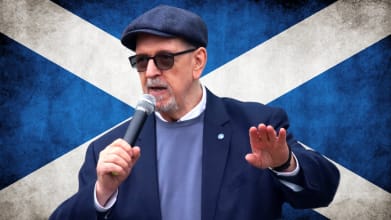
Muscular nationalism?

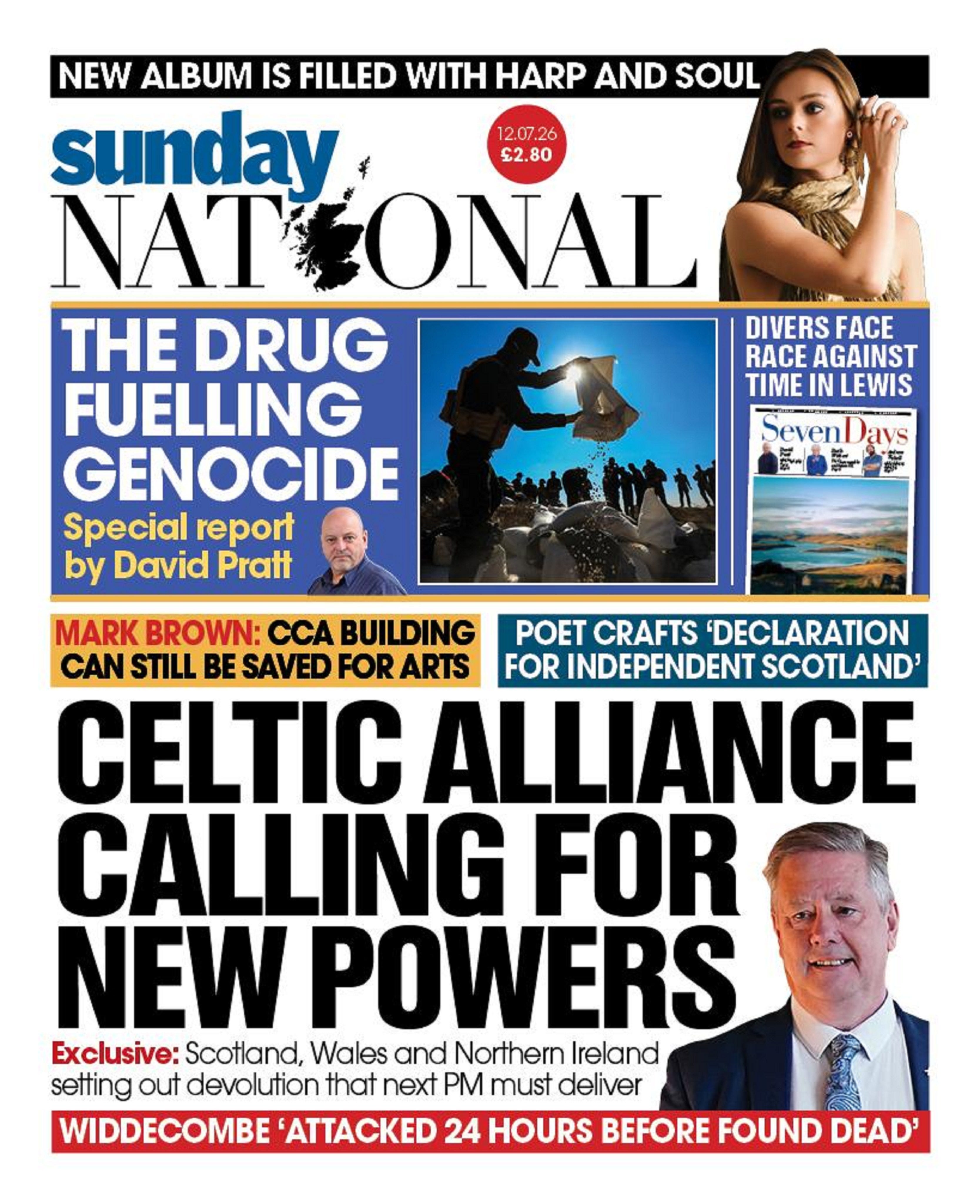
Glancing at the front page of today’s Sunday National, one might be forgiven for imagining that independence was as high on the SNP Scottish Government’s agenda now as it appeared to be a couple of months ago when the Holyrood election loomed large. When I went to the paper’s website, however, I was perplexed to find that the article referred to by that front-page headline wasn’t featured. At first, I thought it wasn’t even mentioned. Then I noticed the ‘exclusive’ banner above the main item—a piece by political reporter Hamish Morrison examining shifts in SNP policy in the wake of the party’s defeat in Aberdeen.
While the front page of the print edition clearly referred to the constitutional issue, the featured piece on the website didn’t mention the word ‘independence’ at all, other than a solitary reference to pro-independence parties. This struck me as a bit strange, as from my perspective the biggest policy shift of all is the quiet shelving of independence.
Going to the ‘exclusive’ article on the website, I was greeted by a headline declaring, ‘Andy Burnham must end ‘muscular Unionism’, says Celtic Alliance’. My first thought was that rather than pleading for an end to ‘muscular Unionism’, I’d like to see some muscular Scottish nationalism from the SNP.
Prior to the election, John Swinney’s rhetoric on the constitutional issue was a pale imitation of the muscular nationalism I’m thinking of. We heard him boldly ‘guarantee’ a new independence referendum if the SNP won a majority of seats. The Scottish Parliament was going to take the lead in the “development of a Section 30 [order]”. And of course, there was the usual stuff about demanding a referendum, which is now standard fare when there’s an election in the offing.
That was a couple of months ago. Can anyone remember the last time Swinney mentioned the ‘r’-word? Instead of the muscular nationalism I long for, we get Keith Brown’s limp-wristed devolutionism, with the word ‘independence’ dropped in here and there in the hope of preventing it from folding like a cheap suit.
Holyrood has said quite categorically that our democratic future should lie with the Scottish people and that our vast energy resources should be controlled by the Scottish Parliament.
If Andy Burnham’s words mean anything, then he will respect those two facts – these are the key tests of whether he is serious about where power lies on these islands.
Scotland, Wales and Northern Ireland are led by governments that see a future beyond broken, Brexit Britain – if Andy Burnham wants a discussion about power and devolution then the direction of these governments raise a basic question he cannot ignore.
In the New SNP, this insipid gruel is what passes for talking tough. And there is nothing to indicate Keith Brown is even aware of the grating contradiction in this statement as he juxtaposes an explicit mandate from the people of Scotland and abject deference to the British state. The people of Scotland have spoken through their democratically elected parliament, but it is Andy Burnham, the presumed prime minister-in-waiting, who gets the final say. The sovereign people of Scotland have sent a clear message. But Keith Brown MSP, depute leader of the self-styled ‘party of independence’, can do no more than hope that Burnham will heed that message.
Brown said whether Burnham gave Scotland a second independence referendum and his willingness to devolve energy policy to Holyrood were the “key tests” of his commitment to devolution.
Like a child sending a letter to Santa Claus, Brown dictates his wish list. He’ll be a good boy if Santa Burnham brings us a pretend independence referendum and permission to play with our own energy toys. It is pathetic!
It is telling that this dull-as-ditchwater statement is delivered by Brown and not the First Minister. This not-so-subtly symbolises the deprioritisation of the constitutional issue. Some will say I’m reading too much into it. But both Keith Brown and John Swinney must be aware that this is how it will be perceived by pretty much everyone bar the dumb party loyalists who would give a standing ovation if Keith Brown recited the end-user licence agreement (EULA) for Windows 11—all >6,000 joy-sucking words of it!
Where is the fire? Where is the drive and determination? Where is the sense of mission? Where is the nationalism?
Many leading figures in the SNP, such as Nicola Sturgeon and Ian Blackford, have expressed discomfort with the word ‘nationalist’ or felt the need to explain it. The National columnist Assa Samake-Roman wrote “I love civic nationalism, but never could call myself a nationalist”. It was not at all uncommon during the Yes campaign to encounter speakers and writers, especially on the political left, expressing similar sentiments. Which always irked me. I am a Scottish nationalist, and I have never been afraid to say it.
Unionists / colonialists / imperialists like to burden the word ‘nationalism’ with all manner of negative and nasty associations. They would have us think of all nationalists as goose-stepping, blood-and-soil, Kinder, Küche, Kirche (Children, Kitchen and Church) members of the master race.
There ain't no master race, we′re all just monkeys with toothpaste - Early James Dance In The Fire
Obviously, it suits imperialist powers to describe liberation movements in their annexed territories in this manner. If you want constitutional and democratic normality for your country, the very best that can be said of you is that you are narrow-minded and inward-looking. If you express a preference for native culture, you are parochial. If you prioritise the health and welfare of the citizens in your own nation, you are asserting ethnic superiority. We’ve all encountered this, I’m sure. Everybody who is born and bred in a colonised country gets to feel the sting of these calumnies. Racism is the constant companion of colonialism. As Paul Martin says:
Racism was not a side-effect of empire—it was its operating system. From the 15th-century “Age of Discovery” to 21st-century border regimes, racial hierarchies have justified land theft, slavery, resource extraction and permanent war.
I have no hesitation in calling myself a Scottish nationalist because I don’t allow others to define that term on my behalf. Only I am entitled to describe the nature and content of my nationalism. To my way of thinking, nationalism is no more than accepting that it makes sense to concentrate efforts at reform and improvement on the territory within which one has the power to effect change by the democratic process. I know there are many other ways to define a nation. I have always liked Ernest Renan’s exploration of the concept. But thinking of the nation as the territorial reach of the legislature serves for most, if not all, purposes.
Scotland is where the rule of law means the rule of laws enacted by the parliament I vote for. Being a Scottish nationalist need mean no more than advocating that only laws enacted by the Scottish Parliament should have effect in Scotland. With the corollary that no laws enacted by any parliament other than the Scottish Parliament should have effect.
Being a Scottish nationalist need mean no more than advocating that only laws enacted by the Scottish Parliament should have effect in Scotland.
I should stress that I am saying only that being a nationalist doesn’t have to mean more than identifying with the territory where Scottish laws apply. It should go without saying that it can mean much more than this. I suspect everybody would want to add something of their own to this basic definition.
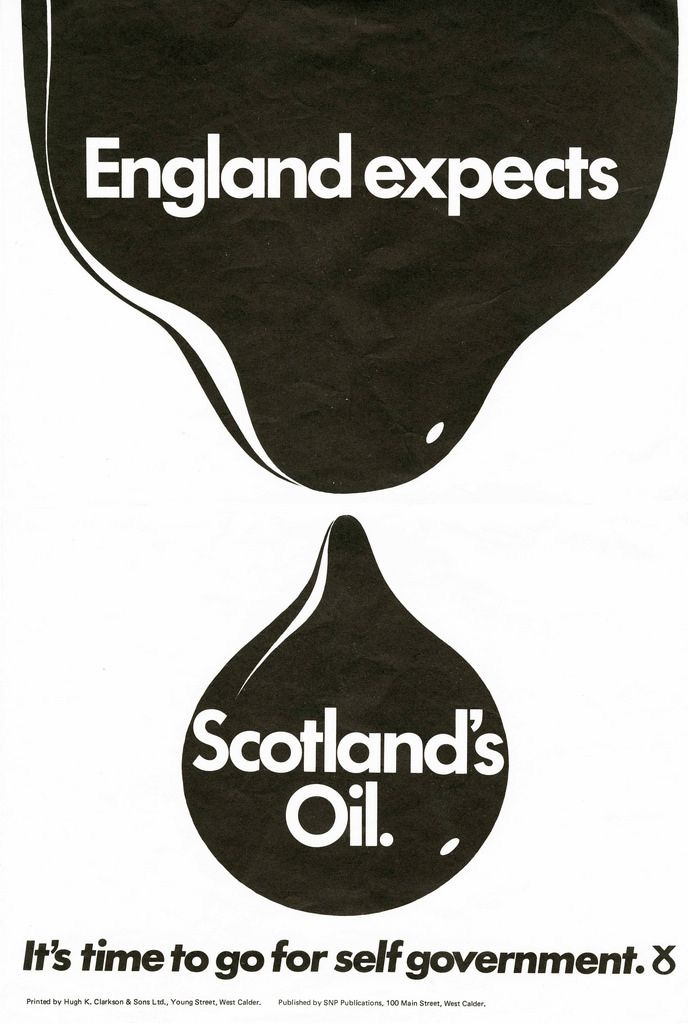
In truth, the SNP’s nationalism has never been particularly muscular. The ‘It’s Scotland’s Oil’ campaign was about as muscular as it got. It is no coincidence, I think, that this is generally recognised as one of the party’s most successful campaigns.
Contrast even that middling muscularity with the SNP of today. Would anybody accuse John Swinney of muscular nationalism? I really don’t think so. Even compared to Alex Salmond, Swinney’s nationalism looks almost skeletal. And bear in mind that Salmond’s nationalism allowed for ‘Five Continuing Unions’:
A speech made by Alex Salmond in 2013 is used as a means of examining different strands of the party’s unionism following its formation in 1934. First was the SNP’s attachment to some form of supra-national authority, initially the British Empire and later the European Union; second was defence co-operation via NATO; third was a form of monetary union as advocated by the Scottish Government during the 2012-14 referendum campaign; fourth was a long-standing SNP commitment to the 1603 Union of the Crowns, or retention of the Queen as head of state in an independent Scotland; and fifth was what Alex Salmond called a ‘social union’ between the ‘peoples of these islands’.
For Salmond, independence involved no more than ending the political union with England-now-Britain. One would think it impossible to dilute the idea of independence any further. But John Swinney has done so by stepping away from the idea of breaking anything. The modern SNP’s idea of independence is better described as idealised devolution. It is all about ‘more powers’. Never about all powers. Read again the words of Keith Brown above. The language is that of someone resigned to the idea that England-as-Britain has and will always have a rightful say in Scotland’s affairs. It is the voice of someone who has accepted devolution as a constitutional settlement. The entire statement is predicated on the idea that power resides with Westminster and Holyrood may only have what the British state graciously bestows. Or not!
The modern SNP’s idea of independence is better described as idealised devolution. It is all about ‘more powers’. Never about all powers.
If you are asking for powers, you are necessarily acknowledging and validating the superiority of the entity to which the request is addressed. If you are asking for powers, you are necessarily allowing that the entity to which your request is addressed has the rightful authority to refuse your request. Today’s SNP isn’t even talking about independence as a Scottish nationalist would understand it. It speaks only of independence as the realisation of the Scottish Parliament as “one of the most powerful devolved parliaments in the world” in the words of none other than arch-unionist David Mundell.
As an unapologetic Scottish nationalist, I am horrified at the thought of John Swinney leading ‘negotiations’ for Scotland’s independence. Not that I think it’s ever going to happen. But the very thought of it gives me nightmares. It is too easy to imagine Swinney compromising and conceding us into something that is nothing more than redefined devolution. If he is prepared to treat the principle of popular sovereignty as something that is negotiable, what else will he concede?
We are back to the matter of learning the lessons of the past. Or not! Everything the past has taught me has made my nationalism more and more muscular. At the same time, the SNP’s idea of independence has been increasingly watered down. No wonder we have parted company!
Everything the past has taught me has made my nationalism more and more muscular.
I am daily more persuaded that the break with the British state must be as total as can possibly be contrived. Our starting point as a nation once more independent must be pristine, because only then could we have confidence that any relationships entered into with other nations were of our choosing. From day one, we must function as a truly independent nation – to the fullest extent that this is possible in today’s highly connected world. Otherwise, everything that follows will carry the taint of colonialism.
The independence that I describe will never be brought about by political leaders who regard independence as some kind of extension of devolution. Scotland’s independence will only be decisively and satisfactorily restored if we are prepared to embrace a nationalism that is both muscular and impeccably democratic.
Muscular Unionism can only be countered by muscular nationalism.
The snp departed from nationalism around the mid 80s. I recall the vitriol generated by our own members against Douglas Henderson who was then VC publicity. And produced a couple of nationalist leaflets, one of a crowd of siluated rebels shaking fists in anger. Another depicted Thatcher with bleeding incisors as a vampire sucking the blood from Scotland. Poor Douglas rip a real nationalist pillaried by the so-called nationalist party of the snp. At that point we became the devolution party. Of course our membership then was based on middle class academic membership and to a lesser extent the heart left, and the split between siol. Nan gael the real nationalists... Under 79 group the faux socialist of universal brotherhood..
I am certain that Swinney Brown et al would race to publicly condemn even the slightest nose bleed suffered in our Cause of indeoendence.
An interesting essay. I’d probably frame it slightly differently: Scotland doesn’t just need confidence, it needs capacity. Strong institutions create national confidence just as much as national confidence creates strong institutions.