
Motion to stand still

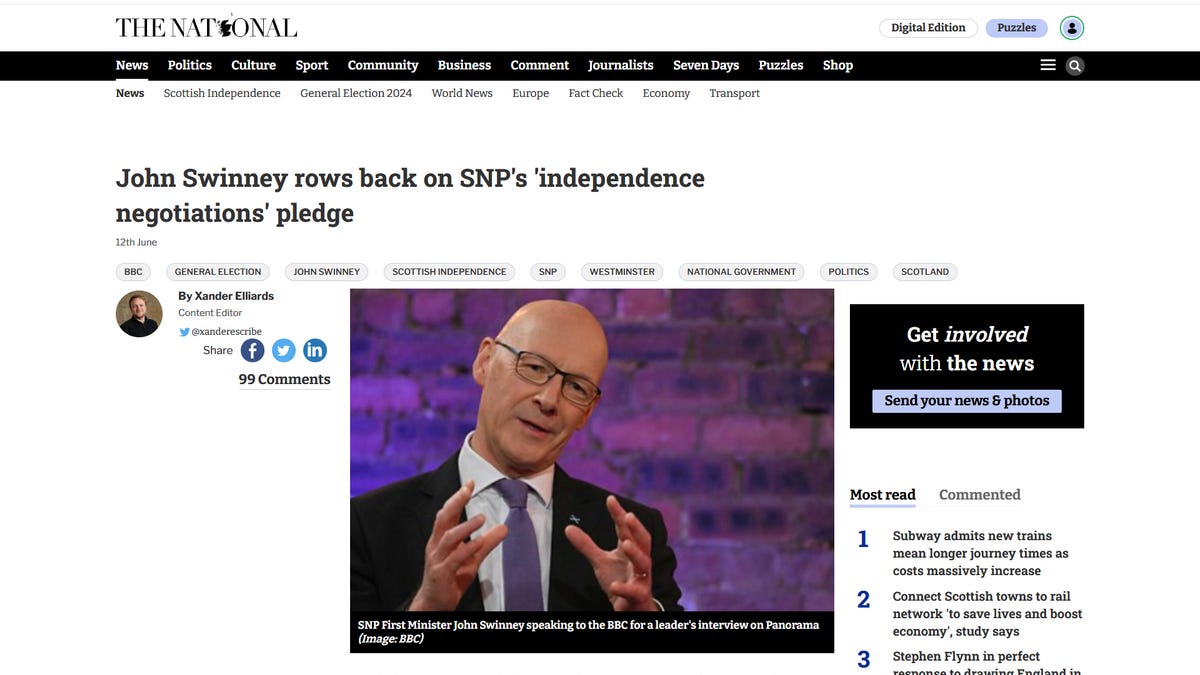
I’ve been poring over the motion John Swinney intends to bring to the Scottish Parliament on Tuesday 26 May, and even allowing for the customarily stilted parliamentary language, I can’t shake the sense that it is something cobbled together at the last minute. The National insists on referring to it as “John Swinney’s indyref2 motion“. However, it is not a vote on having a new referendum but on asking the UK Government for permission to hold a referendum on whatever terms the UK Government chooses to insist on.
Why? What is the point of this motion? How does it benefit Scotland’s cause?
Here is the text of the motion in full:
That the Parliament welcomes the emphatic democratic mandate for bold and ambitious reform backed by the people of Scotland at the Scottish General Election; further welcomes the Scottish Government’s clear commitment to eradicate child poverty, deliver a stronger NHS and public services, build a more prosperous economy and help people in the cost of living crisis and tackle climate change; recognises that the people of Scotland have returned the largest pro-independence majority ever elected to the Scottish Parliament; believes this majority affirms a clear mandate that decisions about Scotland’s future are best taken in Scotland and that mandate must be respected; calls on the UK Government to make a Section 30 order under the Scotland Act 1998 to devolve the powers to the Scottish Parliament to hold a referendum on Scottish independence; and agrees that the Parliament is at its best when it works together in pursuit of a country that can be confident in its future.
We can safely ignore the glittering generalities that the motion leads with. This is just the administration primping and preening before the public. It is Swinney saying, “Never mind my actions; look at my intentions!” To the very limited extent that there is any meat on this gobbet of political posturing, it starts with the assertion that the electorate has given the Scottish Government a “clear mandate” for “decisions about Scotland’s future“ to be made in Scotland. This assertion immediately precedes a call for a decision about Scotland’s future to be made in London.
The motion asks the Scottish Parliament to endorse a request for a Section 30 order, which the First Minister can make without the need for any endorsement by the Scottish Parliament. There is nothing to stop the First Minister requesting a Section 30 order at any time. The motion is pointless.
As I read the bit that asks the UK Government to “make a Section 30 order”, my first thought was that this is not what Swinney promised. I seemed to recall him saying that he intended to ask MSPs to agree to him drafting a Section 30 order. Knowing my memory isn’t exactly reliable, I checked. What I found was that Swinney had merely strongly implied that he would be drafting the Section 30 order.
So I can confirm today that on the first sitting day after the appointment of the new government, we will bring forward a vote of the Scottish Parliament to approve the development of a Section 30 order to give Scotland the power to hold an independence referendum.
I’m sure I’m not the only one to take this as meaning the “development“ of a Section 30 order was to be done by the Scottish Government. Not that this was at all significant. It just demonstrates the need for great care when reading politicians’ words. Even now, I read the above and wonder why the Scottish Parliament is being asked to “approve” something that the UK Government was going to be asked to do.
More important is the disjuncture between the claim that the Scottish electorate has voted in favour of independence by returning “the largest pro-independence majority ever elected to the Scottish Parliament“ and referring the matter to the British state. If the people of Scotland are sovereign, our word is final. If the people have voted for independence, that is what must be delivered. If the people have voted for a new referendum, that is what must be delivered. The UK Government has no say in the matter.
If the people of Scotland are sovereign, our word is final. If the people have voted for independence, that is what must be delivered.
Did the electorate give Swinney a “clear mandate” for anything? Not if the man himself is to be taken at his word. Prior to the election he insisted that only 65 seats or more for the SNP would constitute a mandate. Now, he is claiming as a mandate the very thing he rejected as constituting a mandate prior to the election. It all gives the distinct impression John Swinney is just making it up as he goes along. Which makes a mockery of the notion that there is a secret plan.
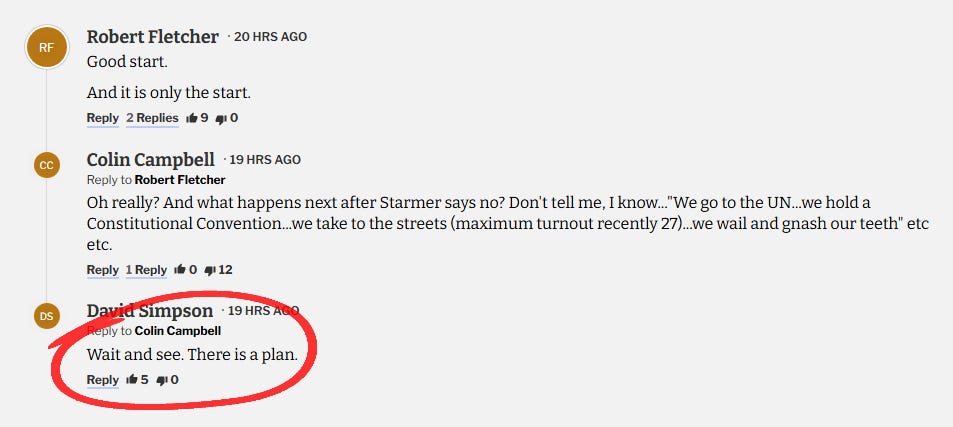
Swinney’s motion is performative. It is meant to give the impression that when it comes to the constitutional issue, he’s on it. It would be more accurate to say he’s at it. The UK Government can and probably will simply ignore this clumsy bit of parliamentary theatre. Which is for the best. The worst thing that could happen would be for Starmer (or successor) to grant that Section 30 order. But I’m not going to get into explaining why the Section 30 process is a trap yet again.
Swinney’s motion prompts many more questions. His ‘strategy’ is not new. It is around fifteen years old. What Swinney is doing now could have been done at any time since the vote in 2014. So, why hasn’t it been done? If this is a brilliant strategy now, it was just as brilliant two years ago. Or four years ago. Or eight years ago. Of course, the request for a Section 30 order would have been denied every time. But isn’t that the whole and sole point of the strategy? Isn’t its only purpose to extract that refusal from the UK Government? Isn’t the SNP’s argument that these knockbacks all drive more people towards supporting independence? If that is the case, surely more is better. If every refusal increases support for independence, surely at least one a year would have done wonders for the cause.
If this is a brilliant strategy now, it was just as brilliant two years ago. Or four years ago. Or eight years ago.
There is no evidence that Section 30 requests being denied increases support for independence, of course. But what does that matter? Since when did the independence movement demand such evidence for the SNP leadership’s pronouncements? The larger part of the independence movement seems convinced that Swinney is following some minutely crafted plan. There is no evidence for that either. Swinney has been stumbling and fumbling on the constitutional issue ever since he became party leader again. Everything the SNP says seems to be at odds with whatever they said previously. It all looks reactive and erratic.
Swinney’s motion on Tuesday will change nothing, no matter how much fanfare it is afforded. It is all but certain the motion will be approved. This will be hailed as a leap forward for Scotland’s cause. The party loyalists will cheer themselves hoarse. Other than that, nothing will happen.
You have just rained on my parade Peter! Here was I thinking that Holy Wullie would sort out all Scotland's problems..when in fact HE is the problem. Intending to BEG permission of the shitty foreign english if we can pretty please have a something or other that still hasn't been drawn up but is still in the development stage...then ratified by aliens followed by a long wash cycle ..before coming back for another vote that will ensure bu**er a'...have I got that right?
I'm afraid it's back to... the kill the foreign english b*st*rds ...or sit around for the next 50 years contemplating our navel...my lochaber is startlingly sharp...
(I noticed that Fiona Bruce has let us know that a generation is 20 or 30 years...my message tae hur is don't come here hen...)
For OUR Scotland and her snarling weans...
I read the motion and noted the same i.e. Swinney's not even proposing to initiate a S30 request in Holyrood that his pre-election 'commitment' implied but going to ask Westminster to do it instead.
In reality, as you say, it would have made no difference as either route grants the British a veto over the process and, therefore, over Scottish sovereignty.
I like your summary of what John Swinney is really up to and think that you may be able to use this to show the yawning chasm between the dishonesty of the SNP's posturing Section 30 approach and the credibility and integrity of the Manifesto For Independence & Scottish UDI process thus:
SNP: At it!
NSP: On it!!!