

It's our parliament
The arguments for #ScottishUDI

I have frequently stated that we need to reframe the constitutional issue and rethink the campaign to restore Scotland’s independence. The language we use when discussing the constitutional issue should both form and reflect the way we approach Scotland’s cause.
You have just seen an example of reframing without, perhaps, realising it. The phrase ‘restore Scotland’s independence’ is not what you’ll hear from the independence industry, where it is all talk of ‘gaining’ or ‘winning’ independence. As if independence were a prize which we might win from the British state if we jump through whatever hoops they put in front of us. The problem with this is that the British state has a near-infinite supply of hoops.
The phrase ‘restore Scotland’s independence’ is not what you’ll hear from the independence industry, where it is all talk of ‘gaining’ or ‘winning’ independence.
The language used by the independence industry frames independence as the property of England-as-Britain which they might give us if we pass some kind of test. Needless to say, they reserve the right to formulate this test and to alter it without notice.
Using the word ‘restore’ instead of ‘win’ may seem trivial to some. But while it is a small change in the language, it implies a huge change in the way we think about the issue. The phrase ‘restore Scotland’s independence’ necessarily implies that independence is ours. It is not something which is naturally in the gift of the British state but something which we own or are fully entitled to. Something which we would have were it not being illegitimately withheld from us by the British state.
For centuries British propaganda has presented the superiority of England-as-Britain — with the corollary of Scottish inferiority — as nothing more than the ‘natural order’. The order ordained by an omniscient, omnipresent, and omnipotent entity. That supernatural entity is imaginary. The power that flows from it is very real.
The independence industry’s framing of the constitutional issue implicitly accepts this ‘natural order‘ whilst striving to disrupt or destroy it. The independence industry insists we must play by the British state’s rules. Only by compliance with the rules which keep Scotland down can we hope to elevate our nation. It is an approach which simply makes no sense.
The required reframing of the constitutional issue is evident in the slogan deployed by New Scotland Party when it was launched in November 2024.
Take back our government!
Take back our parliament!
Take back our nation!
Thus, the constitutional issue is reframed as a campaign to recover or repossess that which has been taken from us and which continues to be withheld from us. Another aspect of this reframing is more subtle but no less important. It represents a mindset in which the constitutional issue is split into two battles:
The battle to secure the means and opportunity whereby the people of Scotland can fully and freely exercise our right of self-determination.
The battle to restore Scotland’s rightful status as an independent nation.
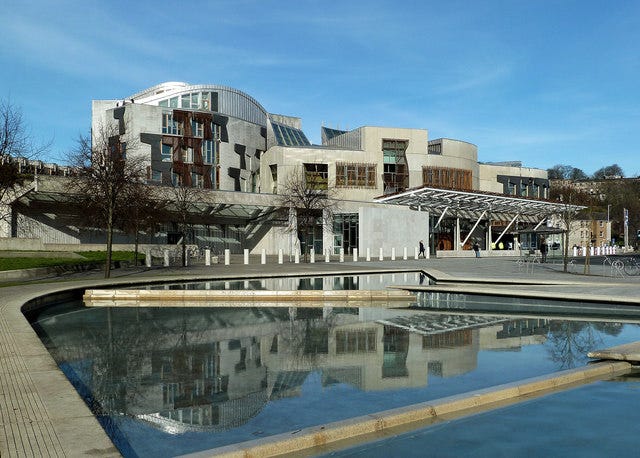
Let’s focus for the moment on the idea of taking back, or recovering or repossessing, our parliament. Discourse on the topic of Scotland’s cause tends to emphasise the fact that the Scottish Parliament is a creature of the British state. It is commonly dismissed as an agency of England-as-Britain. Some even label it a colonial administration. There are weel-kent voices in the independence movement which maintain that the Scottish Parliament must be abolished because it is owned by Westminster. I stipulate the facts but reject the conclusion.
To my way of thinking, the foregoing is the British framing of the Scottish Parliament. I see no good reason to simply accept that framing, as the independence industry does. I would reframe the Scottish Parliament from a Scottish nationalist perspective. I speak of the Scottish parliament as our parliament. I reframe it as the ancient parliament of Scotland, which was taken from us by dubious means in 1707 and returned to us in 1999, but bound by the chains of devolution.
I would reframe the Scottish Parliament from a Scottish nationalist perspective.
My framing of the Scottish Parliament maintains it is the true national parliament of Scotland from which a raft of critical powers are illegitimately being withheld by England-as-Britain. My rethinking of the campaign follows from this reframing. I am not interested in campaigning for more powers to be bestowed on the Scottish Parliament by the British state. Real power isn’t given. Real power is only ever taken. That which is given is not power so much as an affirmation of the giver’s superiority.
This reframing of the Scottish Parliament allows us to mount a much stronger campaign. The message of this campaign is that we are retaking something that has been taken from us. Certainly, it’s a more powerful message than please, can we have this or that power? Especially when the request is no more than an invitation to rebuff.
Excellent Peter.
Over the years since the Scottish Independence Referendum of 2014 I have come to realise the importance of language as it relates to Scotland’s Cause.
As such I have now for years used ‘returning Scotland’s independent statehood’ or ‘reinstating Scotland’s nation-state status’ or ‘restoring Scotland’s full self-government’ when referencing the campaign in support of Scotland’s Cause.
I refer to this campaign as ‘Scotland’s Cause’ as this elevates the campaign onto a higher plane that mere day to day political policies. It implies something higher, nobler, principled and moral. It suggests that a country making its own decision is normal, that setting its own priorities in accordance with its own values is the natural state of affairs.
Equally I never refer to the UK as ‘the country’ or even ‘a country’ as it is a) not my country and b) is not a country, it being a state comprising multiple jurisdictions including the country of Scotland.
I always talk of Scotland’s right of self-determination as something that is ‘not theirs to give, but ours to have’ since we already own it, via the UN Charter. Power we take by asserting that right, not by requesting permission to exercise it.
In order to counter years of British propaganda and indoctrination we must use the power of language to change mindsets and control the narrative.
I’ve commented on the lexicon and phraseology we use in independence circles when confronting the coloniser. We need to develop our own language that frames the relationship and Independence on our terms. Primary among the changes we need is to never use the word Union, it is Annexation. There is so much more, which you allude to here, Peter.
It’s powerful and effective. Notice that the Good Friday Agreement is now also tagged The Belfast Agreement. That occurred as a result of NI Unionists coining the phrase and repeating it into common currency. In my example, replace Union with Annexation. How and what does it make you think?
This is something that sorely needs to be addressed and helpful you have gone some way to addressing it here.