

Better dead than 'cherished'?

Comparisons with Nazi Germany or early 20th-century totalitarianism in general are invariably simplistic and do justice to neither. A more valid and valuable analysis delves into the characteristics that define Nazism and related ideologies to determine which are present in the movement being compared. In his seminal essay, Ur-Fascism (Eternal Fascism), Umberto Eco identifies 14 key characteristics of fascist regimes, offering a framework for understanding the mechanisms and strategies employed by these movements.
Powerful, Populist Nationalism and Cult of Leadership
Political Power from Myth, Rage, and Lies
Fixation on National Decline and Victimhood
Replacement Theory and Opposition to Harmony
Disdain for Human Rights
Scapegoating Enemies
Supremacy of the Military
Rampant Sexism
Control of Mass Media
Obsession with National Security
Religion and Government Intertwined
Protection of Corporate Power
Disdain for Intellectuals
Cronyism and Corruption
I challenge anybody to identify one of these characteristics that is not to be found in the United States of America in the reign of King Donald I. Anybody intending to attempt to do so should first read this article, which explores each characteristic in detail, using examples from Nazi Germany, other historical periods, and contemporary examples from the United States.
One characteristic not clearly identified by Umberto Eco is territorial expansionism—the policy or practice of a state expanding its borders by acquiring new land, typically achieved through military conquest, colonisation, or diplomacy. This, too, is a plainly evident characteristic of the Trump regime. Today, Caracas! Tomorrow, the world!
Textbooks typically say that expansionism is driven by motivations such as economic gain, political power, and cultural dominance. Less often noted as a motivation is fear. Fear of military incursion, obviously. But also fear of ‘contamination’ by The Other.
Imperialist enterprises understandably regard the Homeland as sacrosanct and its borders as its weak points. The Homeland—or Motherland, or Fatherland—must not be tainted by foreigners nor blighted by battle. So, the imperialist enterprise commandeers neighbouring lands as a buffer zone, coopting its people as defenders of the Homeland.
Imperialist enterprises understandably regard the Homeland as sacrosanct and its borders as its weak points.
In time, the annexed territory comes to be regarded as part of the Homeland. It also becomes sacrosanct and must be protected by acquiring yet more neighbouring territory. And so it proceeds—expansionism driven by fear.
One possible reason Umberto Eco omitted expansionism from his list of fascism's characteristics is that he considered it an inevitable consequence of the traits he did list. And indeed it is. Supremacy of the military, for example, presupposes something for them to do other than to serve as ceremonial ornamentation. Fighting expansionist wars—or ‘defending the Homeland’—would fit the bill nicely.
I believe that whatever else might motivate territorial expansionism, fear is always a factor. Fear, which can readily transform into paranoia and aggression. Again, Trump’s America comes readily to mind.
In ancient times, the growth of empires was limited by the increasing difficulty of communication and control over the ever greater distances involved. The modern imperialist enterprise is subject to no such constraints. If there is no limit to Donald Trump’s ambition and/or no bounds to his fear, he literally can conquer the world.
If Venezuela, why not Colombia? Or Ecuador? Why not the nations to the north—Panama, Costa Rica, Nicaragua, Honduras, El Salvador, Guatemala, and Belize. At what point does Trump decide that the US doesn’t exercise sufficient control in these places? At what point does it become convenient to identify a new enemy?
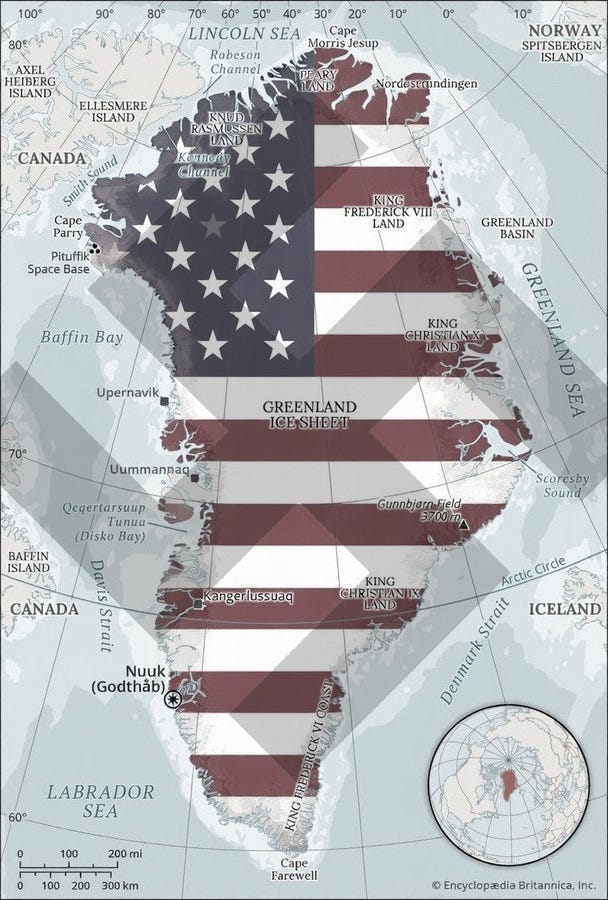
Trump is also known to be casting a baleful eye northward. From The National:
When asked about a potential takeover of Greenland by force, Trump said in May: “I don’t rule it out. I don’t say I’m going to do it, but I don’t rule out anything. No, not there. We need Greenland very badly.”
“Greenland is a very small amount of people, which we’ll take care of, and we’ll cherish them, and all of that. But we need that for international security.”
Stop a moment to ponder what the term ‘cherish’ might mean to Trump. The only people queuing up to be ‘cherished’ by Trump are simpering sycophants such as Sir Keir Starmer. I think I can say with little fear of contradiction that the people of Greenland are far from eager to accept Trump’s offer. Bathing in hagfish mucus is a more appealing prospect.
The only people queuing up to be ‘cherished’ by Trump are simpering sycophants such as Sir Keir Starmer.
The trend is the rolling back of the modern concepts of the nation, sovereignty, and peoples' rights, which have served as legal and moral constraints on expansionism, which, to some extent, replaced earlier logistical limits. A return to a time when nations with the power to conquer needed nothing more than that to justify their foreign military adventures.
By way of an example, see the difference between the demonising ‘drugs and guns’ rhetoric used in the case of Venezuela, and the language used when Trump talks about Greenland. In the latter case, no more justification for threatened annexation is required than the fact that it serves US interests.
After Greenland, it’s the Arctic. Or maybe Canada! The introduction to Star Trek used to start with the words ‘Space! The final frontier!’ That is where imperialist enterprises are always headed—the final frontier. And if that means you must be crushed to get there, well, tough! That’s why they came up with the term ‘collateral damage’.
Mind you, being collateral damage might be better than being ‘cherished’ by Trump.
Perhaps Trump and the Americans have just woken up to the consolidation of just under half of the World's population forming BRICS? An organisation containing the manufacturing powerhouses of China and India plus the huge nuclear arms store of the former plus Russia.
That would be overwhelmingly sufficient to trigger the fear and paranoia among such an obvious narcissist as the POTUS and his cronies. Expanding the US' to include the geographic and economic 'padding' of the countries and territories you mention might well be a reaction to feeling threatened by developments which have left them feeling isolated and vulnerable.
In any event the post-WW2 international law and order settlement with the UN as the arbiter seems under threat now as never before.
Somewhat surprisingly this extensive list still manages to miss two more major drivers of expansionism (Imperialism).
Empire is a business, and it is big business.
A business based on extracting wealth from those unfortunate enough to be subjected to its violence and concentrating it in the hands of the administrators of the Imperial centre.
In the modern era the empire of the dollar supplanted the brutal British empire as the global hegemonic power.
As Paul Krugman once candidly noted, the dollar is backed by men with guns, i.e. The Pentagon.
These drivers have been visible throughout history from the extensive written accounts we have from the Roman empire onwards.
And 'state' spending on militarism is a honeypot for the kleptocracy.
As heavily decorated war hero Smedley Butler [1] once wrote, "War is a racket"
In the modern era of fiat currency created from nothing by the Fedral Reserve the American Oligarchy benefits from more than a Trillion Dollars a year of money creation being transferred to the Military Industrial Complex.
That is over a thousand billion, or if you prefer over a million million dollars per year.
That combined with a perceived need for particular resources such as titanium metal for aerospace (weaponry) and petrochemicals can provide another justification to the regime.
Perhaps European leaders will begin to wise up to what is happening in the world today.
Perhaps they will choose to confront the reality.
I doubt it. They are supine to the American hegemony, whilst continuing to excercise all of the brutish neocolonial control that they can.
Looking on the bright side, Scotland will find many understanding friends in the exploited Global South, now that realisation is slowly dawning as to which side of the geopolitical dividing line the exploited people and terrritory of Scotland has come to recognise itself to be on.
;-)
[1] https://en.wikipedia.org/wiki/War_Is_a_Racket