

Beautiful dreamer

Addressing workers at Nigg Bay on the Cromarty Firth in July 2013, First Minister Alex Salmond spoke of the six unions that “govern our lives today in Scotland”. The political union of the UK; union with Europe through the EU; the monetary union, the Union of the Crowns; a defence union based on NATO, and a social union among the people of the UK.
At the time, I happily concurred with this perspective, as evidenced by an article titled Vote Yes to save the union I wrote for Yes Clydesdale‘s Aye Magazine in November 2013.
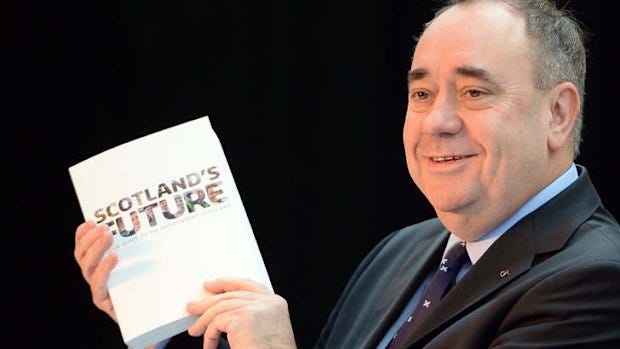
Later that year, when launching the Scottish Government’s White Paper Scotland’s Future—described as a ‘blueprint for independence’—in November 2013, Salmond said:
We do not seek independence as an end in itself, but rather as a means to changing Scotland for the better.
Much as I admired Alex Salmond for his political acumen, I strongly disagreed with this statement. I disagreed with it then. I disagree with it even more strongly twelve years on.
Today, I am slightly embarrassed to admit that I ever subscribed to Alex Salmond’s six unions perspective. In particular, I am ashamed that I ever supposed five of those six unions could continue after Scotland’s independence was restored. I now find it hard to believe that I ever thought only the political union needed to be abolished for Scotland to be fully a nation again.
I am embarrassed by this until I remind myself that these things must be appreciated in the context of their time. I also realise that while I was quite wrong about the notion that Scotland could reclaim its statehood while preserving much of what binds us to England-as-Britain, my embarrassment is largely offset by the satisfaction of knowing I was and remain wholly correct in my view that restoring Scotland’s independence is an end in itself. Not the end, but an end!
I now find it hard to believe that I ever thought only the political union needed to be abolished for Scotland to be fully a nation again.
We must bear in mind that when Salmond spoke of five out of six unions surviving the restoration of Scotland’s independence, he was attempting to counter the British propaganda machine’s portrayal of independence as a rough severing with consequences that somehow managed to be simultaneously unknown, unknowable, and indubitably horrific. He was, if you like, trying to reassure the horses as a Unionist propaganda campaign dubbed ‘Project Fear’ sought to scare the beasts half to death.
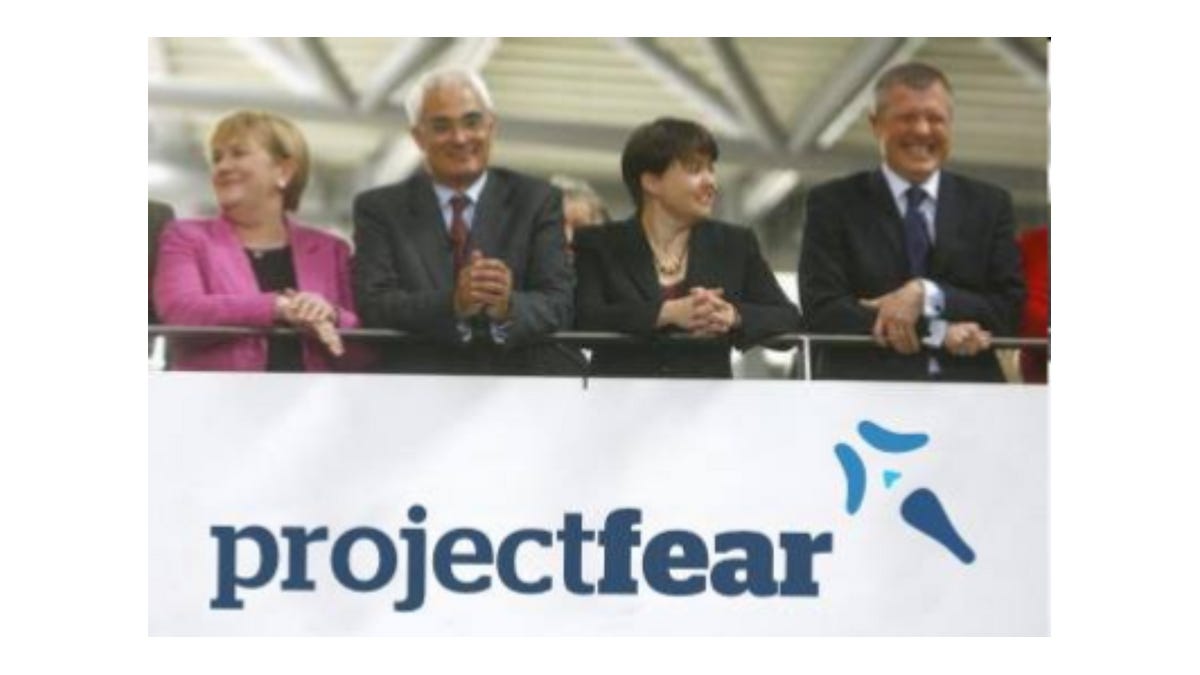
At the time, Alex Salmond’s mollifier seemed a perfectly reasonable response to a ‘Better Together’ campaign which I later came to recognise would be more appropriately tagged ‘Project Doubt’. Viewed with the benefit of hindsight, such appeasement looks to be a gross miscalculation. The intervening period of more than thirteen years has taught us that when the break from the Union happens, it must be as complete as possible.
If there is to be renewal, there must first be cleansing. We must strive to purge Scotland of imperialism’s legacy. The Union makes Scotland less than it might be. If we aspire to be all we can be, any remaining remnant of the colonial era is a hindrance.
The only one of Salmond’s six unions that deserves to remain is the social union. But even that is being put in jeopardy by the rise, mainly in England, of a deeply unpleasant British nationalism as manifested in Reform UK.
If there is to be renewal, there must first be cleansing. We must strive to purge Scotland of imperialism’s legacy.
Whereas the passage of time has led me to revise my conception of the Union and my thinking as to how it must be ended, that same opportunity to consider and study has only solidified my view that independence is an end in itself. It is a question of justice. The following is from a blog article published in April 2022.
Righting a wrong must always be an end in itself. Should we only right wrongs where there is some tangible ancillary benefit? Must we do some kind of calculation before choosing to rectify an unjust anomaly?
I anticipate that Unionists will take this talk of cleansing and purging and label it extremism. They will seek to contrive associations with totalitarian ideologies, past and present. I fully expect that they will be joined in this effort by more than a few weel-kent faces from the independence industry. Was it not always so? Look to history! Were those who sought liberation from colonial oppression not invariably branded terrorists or revolutionaries? It is one of the ways in which the coloniser seeks to undermine those who would take back that which the coloniser has taken from them.
Freeing Scotland from Britannia’s jealous grasp is not revolution but restoration. The independence movement is not insurgency but resistance. Our ambition is not to gain dominion over others but merely to repossess the status, authority, and responsibilities that are rightfully ours.
Our ambition is not to gain dominion over others but merely to repossess the status, authority, and responsibilities that are rightfully ours.
I will be accused of seeking confrontation. This is untrue. I seek the liberation of Scotland. Confrontation is inevitable only because there are forces working to prevent liberation. I do not seek this confrontation, but neither will I shy away from it. There is no liberation without confrontation.
The idea of independence being restored by gentlemanly agreement is naïve to the point of insanity. In defeat, the coloniser will always try to retain as much as possible of what has been annexed. This doesn’t only mean territory. It is not only land that is colonised, but also institutions, culture, and minds. Scotland can only be free to the extent that the coloniser’s undue influence is flushed from our institutions, eradicated from our culture, and removed from our minds.
The idea of independence being restored by gentlemanly agreement is naïve to the point of insanity.
To date, Scotland’s liberation struggle has been adversely affected by the debilitating delusion that it is or must be above base politics. We must disabuse ourselves of such fanciful notions immediately. Nothing is more essentially political than the constitution. Politics is the management of power relationships. The constitution lays down the rules governing who has power, how power is acquired, how power is exercised, in whose interest power is exercised, to whom power is accountable, and how power can be removed.
It’s all about power. However noble, principled, and aspirational the cause, ultimately it is all about power. At its best, the independence movement seeks power not for any person or party, but for the people of Scotland as a whole. The independence movement has not been at its best for quite some time.
James Murphy—who many of you will know from his letters and below-the-line comments in The National—seems to be aware that it is all about power. His letter in the Sunday National (Sunday 1 February) on the subject of the recent spat between John Swinney and Douglas Alexander makes plain Richard’s understanding that it is all about power. I take the considerable liberty of reproducing that letter in full.
The letters exchanged last week between John Swinney, Douglas Alexander and Keir Starmer should end a great many comforting illusions.
This was never a dispute about tone or courtesy. It was a demonstration of how power actually functions inside the devolution settlement – and why the idea of another Section 30 is finished.
A foreign military operation took place with direct implications for Scotland. The First Minister learned about it from the media. Westminster’s response was not apology or explanation, but assertion: defence is reserved, security is reserved, and Scottish ministers are informed only when the UK state decides it suits.
That is not an error. That is the system working exactly as designed.
Devolution does not share sovereignty. It delegates responsibility. Holyrood manages consequences; Westminster controls causes. When matters become serious – military action, borders, currency, the Union itself – Scottish authority ends. Not symbolically. Practically.
Section 30 is still spoken of as if it were a constitutional precedent. It wasn’t. It was a one-off response to a political shock the system was never built to absorb: an independence party winning outright in 2011. Westminster adapted once to release pressure. Then it shut the mechanism down.
Nothing in these letters suggests that door is even slightly open today. Starmer’s reply does not concede ground. It delays, redirects and ultimately reasserts reservation. Alexander’s letter does not seek co-operation. It draws a boundary.
These letters do not reveal misunderstanding or poor communication. They reveal a fundamental misreading of how the UK state operates. Westminster is not engaged in a shared constitutional process with Scotland. It is enforcing a hierarchy. Defence is reserved. Security is reserved. Final authority is reserved. Scottish ministers are informed when it suits that authority – not because they possess any entitlement.
Anyone still speaking of patience, persuasion or process after reading these letters is not engaging with political reality. They are projecting norms on to a system that does not recognise them.
This is not trust breaking down. There was no trust. It is not partnership failing. There was no partnership. The letters simply state the relationship as it exists.
The danger for the independence movement is not Westminster’s clarity, but Scotland’s refusal to take that clarity seriously.
The choice is now unavoidable: either Scotland prepares for a political confrontation over authority – not another legal appeal, not another polite request – or it accepts devolution as a permanent condition.
These letters were not humiliating because they were rude. They were humiliating because they were honest.
Heed this voice! Then ask yourself whether any of the nominally pro-independence parties or politicians looks as if they are prepared for confrontation with the British state. Ask yourself whether they seem capable of handling such confrontation. Ask yourself whether they give the impression they might prevail in this confrontation. Ask this most particularly of whatever political party you happen to be championing in the upcoming election campaign.
If you are completely honest, you’ll also be deeply concerned.
I end with the voice of the late Alex Salmond taken from an interview dated less than a month before his tragic death with Catalan-language nationalist news outlet VilaWeb. Asked what he would do the day after winning a de facto referendum, he replied:
You mobilize the Scots. Then you can hold a referendum, not on independence, but on who should be the arbiter. Who should decide independence—the Scottish Parliament or Westminster? It would be a referendum on the powers of the parliament, and that is within the Scottish government’s remit.
That sounds very much like the #ScottishUDI approach, does it not?
Later in the interview, Salmond says:
Politicians seeking independence for their country have the obligation to ensure they can deliver on their promises and make the path to independence credible. It has to be achievable.
Again, is this not precisely what I have been advocating? I have repeatedly made the point that to re-energise Scotland’s cause, pro-independence politicians must demonstrate not only that independence is desirable, but that it is achievable. And they will only do this by setting out a clear and credible process by which they intend to restore Scotland’s independence.
Alex Salmond dreamed a beautiful dream. He was a beautiful dreamer. But he was much more than that. When required, he was a hard-headed, pragmatic political operator. The independence movement today has a surfeit of dreamers. But pitifully few hard-headed political operators.
A brilliant piece of writing Peter...'the union makes Scotland less than it might be....our ambition is to repossess the status, authority and responsibilities that are rightfully ours.'.(ref Peter A Bell)Spot on . Now here's my take..I fell off a wall aged 7 landing on my heid. I stood up eventually and knew 2 things.
1. What it's like to be deid..told dad...he nodded sagely...went back to his newspaper
2. We had to get rid if the new so called 'queen' then Scotland could be free..told dad.. he went back to his newspaper ..
We were given a tin of sweets and a penny for the coronation...refused them.
I need no reason to TAKE freedom and would advocate violence towards anyone standing in Scotland's way. Nothing else will get us free..no' gentlemanly agreements'..we are being erased...
300years of invasion, abuse, theft, cultural oblivion, insults.... Tell me that it's NONE OF MY BUSINESS when foreigners use our country to attack others with the permission having been granted by the foreign english sh*te should be the reason for Scotland to finally turn viciously on those who would insult and make us look a laughing stock on the world stage..
Meanwhile holy willie wants to go and ask the foreign english sh*te if we can please have a referendum! If you are still not sure about how to achieve independence or want to chat inanely with the foreigners who own our country..hoping they'll give it back.... go and jump off a wall ..land on your heid and knock some sense into yourself...it will be a revelation.
And no I won't tell you what it's like tae be deid..you'll find out soon enough...
For OUR Scotland..OUR Scotland..OUR Scotland...got it?
Very good summing up of where we are. I saw James Murphy's letter too, and thought it was spot on. As time goes on, and the revelations about what has gone on pile up, I am more and more amazed at how naive I was back in the day.