

A void unfilled
Thoughts on the IFS Autumn Convention “Routes To Independence” discussion

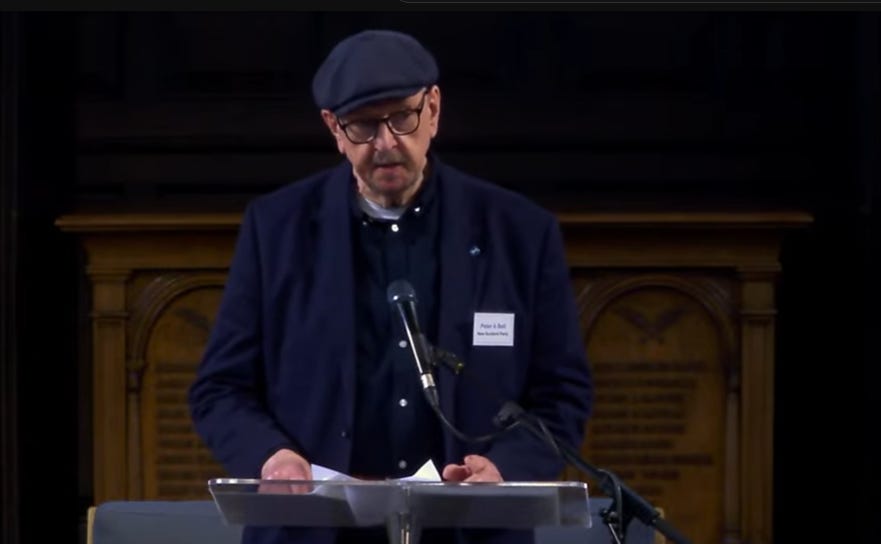
It is ‘interesting’ that in an event whose principal theme was “Routes To Independence”, only one actual route was described. Despite being the only route spoken of, and despite the #ScottishUDI strategy being “popular with the audience”, there was no further discussion of the strategy at the Independence Forum Scotland (IFS) Autumn Convention. And it is afforded one short paragraph in the report published by The National. Some may find this odd. They might also consider it curious that the speakers in the “Routes To Independence” session were not included in the panel discussion.
More curious still is the fact that of all the political parties claiming to have a ‘route to independence’, not one chose to take the opportunity to present their ‘strategy’ to the IFS Autumn Convention. Not one!
I define a route to independence as a sequence of actions with the restoration of Scotland’s independence as the endpoint. If it does not have independence as the endpoint, it is not a route to independence. As I pointed out in my presentation, however, we are not really talking about a route to independence. That is just a shorthand term.
I define a route to independence as a sequence of actions with the restoration of Scotland’s independence as the endpoint. If it does not have independence as the endpoint, it is not a route to independence.
We talk of independence being our destination. But that’s not quite correct. Strictly speaking, our destination is the place where the sovereign people of Scotland exercise our inalienable right of self-determination. It is then for the people to decide whether we go on to independence, or not.
Independence is the aspiration. A proper constitutional referendum is the destination.
The independence movement needs to be reminded from time to time that our first objective is not independence but the chance to choose independence.
Professor Aileen McHarg very ably presented the matter from a legal perspective. But that’s all! Her account was, as one would expect, stripped of all political context. As she was considering the matter strictly within the legal and constitutional framework which has developed under the influence of England-as-Britain’s imperative to preserve the Union, it is hardly surprising that her analysis led her to a conclusion that put the Union in no jeopardy. Nor was it at all surprising that her conclusion so closely resembled John Swinney’s proposed ‘strategy’ as to be indistinguishable. The Professor followed the path prescribed by the British state and arrived at a Section 30 referendum, just as John Swinney did.
The British did not build a global empire by allowing its territorial captures an easy escape route through legal channels.
Professor McHarg could do no other. She was constrained to present a purely legal perspective, with no politics involved. That is what she did. That is all she could do. However, John Swinney is a politician. He is not obliged to leave politics out of it. In fact, he is required by his role as a politician to afford the political aspects of the matter at least as much consideration as the legal aspects. He has utterly failed to do so. He has accepted what lawyers such as Aileen McHarg tell him is his only option without applying so much as a second’s-worth of political strategic thinking. Principally because strategic thinking is something of a taboo in the leadership of the SNP.
Thinking as a Scottish nationalist and political strategist, one can follow Professor McHarg’s analysis nodding in agreement right up to the point where she reaches her conclusion. At that point, we part company. While she - and John Swinney - conclude that the Section 30 process is the only way, the conclusion to which the Scottish nationalist and political strategist is led is that there is no route to independence through the legal and constitutional defences erected around the Union by England-as-Britain.
The Section 30 process is legal. But it is most emphatically not a route to independence. If it were, it would not be legal. That which the British state makes lawful cannot put the Union in jeopardy. That which puts the Union in jeopardy cannot be lawful. The British did not build a global empire by allowing its territorial captures an easy escape route through legal channels.
The Section 30 process is legal. But it is most emphatically not a route to independence. If it were, it would not be legal.
A Section 30 referendum cannot be a proper constitutional referendum. In a proper constitutional referendum, the people have the final word. In a section 30 referendum, Westminster has the final word. Adding a political perspective to Professor McHarg’s legal analysis it is clear that a route to independence - or a proper constitutional referendum - must lie outwith the constraints of British-made law while remaining within the bounds of international law.
What of the other participants in the “Routes To Independence” session. Craig Murray gave an update on the Salvo / Liberation Scotland UN initiative. But as Ian Grant and John Proctor of IFS point out in their report, this is not in itself a ‘route to independence’.
This initiative, which is complementary to the political campaign to increase independence support, continues to make progress.
Greg McCarra spoke of Scotland’s inalienable right to decide her future. This is not in dispute. Not even the British state attempts to deny Scotland’s right of self-determination. What we lack is the means and opportunity to exercise that right in a proper constitutional referendum. We are deprived of access to the exercise of our inalienable right of self-determination not so much by the British state’s asserted authority to dictate how and when we may exercise it as by the Scottish Government’s craven failure to challenge this asserted authority. They submit without a fight.
Not even the British state attempts to deny Scotland’s right of self-determination. What we lack is the means and opportunity to exercise that right in a proper constitutional referendum.
Since Greg McCarra didn’t offer any suggestion as to how we might proceed to a proper constitutional referendum, he was not talking about a ‘route to independence’. at best, he was attempting to describe the situation rather than seeking a way out of it.
Then I get my wee paragraph:
Peter A Bell outlined his detailed route to independence, popular with the audience, based on a joint manifesto for independence and a Scottish unilateral declaration of independence.
Not that this is about me. It is about the only route to independence on the table being given no prominence in a session that was supposed to be about “Routes To Independence”.
Time is always an issue at these events. So, I cannot complain that having spoken well over my allotted time the planned Q&A was dropped. It may be thought unfortunate that a matter of such importance was allocated a mere twenty minutes. But that is what I had. I chose to use much of that time explaining the #ScottishUDI strategy. That I therefore lost the opportunity to take questions from the audience is entirely my fault.
My hope was that the only genuine route to independence on the table would come up in the panel discussion at the end of the “Routes To Independence” session. I was to be sorely disappointed. It was barely mentioned. Professor McHarg had already said all she had to say on the matter and could do no more than repeat the legal position. I recall nothing of what was said by senior lawyer Ewan Kennedy. Alex Neil may be a “former Scottish Government minister“, but he still sounds just like one. He talked of the importance of building support for independence but seemed to imagine this could be achieved by continuing to do what the SNP and the independence industry have been doing for eleven years with absolutely no success. Namely, selling independence with ‘visions’ everybody wearied of even before the campaign for the 2014 sham referendum was over and political promises nobody gives any credence to.
Alex Neil may be a “former Scottish Government minister“, but he still sounds just like one.
Leah Gunn Barret used all her time on the panel (and a bit of everyone else’s) flogging the petition to have the International Covenant on Civil and Political Rights (ICCPR) incorporated into Scots law. This is about direct democracy. Which is undoubtedly a good thing and something I would wish to see rolled out in the years and decades after independence is restored. But it has nothing whatever to do with “Routes To Independence”. As Professor McHarg pointed out - and as I have been saying for many months - ICCPR would only provide for referendums in devolved areas. It would not amend the Scotland Act (1998). Constitutional matters would remain reserved. It would not take us to a proper constitutional referendum.
I have no problem with ICCPR enthusiasts riding their hobby-horse. I find it irksome that they intrude on a discussion of “Routes To Independence” to do so. And I find it intolerable that some of them brazenly lie about it, telling people that incorporating ICCPR into Scots law would enable us to demand and get a proper constitutional referendum. It would not.
I have no problem with ICCPR enthusiasts riding their hobby-horse. I find it irksome that they intrude on a discussion of “Routes To Independence” to do so.
One final point on my recollection of and verdict on the IFS Autumn Convention. While I was alone in speaking of a way to have a proper constitutional referendum, there was much talk from various participants about ensuring that the vote was conclusive. However, this talk focused solely on what would constitute conclusive in numerical terms. Nobody that I can recall said anything about the importance of having the right kind of referendum. As if any old referendum would suffice. I longed for a chance to intervene in order to point out that just as important as getting to highest possible vote is ensuring that the democratic event itself is a true constitutional referendum.
In conclusion, grateful as I am to Independence Forum Scotland for giving me the opportunity to present the #ScottishUDI strategy, I have to say that the “Routes To Independence” discussion as whole was, to my mind, inadequate and unsatisfying. There has long been a gap in our discourse where meaningful discussion of a viable process by which to restore independence should be. While I appreciate IFS’s attempt to fill this void, I cannot pretend that the effort was more than partially successful, at best.
I have to say that the “Routes To Independence” discussion as whole was, to my mind, inadequate and unsatisfying.
I hasten to add that IFS is not necessarily or entirely to blame for this. Remember that apart from myself, nobody stepped up to describe such a process. Many didn’t even seem to understand what a route to independence is. It is deeply perplexing that there can be an independence movement as mature as Scotland’s which still lacks a settled and viable political strategy for achieving its objective. But what is most disturbing is that nobody seems to even want to talk about this. My lasting impression of the IFS Autumn Convention is of a group of very dedicated and genuinely committed people content to talk about the same things they’ve been talking about for years.
Personally, I am weary to breaking point of being told that we cannot act until we have won more support when it is plainly evident that we will not win more support unless we act.
Listening to the contributions, Peter, it did appear that yours was the sole effort to really get to grips with how we actually navigate our way to self-determination, the point where the people of Scotland make their choice.
However, there were moments in your talk where you elicited some cheers, notably when you stated:
"Those powers were taken from us. We must take them back. Power is never given. Power is only taken. That which is given is not power, but an affirmation of the power of the giver."
In addition you mentioned yesterday on your podcast that you had plenty of folk from the floor approaching you to discuss the subject at the end of the convention, so much so that you risked missing your bus hame!
So I wouldn't get too downhearted. You did well and are to be congratulated on your efforts and impact.
I can understand that your feelings, post convention may be tinged with a touch of disillusionment and despondency at the lack of support from other speakers in terms of actual viable routes to independence. My advice, for what it's worth is stay strong, and stay the course. If you changed one person's way of thinking about how to achieve our independence, then your presence was a success. Each individual who went home with a lunchbox containing food for thought, will likely talk to or influence others. Never forget that every landslide starts with a solitary rock.
It is my belief that you opened the eyes of many more than just one person regarding the way forward. You made an impact, of that there is no doubt. The eruption of applause when you explained that power is never given, was ample evidence of that. It would have been very helpful for your case and for ours, if you had the chance for even a short Q&A session but time is always of the essence at events like these.
I would like to think that there would have been some form of SNP representation in attendance at such an important event to report back to party HQ. I sadly doubt however that the leadership of the party will give due cognizance to any view or strategy that differs to their own. I feel like using some mouthwash, after calling the current SNP efforts a strategy. It certainly isn't that.
The way forward from here, is not going to be easy for those of us who want to see an effective and coherent plan implemented. The indolence of the SNP leadership is, at the very best, disappointing and unhelpful. I can only hope that the dissension within the party grows, triggering a leadership change, but I do not see that happening before next year's election.
This puts us in an extremely difficult position, where we may need the SNP to get their proverbial arses tanned in next year's Holyrood election in the hope that a whipping may perhaps elicit a change in attitude. Unfortunately for those of us wanting to see progress, history tells us that the SNP got their arses severely tanned in the last General Election and it changed their attitude not one jot. Will a second bashing in succession next year make a difference? I honestly don't know.
The major problem I envisage if the SNP gets pasted, is who steps in to fill the void? Reform? Labour? I do not see any other party with enough of a presence that can pick up the available seats. That could effectively lead to a Unionist coalition running Holyrood and Scotland. That thought fills me with a sense of dread that causes parts of me to shrivel up in terror. These are worrying times indeed.